

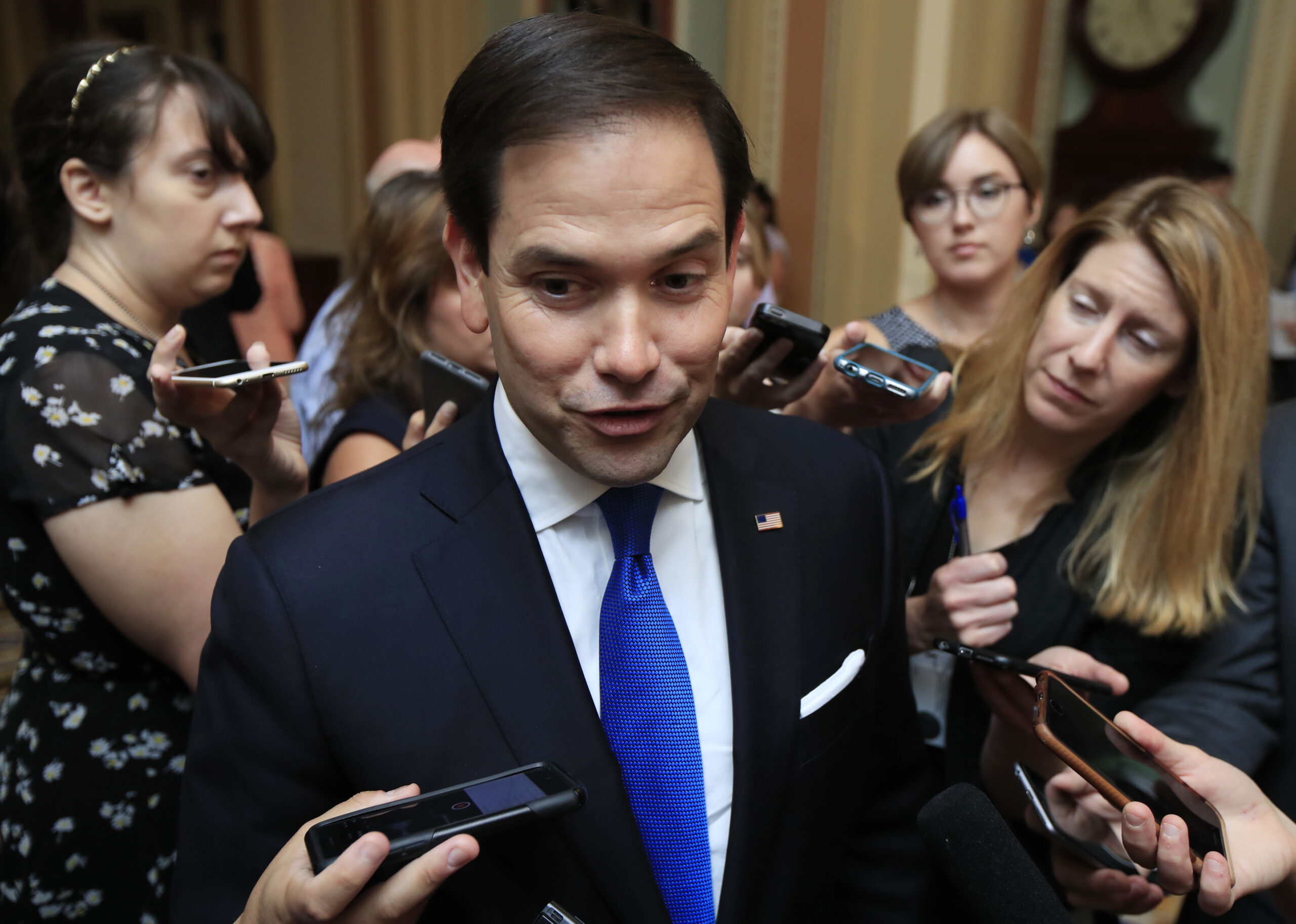
Sen. Marco Rubio, R-Fla., Monday shrugged off barbs from gun control advocates disappointed with the Florida Republican for not doing more to crack down on access to firearms.
Rubio has thrust himself into the cauldron of gun politics since the Valentine’s Day massacre at Marjory Stoneman Douglas High School in Parkland, Fla., that left 14 students and three educators dead. Among the few conservative, Second Amendment supporters to explore new federal gun restrictions, Rubio has been thanked for his effort by being singled out for special condemnation.
Recommended Stories



“I’m a U.S. senator; I can defend myself. But a lot of people can’t, and the message to them is: If you don’t agree, you need to be quiet or go away or we’ll turn on you too,” Rubio told the Washington Examiner. “When you’re involved in politics at this level, you get attacked every day. So, I’m not worried about me. But I am worried about how all of this sort-of narrative and rhetoric, in politics in general and this in particular, affects other people whose views might not align with the people that you see on TV.”
“I’m focused on one thing,” Rubio added. “Changes that’ll prevent what happened in Parkland from ever happening again, and I realize that to achieve changes like that in this country requires people that have different views and opinions to come together and figure out what they can agree on, and do it.”
As an estimated 200,000 people marched near the National Mall in Washington this past Saturday to demand legislative action preventing gun violence, Rubio was called a corrupt killer by some for refusing to denounce the National Rifle Association and embrace an assault weapons ban.
Some Majority Stoneman Douglas students who participated in March For Our Lives donned mock price tags that read $1.05, to suggest that that is the value Rubio places on each Florida student’s life. The “price” was derived from dividing the total number of Florida students by the donations Rubio has accepted from the NRA during his political career.
At least one sign spotted at the march called Rubio a “kid killer.” The event in Washington was joined by affiliate demonstrations in cities across the country.
The vitriol was directed at Rubio one day after Congress approved an omnibus spending package that included the first new significant gun regulations in years — measures the senator played an instrumental role in inserting into the bill in consultation with the survivors of the 17 Parkland victims.
David Hogg, the Marjory Stoneman Douglas student who has been among the gun control movement’s most recognizable figures since the shooting, was unapologetic when pressed Monday in an interview with CNN’s Alisyn Camerota if his criticism of Rubio was unfair.
“Maybe your ire is misplaced, since he is actually trying to work across the aisle,” she said.
“He can pass as many laws as you want,” Hogg responded. “But if those laws are not very strong and they have so many loopholes that the NRA works so hard to ensure that they have, they aren’t going to be strong enough.”
Rubio said his views on gun rights haven’t undergone a material change since Parkland. The senator, who rose to prominence through the ranks of the conservative movement, remains a staunch defender of the Second Amendment. What Rubio has done, he said, is broaden his knowledge of issues as they relate to gun safety and keeping firearms out of the hands of people who would hurt innocent people.
That has included taking a look at raising the age limit to purchase certain kinds of firearms, studying whether certain high-ammunition magazines should be banned, and supporting rules that would keep guns out of the hands of people who have demonstrated might be a danger to others.
Rubio said his only goal is to pass legislation that prevents another Parkland. Demonizing the NRA and trying to pass a blanket ban on all assault weapons simply wouldn’t accomplish that, he said.
“In terms of banning specific types of guns, if I believed that that would change these things, I would support it. I just don’t believe it will change it,” Rubio said.
Of the NRA, called by Republican insiders as perhaps the most respected advocacy group among GOP primary voters, the senator added:
“They’re an organization that defends the Second Amendment and the most prominent one. Obviously they’re doing to take a lot of criticism because of it. And people have a right to do that. The NRA is a group that can stand up for itself and so they’ve been through that before. But they’re basically a group that supports the Second Amendment and support people who support the Second Amendment. And if people want to focus on that, it’s fine.”
This isn’t Rubio’s first foray into third-rail politics.
In 2013, he spearheaded an effort to forge consensus on immigration reform. Ultimately, Republicans were disappointed that he was willing to compromise on the core principle of a path to citizenship for illegal immigrants, and Democrats were unsatisfied that he wasn’t willing to create more distance between himself and his party.
Rubio runs the risk of that happening again, although he said in a separate interview late last week his work to push gun legislation to address school shootings has not generated the pushback he received from the Right when he was leading the effort to reform U.S. immigration law.
“On gun violence restraining orders, it’s just a new thing. Any time you tell people we’re going to give a judge the power to take away a gun it makes some people nervous. But when you walk through how it works, the due process in place, how difficult it would be for people to abuse it, the opposition generally melts away,” Rubio said.
Still, some grassroots Republicans are likely to view Rubio’s zeal for gun safety with suspicion, while Democrats, who already disagree with Rubio on several issues, will probably never be satisfied. But the senator isn’t on the ballot again until 2022; political operatives say it’s hard to predict how the politics will play out.
“I haven’t analyzed it that way,” Rubio said. “I get it — I’m not on the ballot for almost five years, so maybe I’m in a different position than other people in that regard. But I still want to do what’s right. I just haven’t analyzed it that way. I’ve analyzed it as: What happened in Parkland and what could have prevented it.”
