

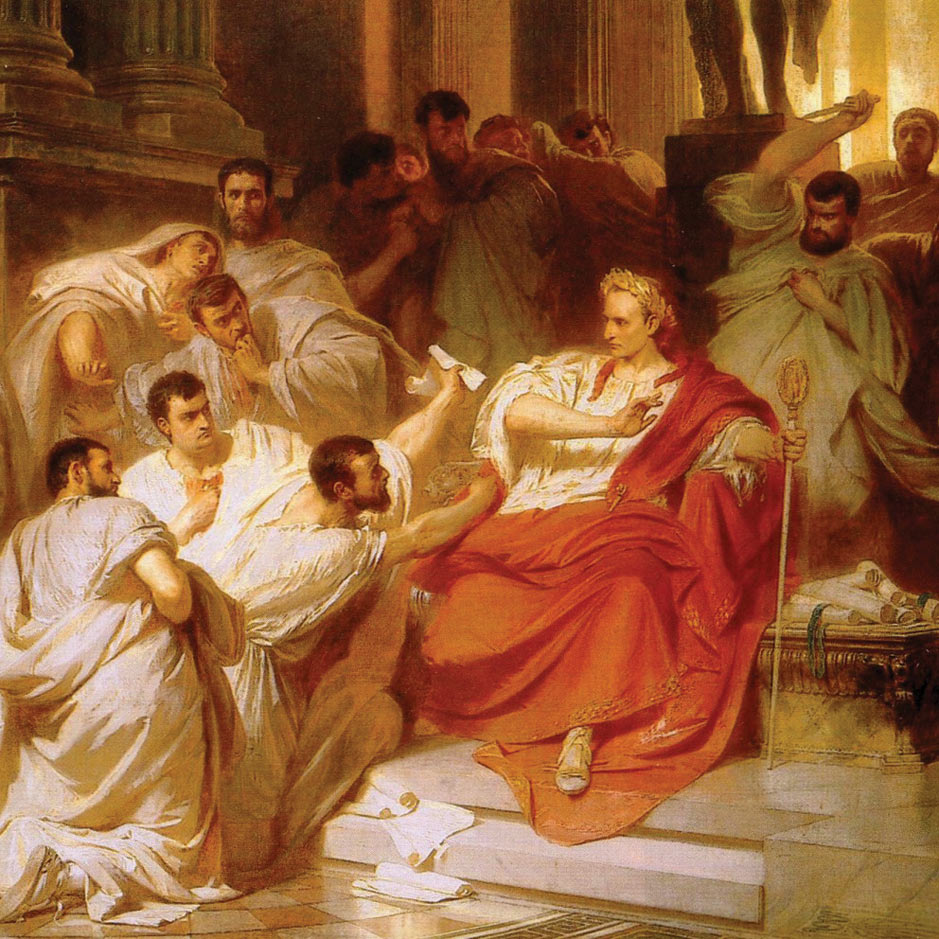
Ronald Syme — actually, Sir Ronald Syme — is not a household name in America, but perhaps it ought to be. Syme (1903-1989) was a New Zealand-born classicist, later an Oxford don, who is in many quarters regarded as the greatest historian of ancient Rome. He wrote a biography of Sallust and a two-volume biography of Tacitus, who, in the time of the emperors, was himself the greatest historian of Rome. With a book called The Roman Revolution (1939), Syme turned round the standard interpretations of Roman history, demonstrating that Augustus, the first undisputed monarch of Rome, was, in his pretensions to restoring the Roman Republic, a brilliant fraud. As for the Roman constitution, Syme called it “a screen and a sham.” No one has come along since to disprove his bold claim.
I was reading The Roman Revolution when I came across the chapter “Political Catchwords,” and realized that it is a vade mecum, a guide or handbook, on the use of the language of politicians, one that belongs alongside George Orwell’s “Politics and the English Language.” Syme’s “Political Catchwords” is perhaps better than Orwell’s justly famous essay in that it supplies a context for the way political catchwords are used. The context is the time of the rise of the young Octavianus, later to be known as Augustus, as he aligns himself with various factions in Rome to defeat, first, the assassins (Brutus, Cassius, et al.) of his adoptive father Julius Caesar, and then Marcus Antonius (or Mark Antony), all on his way to a forty-year reign that put paid to the Roman Republic.
Stay informed.Stay ahead.
Join Washington Examiner for unlimited access to the news, analysis, and commentary that matter most.
Already a member? Log in
