

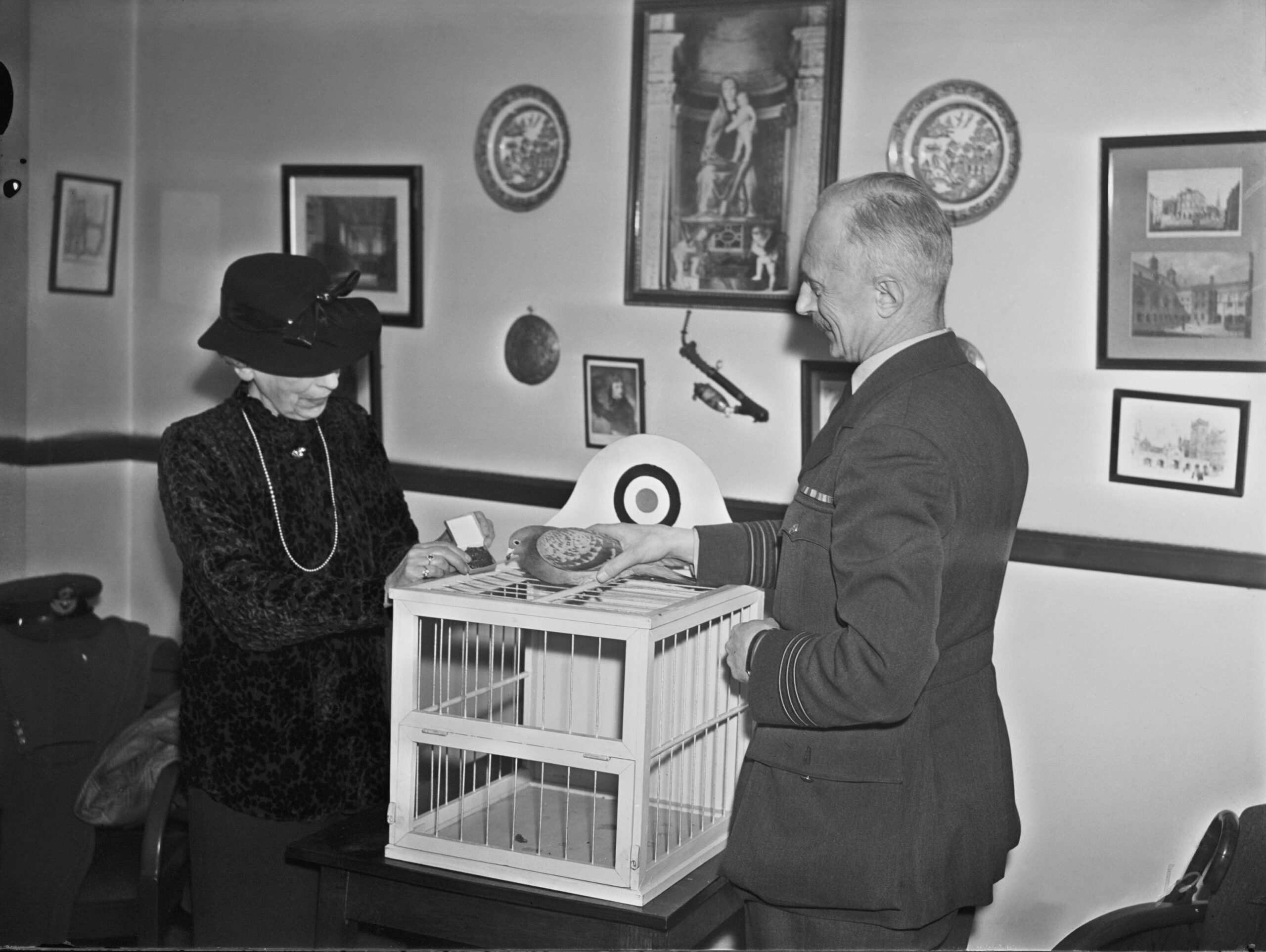
If, as Vicki Hearne wrote in her 1991 essay “What’s Wrong with Animal Rights,” happiness in animals is the fulfillment of “a capacity for satisfactions that come from work in the fullest sense,” then joyful indeed was the Scots homing pigeon White Vision, which, in 1943, crossed 60 kilometers of windswept ocean to alert rescuers to the position of a disabled American flying boat. Blissful, too, were fellow birds Winkie, which the previous year aided the crew of a downed British torpedo bomber; Beach Comber, which carried news from France to Britain of the commencement of the Allied attack on Dieppe; and Kenley Lass, which, in 1945, successfully delivered a communiqué from an intelligence agent deep in Nazi territory to the agent’s handlers in Shropshire. For their efforts, all four pigeons were awarded the Dickin Medal, a prize given as warranted by a prominent U.K. veterinary charity to animals that serve heroically in theaters of war. And thus, for a moment, were matters between man and the lesser creatures ordered rightly.
The People’s Dispensary for Sick Animals (PDSA) has awarded the medal 70 times since 1943. Pigeons account for 32 of the recipients. Dogs account for 33, including Mali, a Belgian Malinois who, on the hunt for explosives, sprinted twice through enemy fire during a 2012 deployment to Afghanistan. Salty and Roselle, Labrador retrievers who led their sight-impaired owners down more than 70 floors of the World Trade Center during the 9/11 attacks, were awarded the medal in 2002. Four horses have been awarded the medal, and so has one cat: Simon, a feral feline smuggled aboard HMS Amethyst in 1949 by a 17-year-old English seaman, only to spend the near-disastrous Yangtze Incident—in which the British sloop became trapped on that river for three months late in the Chinese Civil War—rooting out the ship’s rat infestation, thus protecting the ship’s food supply. The animals selected are part of the millennia-old story of domestication that has shaped nearly every facet of the human experience; in honoring them, we acknowledge that world-shaping partnership.
Recommended Stories



So, too, do we remember one of the most important animal advocates in modern British history. Born in London in 1870, Maria Dickin was a successful businesswoman in her own right (she ran a voice production studio in Marylebone) before her marriage to a wealthy first cousin. As was the case for many women of her class and means, Dickin’s interests soon ran to social work, in the pursuit of which she was horrified to discover that the animals belonging to London’s poor often lived in circumstances even more appalling than their owners’. Reflecting upon her tours of East End poverty in her 1950 book The Cry of the Animal, Dickin recalled the “many dogs and cats walking on three legs, dragging along a broken or injured limb; [as well as the] others nearly blind with mange; covered with sores; nearly all looking dejected and miserable and searching for food in the gutter.” Determined to address what she saw as the “suffering [of] animals all over the world,” Dickin founded the PDSA in 1917 with a single one-veterinarian clinic in a Whitechapel basement. By 1924, the fledgling organization had expanded to 17 pet clinics across the United Kingdom and had begun to treat as many as 150,000 animals every year.

Despite her focus on the misfortunes of beasts rather than those of their masters, Dickin understood animal welfare largely in terms of human need, insisting to a public skeptical of both her project and the habits of the downtrodden that “poor people do not only keep animals as pets but as a means of earning their living” and that London’s humbler dwellings would be “overrun with vermin” if their inhabitants “did not keep a cat.” It was in the spirit of this philosophy of stewardship that the PDSA instituted the Dickin Medal in the fifth year of World War II. Aware of the exertions of animals in that utterly human conflict, and mindful of their devotion during previous wars, Maria Dickin resolved to establish an animal analogue to the Victoria Cross, which recognizes courage “in the presence of the enemy” and is the highest honor a British soldier can receive. Dickin’s creation, a bronze medallion bearing the words “We Also Serve” and “For Gallantry,” captures the humanistic ideology at the heart of her vision. The first of those phrases places animal heroism in the fitting context of a critical social endeavor, without which it would have no significance. The second is pure anthropomorphism, an ascription of human virtues—nobility, generosity, and high-mindedness—to beings that cannot, in any real sense, possess them. To acknowledge as much is not to make light of the contributions of animals but to understand and value them properly.

It hardly needs arguing that the Dickin Medal is not ultimately for its recipients but for us, their masters and companions. It is we, not they, who must define our relationship correctly, an idea approached by Vicki Hearne when she wrote, of her Airedale, “I have enfranchised him in a relationship to me by educating him, creating the conditions by which he can achieve a certain happiness specific to a dog, maybe even specific to an Airedale.” Given the Dickin Medal’s obvious alignment with such thinking (and the fact that, as Hearne noted, “the very keeping of a dog or a horse or a gerbil or a lion is in and of itself an offense” in the minds of “people who claim to speak for animal rights”), one wonders why the award has not become a source of controversy in these squeamish times, implicitly positing, as it does, that animal suffering in the cause of human progress is not only to be borne but celebrated.
Because suffering is the line that many have chosen to draw—the theme of myriad “rights” treatises from Jeremy Bentham to Peter Singer. If the Dickin Medal feels subversive today, it feels so precisely because it turns such thinking on its head. Sergeant Reckless, a Marine Corps horse who evacuated numerous fallen Americans in Korea before taking wounds herself, suffered. So, too, did Lucca, a German shepherd who completed 400 missions in Iraq and Afghanistan before losing a leg after an IED blast. Failing to honor such creatures would be obscene. But so, in the end, would arguing that their use in man’s service was anything other than right.
Happily, it seems that the Dickin Medal will continue to be awarded, a fact affirmed in part by the presence of nominating information on the PDSA’s website. May the prize endure, a symbol and reminder of our gratitude for our animal companions.
