

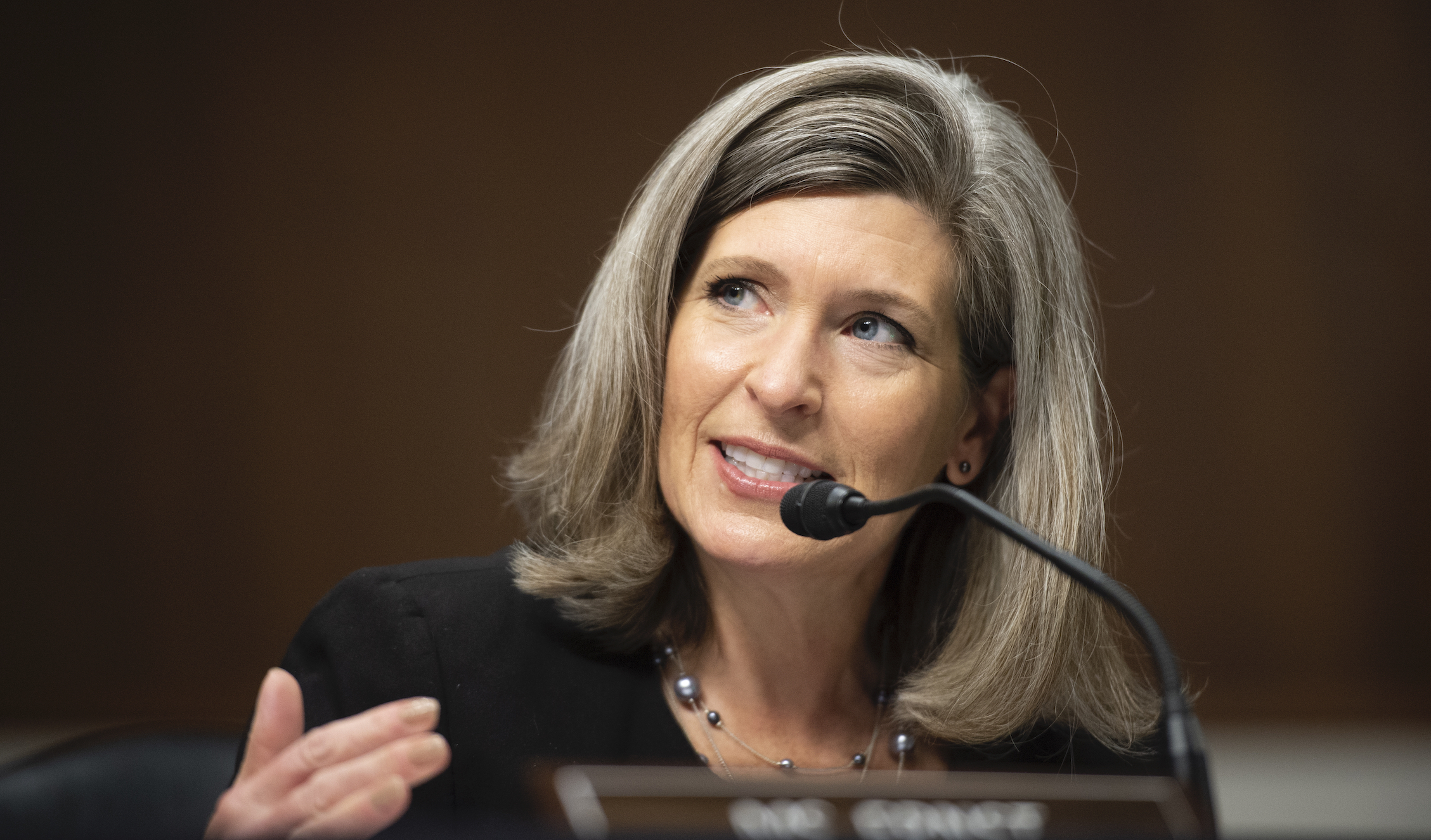
To see why Senate Republicans’ fortunes for the November elections are sagging, look no further than Iowa.
Sen. Joni Ernst, elected in 2014, finds herself tied or trailing in polls against Democratic challenger Theresa Greenfield. And Iowa at the outset of the election cycle wasn’t expected to be one of the more competitive states for Senate Republicans, who are trying to hold on to their 53-47 majority while tied closely to President Trump and his own falling polls numbers.
Recommended Stories


The Cook Political Report may have slapped a “lean Republican” label on the 2020 Iowa Senate race, but Ernst trails Greenfield on average by a single percentage point ahead of the fall, according to RealClearPolitics.
Iowa’s competitiveness puts the Senate’s balance of power in play on Nov. 3, along with a handful of other states, some that also trend Republican. And Senate Democrats only need to add three or four seats to their column to seize control of the chamber, depending on whether Joe Biden, the presumptive 2020 Democratic presidential nominee, beats Trump for the White House as well.
Cesar Conda, a Republican strategist and former chief of staff to Florida Sen. Marco Rubio, predicted Democrats “would certainly” take the Senate if the elections were held today. But four months is “a lifetime away in political terms,” he explained.
“There are too many things that can go wrong for the Democrats and right for Republicans. For example, the economy is creating jobs at an unexpectedly healthy clip,” Conda told the Washington Examiner.
Ryan Berger, Conda’s Navigators Global colleague and an ex-National Republican Senatorial Committee aide who worked for Ernst on the campaign trail and in the Senate, was hopeful regarding her odds.
“Greenfield got a boost from significant uncontested spending in the primary last month, which helped hide her record as a real estate executive,” he said. “She continues to duck the tough questions Iowans ask on a regular basis, so once Greenfield’s inexperience and radical positions are exposed, I am confident Iowans will reelect Sen. Ernst.”
Ernst clinched the right to succeed longtime Democratic Iowa Sen. Tom Harkin in 2014 against then-Rep. Bruce Braley by 8 points, though with only 52.2% of the vote.
The former Iowa state senator and retired Army National Guard lieutenant colonel gained national prominence during her campaign for her stance against wasteful federal government spending and congressional pork-barreling because of her “make ’em squeal” ad featuring pigs.
“I’m Joni Ernst. I grew up castrating hogs on an Iowa farm. So when I get to Washington, I’ll know how to cut pork,” she said in the 30-second spot.
Once in Washington, D.C., she quickly rose through Senate Republican ranks, becoming the conference’s vice chairwoman in 2018. But her ties to the GOP establishment may hamstring her as she vies in the fight of her political life.
In November, Ernst will share the ticket with Trump, who’s on average only 0.3 points ahead of Biden in Iowa, FiveThirtyEight found. In comparison, the Oval Office occupant dominated then-Democratic rival Hillary Clinton in Iowa four years ago by almost double digits.
University of Iowa political science professor Timothy Hagle wasn’t surprised by the race’s dynamics given Iowa’s “purpleness.”
Iowa’s a swing state due to the number of “no party” voters, its version of independents, since Republican and Democratic registrations are roughly the same, Hagle insisted. The fact that George W. Bush relied on Iowa in 2000 has been overlooked two decades later by the emphasis placed on Trump holding onto states he won in upsets last cycle, such as Michigan, Pennsylvania, and Wisconsin, Hagle continued.
“You have a situation where you’ve got a relatively new senator up for reelection for the first time. And so that always makes a person a little bit more vulnerable,” he said.
For Hagle, Ernst has to overcome Trump energizing the Democratic base, for instance with his handling of the COVID-19 outbreak and racial tensions reignited by George Floyd’s death. Congressional candidates in three close districts have to do the same, he told the Washington Examiner.
“There’s always the attempt to nationalize politics, especially in presidential years,” Hagle said, but it “works both ways” with negative ads linking Greenfield to House Speaker Nancy Pelosi.
On a local level, he agreed with Berger that Greenfield’s primary bolstered her name recognition.
To Drake University professor Dennis Goldford, Ernst’s needs to prove she has “staying power” and that her 2014 success was not “simply a fluke” to rejoin 39-year Republican Sen. Chuck Grassley in the chamber for the 117th Congress.
“To a great extent, this will be a referendum on the president. His name on the ballot will attract a lot more of his supporters. At the same time, it will attract a lot more of his opponents, who showed up, for example, in 2018 to add two Democratic women to the House of Representatives from Iowa,” he said.
That’s how Ernst’s role as part of the “firewall” protecting Trump in the Senate could help and hinder her, according to Goldford. He cited how the incumbent’s among the most unpopular senators in the country based on her approval-disapproval ratings.
“You have what’s considered to be a vulnerable Republican first-term senator in conditions that, at least now, are unfavorable for the governing party in Washington. And then you have, we believe, a credible opponent the Democrats have found for Sen. Ernst,” he said.
Goldford thought it was interesting Greenfield, a self-described “farm kid,” was using Ernst’s rural-versus-urban argument against Braley in their well-funded contest, aided by outside groups that are investing millions of dollars in airtime.
“One of the old arguments is the way to attack an opponent is to attack the opponent’s strengths, not weaknesses, so Greenfield is going after Sen. Ernst’s strengths,” he said. “They believe they’ve got a shot at winning this. And I think at this point it’s a toss-up.”
Goldford noted Ernst chances could rely on whether the Trump campaign’s correct in thinking it can encourage two million more voters, who statistically should be the president’s backers, to cast a ballot for him this season.
“If they can turn these folks out, certainly in Iowa, that will help Ernst. If they can’t turn them out, that will hurt Ernst,” he said.
