

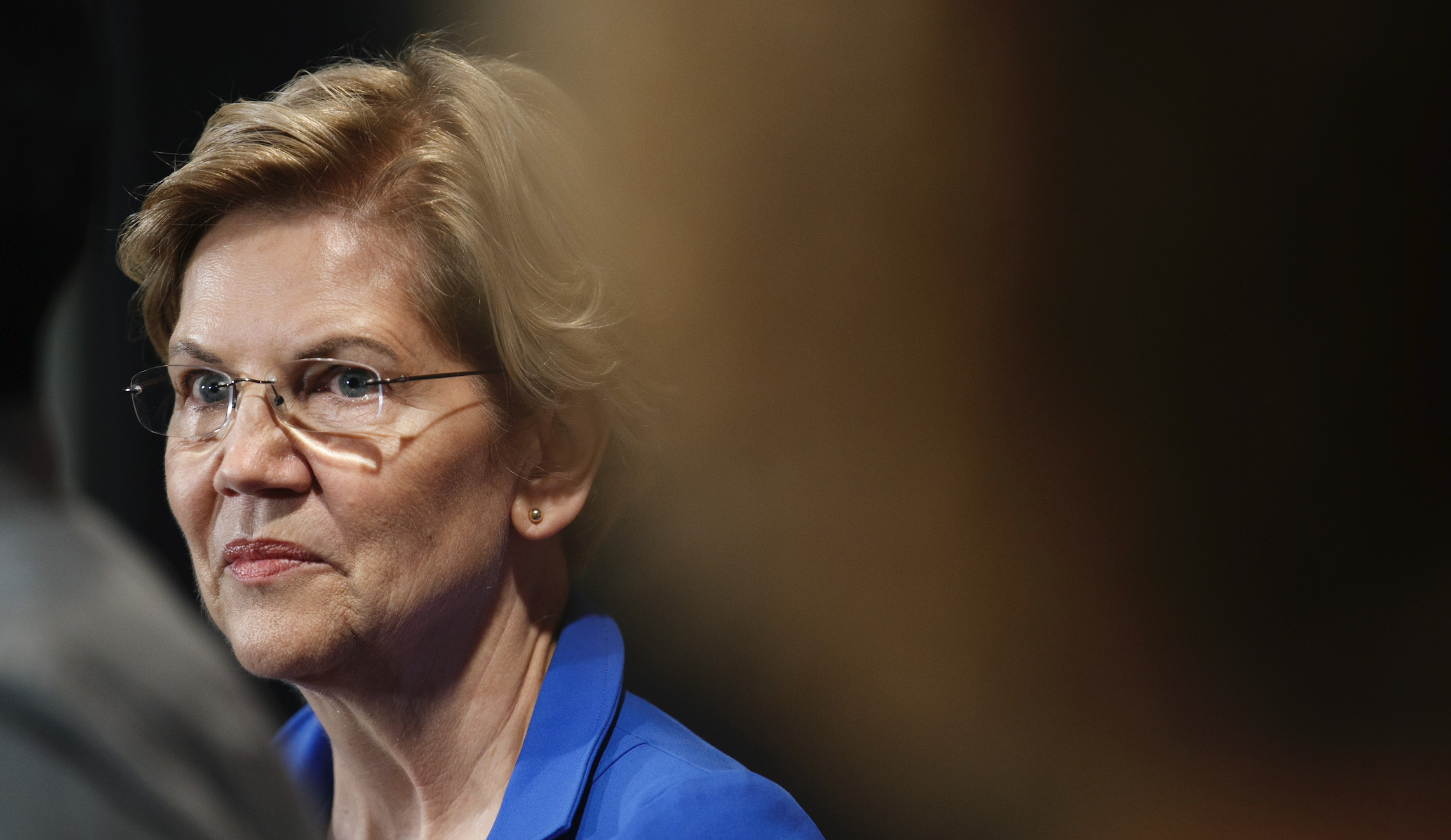
President Trump and Elizabeth Warren may be mortal political enemies, but the populist pair have more in common than either they — or their legions of supporters — care to admit.
On protectionist trade measures and noninterventionist foreign policy, Trump, 73, and Warren’s instincts overlap in a number of ways. That’s becoming more apparent as Warren, 70, solidifies her place atop the 2020 Democratic presidential primary polls with her call for “big, structural change.” Her campaign catchphrase even echoes Trump’s 2016 promise to “make America great again,” except from different ideological extremes on the political spectrum, said George Washington University’s Matt Dallek.
The White House incumbent and the Massachusetts senator may be “diametrically opposite” when it comes to issues like race, guns, and healthcare, as well as the role of government more generally, Dallek said. But there are common themes to their populist messages given they both speak to an “unease” regarding income inequality and a desire for “fundamental change agents to try to fix it.”
“They both tap into a real frustration with what’s seen as politics as usual, and what a lot of people see as the staleness of both parties, and the ways they are challenging party orthodoxy, one from the right, the other more from the left,” Dallek told the Washington Examiner.
Trade exemplifies their similarities, said the Cato Institute’s Simon Lester, adding a caveat.
During his last campaign, Trump railed against former President Bill Clinton’s North American Free Trade Agreement and its impact on Rust Belt manufacturing since it came into effect in 1994. The move allowed him to connect with disenchanted voters in the region and differentiate himself from former first lady and Secretary of State Hillary Clinton, his Democratic opponent that cycle, Lester said.
The Trans-Pacific Partnership, a now-defunct trade deal that was in the works at the time, was also a frequent target of Trump’s anti-globalist, “America First” rhetoric. Trump regularly vowed to withdraw the United States from the “terrible, one-sided” arrangement should he win the election, stating his preference for “good” bilateral frameworks over multilateral ones.
Almost simultaneously, Warren, ripped the TPP, pushed by the Obama administration, for being negotiated behind closed doors without comprehensive congressional oversight and for its investor-state dispute settlement resolution clauses. She argued the provisions would have permitted “foreign companies to challenge U.S. laws — and potentially to pick up huge payouts from taxpayers — without ever stepping foot in a U.S. court.” Her stance earned sharp rebukes from Obama’s team, which described her scrutiny as “false criticism.” More recently, she has blasted Trump’s revamped version of NAFTA, the U.S.-Mexico-Canada Agreement, because “it won’t stop outsourcing, it won’t raise wages, and it won’t create jobs.”
“He is one of the more protectionist politicians that we’ve seen in America in the last couple of decades, that’s my view of it,” Lester told the Washington Examiner of Trump. “She’s certainly been very critical of trade agreements, she’s put out policy plans that seem like they lean toward protectionism, but she hasn’t been in office. We haven’t seen how she would implement things,” he added, referring to Warren’s silence on the World Trade Organization, an international body slammed by Trump as he bickers with trade partners over tariffs.
On foreign policy, both trend toward isolationism, though with limitations, according to Republican strategist Susan Del Percio.
Since the start of his administration, Trump has fought for U.S. sovereignty from international organizations, telling the United Nations he “will always put America first” and the North Atlantic Treaty Organization he was willing to leave over military spending disagreements with allies. But while he initially hoped to pull U.S. troops out of Syria, saying the conflict was “7,000 miles away,” he has in some instances adopted an aggressive posture toward bad actors like North Korea when U.S. prestige or national security has been put at risk.
Warren similarly says she wants to stop “endless wars,” including in the Middle East, and reduce defense spending in favor of exerting diplomatic and economic pressure when needed. But her ability to completely disentangle the U.S. on the world stage is hampered by her belief in liberal democratic norms, such as human rights, seen in her threat to cut U.S. military aid if Israel does not halt settlement building in the West Bank.
Del Percio, a strong Trump critic, noted another commonality was they both had “no experience” in international affairs before seeking the presidency.
“They are similar in another way: They’re both very extreme, but not necessarily correct,” Del Percio said. “For example, Donald Trump went around saying Mexico was going to pay for the wall, his thing was immigration, right? And Elizabeth Warren is saying, ‘Yes I have a $52 trillion plan for healthcare alone and middle-class people aren’t going to pay for it, the rich are going to pay for it.’ That is virtually the same message. They are both so outlandishly wrong.”
Whatever the policy overlap, on a personal level, Trump and Warren despise each other. Trump has long derided Warren as “Pocahontas,” a dig at her claims to Native American ancestry. Meanwhile, Warren frequently chides Trump on the campaign trail and Twitter, describing him as a white supremacist over the summer. In her 2017 book, This Fight is Our Fight, Warren gleefully recounted her tweeted bromides against him during the 2016 campaign.
“Let’s be honest – @realDonaldTrump is a loser. Count all his failed businesses. See how he cheated people w/ scams like Trump U. But just because @realDonaldTrump is a loser everywhere else doesn’t mean he’ll lose the election. Many of history’s worth authoritarians started out as losers – and @realDonaldTrump is a serious threat,” she wrote.
