

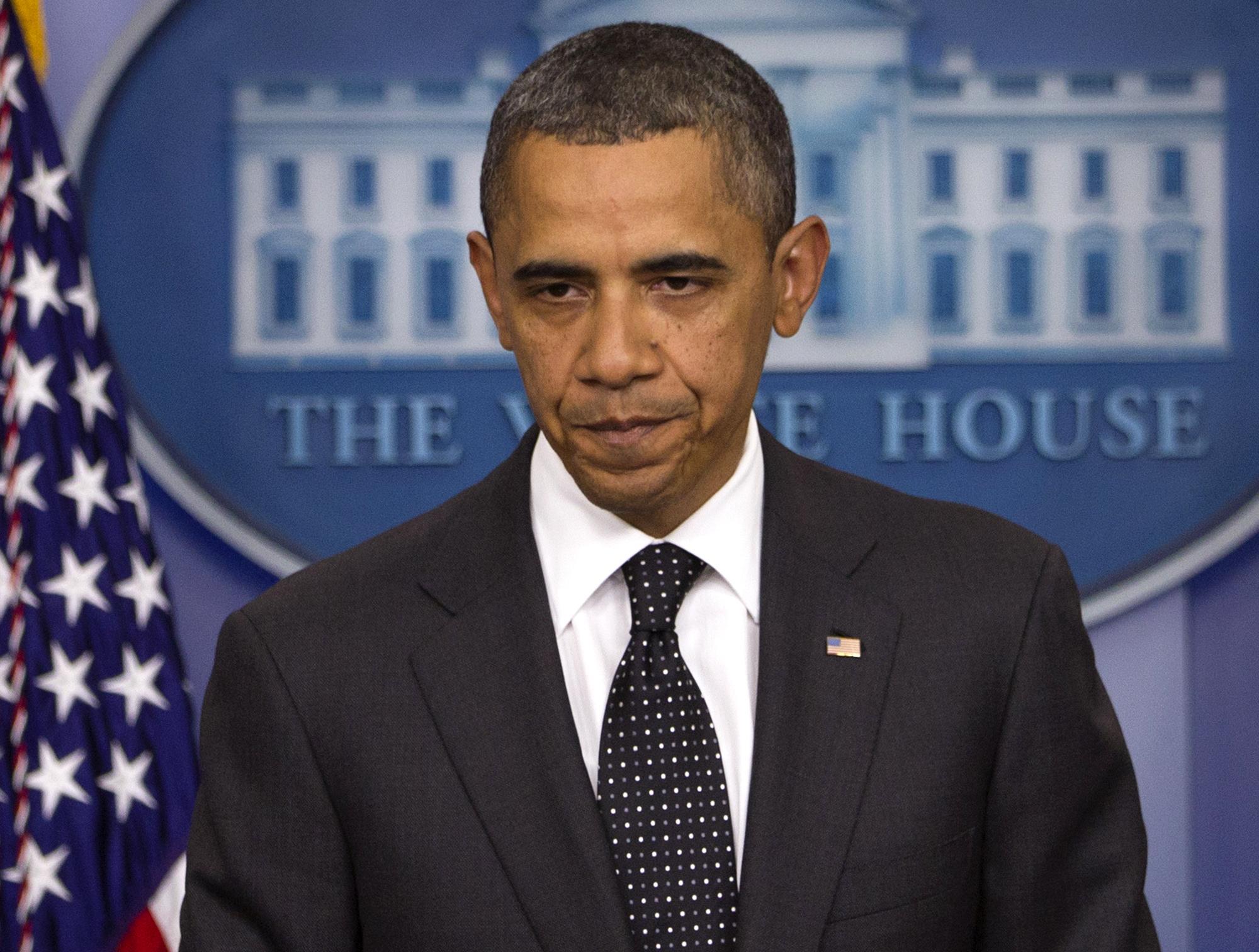
President Obama on Monday sharpened his attacks against a “do-nothing” Congress immediately after the so-called “super committee” tasked with reducing the budget deficit collapsed without a deal.
“There are still too many Republicans in Congress who have refused to listen to the voice of reason and compromise,” Obama said from the White House briefing room shortly after the super committee publicly acknowledged its failure.
The super committee, made up of a dozen Republicans and Democrats, failed during months of negotiations to agree on a plan that would trim at least $1.2 trillion from the government’s budget deficit. Its failure triggers $1.2 trillion in automatic budget cuts to both domestic programs favored by Democrats and defense spending Republicans wished to protect, though those cuts wouldn’t hit until 2013.
The collapse of the super committee allows the president to continue to hammer away at the ineptitude of a Congress that he blames for stalling legislation needed to kick-start the economy and create thousands of new jobs.
But the issue isn’t necessarily a clear winner for Obama, who faces a tough reelection fight next year. The president distanced himself from the super committee’s negotiations, opening himself to Republican criticisms that he once again failed to lead.
“The White House deserves primary responsibility,” said former Congressional Budget Office Director Douglas Holtz-Eakin. “History shows us that to achieve anything this big, you need the president to get involved. And Obama was MIA.”
Unlike the debt-ceiling crisis, when administration officials hosted seemingly daily meetings with lawmakers, Obama sidestepped the politically toxic summits this time around.
As such, others say Obama was wise to avoid intervening when there was little chance of success.
“Obama avoided a trap,” said Charles Walcott, a political scientist at Virginia Tech University. “If he would have tried to lead on this, it would have blown up in his face. He wouldn’t have been able to bridge the gap in Congress just by coming forward.”
Republican presidential contenders were quick to cast blame on the president for the super committee’s failure.
“I would have anticipated that the president of the United States would have spent every day and many nights working with members of the super committee to try to find a way to bridge the gap, but instead he’s been out doing other things — campaigning, and blaming, and traveling,” Republican front-runner Mitt Romney said in New Hampshire.
The White House counters that Obama set parameters for the talks with a proposal to cut up to $3.6 trillion from the deficit over the next decade. But Republicans balked at the president’s plan because it included a tax increase on the wealthy.
Obama, however, vowed to veto any effort to reverse the automatic cuts that would now kick in unless lawmakers can agree on other ways to reduce the deficit.
“There will be no easy off-ramps on this one,” Obama said. “We need to keep the pressure up to compromise, not turn off the pressure.”
While Republicans and Democrats pointed fingers of blame immediately after the super committee collapsed, some analysts said voters will decide who is to blame.
“Nobody looks good,” said Stephen Hess, a presidential scholar for the Brookings Institution. “There’s enough blame to go around. When you get beyond the Beltway, everybody looks bad.”
