

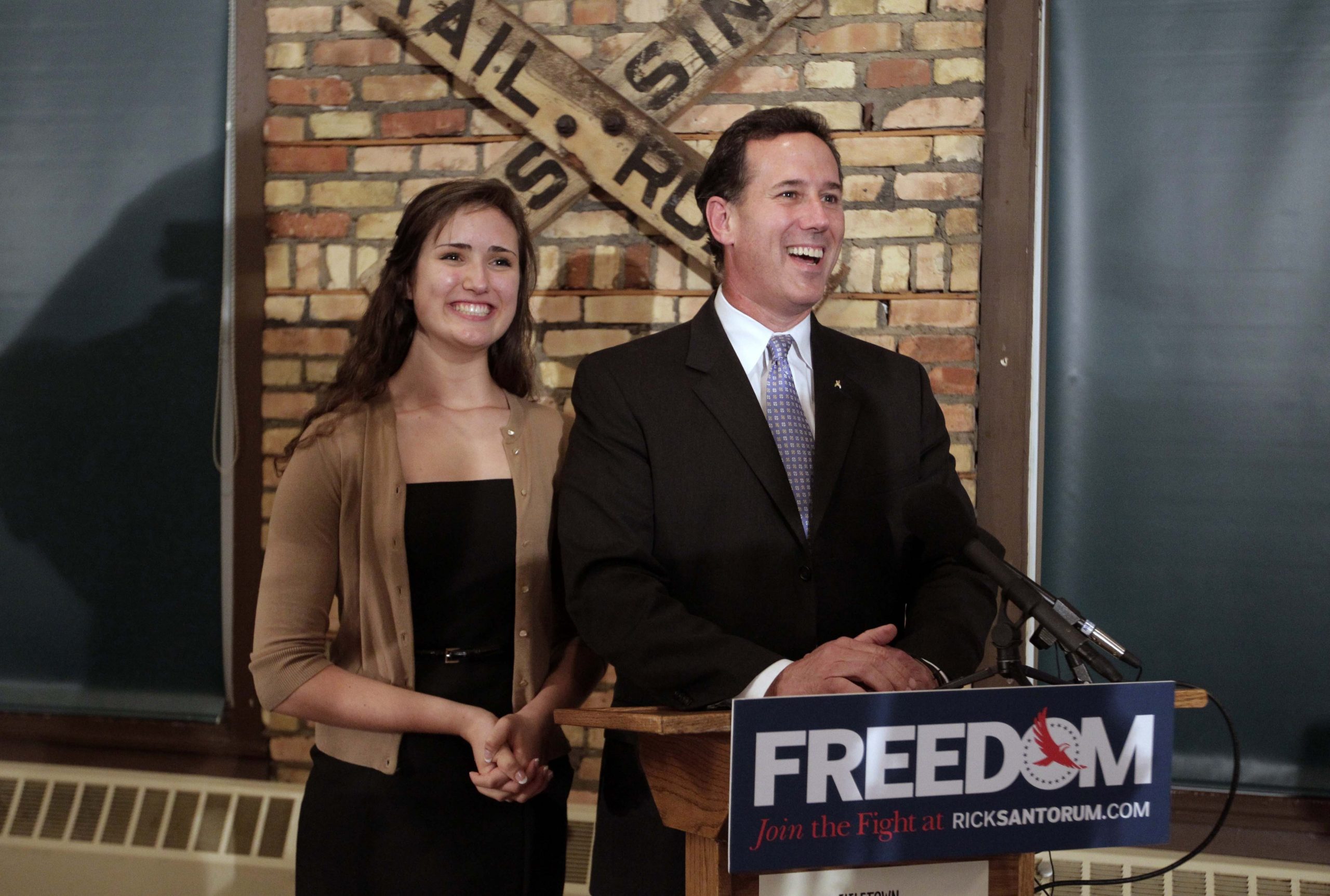
“You don’t believe, as the pundits have said, that this race is over,” Rick Santorum told a small group of supporters at a brew pub in Green Bay, Wisconsin Saturday night. “You didn’t get the memo.”
Santorum was in Wisconsin campaigning for the state’s April 3 primary, but as he spoke, more than a thousand miles to the south in Louisiana, he was racking up his biggest margin of victory of the race so far. Recent polls had shown Santorum up in Louisiana by perhaps a dozen points, but he beat rival Mitt Romney by nearly 23 points, with 49.2 percent of the vote to Romney’s 26.5 percent. Newt Gingrich finished third with 15.9 percent, and Ron Paul was fourth, with 6.1 percent.
“We’re still here,” Santorum told the Wisconsin audience. “We’re still fighting.” Santorum has now won 11 states, to Romney’s 21.
In Louisiana, at least, Santorum appeared to suffer no damage from his comment earlier in the week that there’s little difference between Romney and President Obama, and in a race where a strong contrast is needed, “if you’re going to be a little different, we might as well stay with what we have instead of taking a risk with what may be the Etch-A-Sketch candidate of the future.” If that bothered Louisianans, it didn’t show up in the election results. On the other side, Romney did suffer from a top aide’s comment that after a primary race in which Romney stressed his conservatism, “You hit a reset button for the fall campaign. Everything changes. It’s almost like an Etch-A-Sketch — you can kind of shake it up and we start all over again.”
When Louisiana exit pollsters asked voters whether the Etch-A-Sketch flap was a factor in their decision, 38 percent said it was, and Santorum won big in that group. Fifty-two percent said it wasn’t, and Santorum won that group, too. Whatever the gaffes in the final days before the vote, Santorum won solidly among those who made up their minds in the last week.
Indeed, Santorum’s win crossed most categories and divisions within the electorate. He won men. He won women. Young voters. Older voters. Voters with college degrees. Voters without degrees. Very conservative voters. Somewhat conservative voters. Moderate-to-liberal voters. The only groups Romney won were those who make more than $200,000 a year (a relatively small 11 percent of the electorate), the minority of voters who weren’t evangelical Christians, and voters who don’t go to any church very much.
Santorum spent election day going to several events in Wisconsin. Romney spent the day relaxing, or at least mostly relaxing, in California. “My dad’s finally getting a little R&R this weekend,” son Matt Romney tweeted Saturday evening, sending out a picture of the elder Romney going to a movie with some of his grandchildren. Earlier, Romney aide Garrett Jackson tweeted a photo of Romney and wife Ann eating at a San Diego burger joint with the winners of the campaign’s “Grab a bite with Mitt” contest.
But Romney aides were on the job Saturday night. In Green Bay, a Romney spokesman, Ryan Williams, showed up at the bar where Santorum was holding his election-night event, to make a few disparaging comments and put the Romney campaign’s spin on events. “This is the saddest, most pathetic victory party I’ve ever seen,” an AP reporter quoted Williams saying. “Where are all the supporters?”
Not long after, Santorum campaign manager Mike Biundo asked Williams to leave, which Williams did. “I didn’t think it was appropriate,” Biundo said later. “They keep wanting to write this race off and say that it’s done, yet they keep sending surrogates to our events to spin the press. They’ve been following us around for a while. I’m pretty sure it wasn’t a coincidence that we were in the same bar.”
There’s one thing Biundo and the rest of the Santorum campaign can be sure of: Romney’s supporters will continue to call on Santorum to quit the race. Two days before the Louisiana voting, Romney political director Rich Beeson sent a memo to reporters headlined, “Rick Santorum — President Obama’s MVP.” In it, Beeson wrote that Santorum has no path to victory. “Each day Senator Santorum continues to march up this steep hill of improbability is a day we lose to unite in our effort as Republicans to defeat President Obama,” Beeson concluded. “So as Senator Santorum continues to drag out this already expensive, negative campaign it is clear that he is becoming the most valuable player on President Obama’s team.”
Well, if Santorum can suggest that a vote for Romney would be little different than a vote for Obama, then Romney can suggest that Santorum is MVP of the president’s re-election team (and decry negative campaigning in the very same sentence.) But it seems unlikely that Santorum will leave the race soon. And by one measure, he’s doing things no differently than Romney himself did in 2008.
After running an expensive, mostly self-funded, race against John McCain, Mike Huckabee, and others, Romney ended his campaign on February 7, 2008. Some Romney supporters today have cited that early date to suggest that Romney knew when to quit then, and Santorum should know when to quit now. But dates aren’t comparable in a race in which the Republican primary and caucus schedule is radically different from the last time around.
In terms of delegates awarded, Romney left the 2008 race after primaries and caucuses accounting for 1,313 delegates had been held. Today, counting Louisiana, the primaries and caucuses held so far account for 1,187 delegates. After Wisconsin, Maryland, and Washington DC hold contests on April 4, the total will be 1,285 — still fewer delegates than had been awarded when Romney pulled out back in 2008. Only after the April 24 primaries, after which 1,516 delegates will have been awarded (including in Santorum’s home state of Pennsylvania), will Santorum have stayed in the race beyond the delegate point Romney left in 2008.
So don’t look for Santorum to leave soon. In Green Bay Saturday night, even as he thanked the voters of Louisiana, he took another shot at Romney on the issue of conservatism, noting that in Romney’s damage-control remarks during the Etch-A-Sketch flap, Romney said, “I’m running as a conservative Republican.” Romney’s words were revealing, Santorum suggested. “I’m not running as a conservative candidate for president,” Santorum said. “I am the conservative candidate for president.” And with another win, whatever the steep hill of improbability, Santorum intends to keep at it.
