

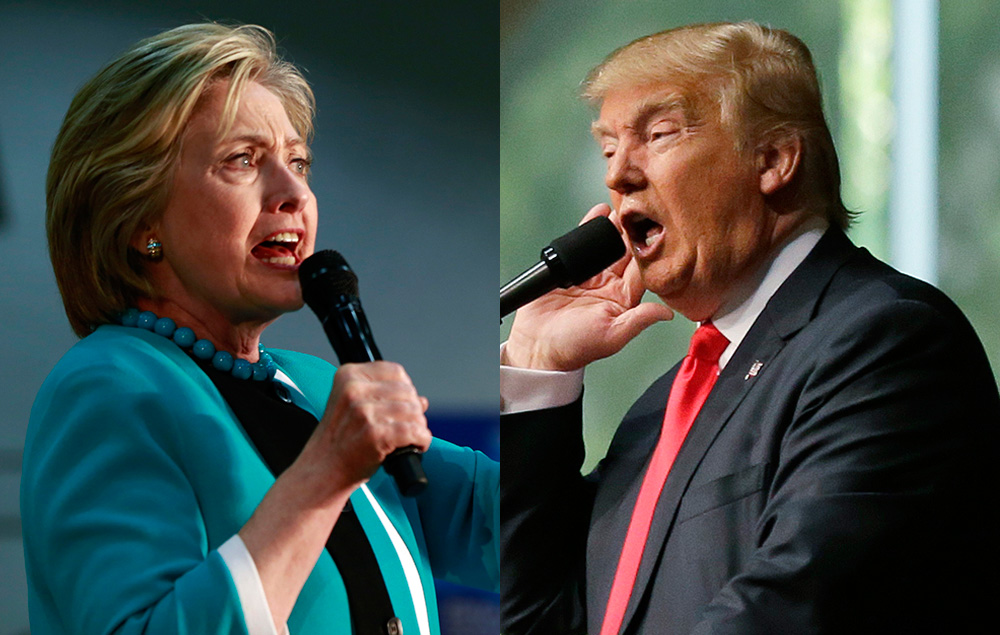
A titanic battle is shaping up as Hillary Clinton tries to get moderate Republicans to defect from Donald Trump and hand her the presidency in November.
The key will be whether those natural, but less fervent, Republicans side with Trump because the GOP is their natural home or whether Clinton can peel away their loyalty by harping on his volatility and demotic style.
Recommended Stories



Stan Greenberg, a Democratic pollster who advised President Bill Clinton, said Clinton is poised to pick off at 10 percent or more of moderate Republicans in the general election against Trump. In Greenberg’s preliminary polling for a Democratic group, another 30 percent of moderate Republicans said that while they wouldn’t vote for Hillary Clinton, they don’t support Trump.
Those people could stay at home on Election Day, deny Trump support and depress his vote.
But there’s a major problem with Greenberg’s analysis, which is that exit polls show Trump won self-described moderates in 21 of 28 primaries, even though there were many Republican candidates to choose from.
Still, in war gaming scenarios for dividing Republicans or, rather, preventing them from coalescing, Democrats see GOP moderates as ripe for picking off. This cohort tends to be socially liberal on issues such as abortion and gay marriage. Combined with Clinton’s claim to a more assertive foreign policy, and Trump’s rhetoric and unpopularity with women, Clinton’s campaign recognizes that Trump is vulnerable to concerted and repeated raiding of his base.
“Moderate Republicans will have the last word in this dramatic presidential election year,” Greenberg wrote in a Washington Post op-ed Friday. “GOP moderates are about to abandon their party’s nominee in large numbers, helping to elect Clinton.”
“Moderate” isn’t the same as “centrist.” Moderate Republicans are fiscal conservatives, suspicious of government power, and hawkish on foreign policy.
That’s on reason why Michelle Diggles, who studies voting trends for the centrist Democratic think tank Third Way, disagrees with Greenberg. Diggles, an expert on moderates’ voting doubts they’ll defect to Clinton in significant numbers. But she thinks they might not vote at all for president, which would damage Trump and help Clinton.
Diggles said moderate Republicans are more like conservatives in their own party than like moderate Democrats, according to polls from previous general elections.
The key data point here is moderate Republicans’ suspicion of big government and the regulatory state. Given that, Diggles said, this group will probably shun Clinton and her liberal agenda, which makes the federal government the core benefactor in ordinary people’s lives.
The blunt and ugly campaign that Trump and Clinton will wage against each other could repel them and prompt them to skip voting on Election Day, or vote only on races for Congress and other jobs further down the ballot.
“It is doubtful that the kinds of issues that distinguish moderates from conservatives within the GOP, views on abortion, gay equality, and climate change, are going to be front of mind for moderate Republican voters this fall. Usually jobs and the economy top the list,” Diggles said.
It’s possible that moderate Republicans might behave differently than those who voted in the primary. And whether Greenberg or Diggles is right, say Republican pollsters, Trump has bigger problems anyway.
He is the most unpopular major party presidential nominee in history, particularly among women and Hispanics.
Even among Republicans, Trump is in trouble. A majority views him positively, but not in great enough numbers yet to win in November. Gallup, which tracked Trump’s favorability from May 2-8, found that just 64 percent of “Republicans and Republican leaners” gave him a thumbs-up.
That’s at least 25 points short of where it needs to be, Republican pollster David Winston said, referencing 2012 election exit polling that showed GOP nominee Mitt Romney with a 90 percent favorable rating among Republicans and President Obama with a 92 percent positive rating. Winston said Trump can improve, but it will be difficult.
Clinton, with only 70 percent approval among Democrats, is only slightly stronger, but she is still struggling to knock out the only serious challenger she has faced, Bernie Sanders.
Usually, candidates begin a general election popular in their own party, and see their numbers drop only after a bruising campaign of attack ads. There’s no precedent for what is happening today, with both candidates unpopular at the start. So there’s no telling how voters will react six months from now.
“Both Trump and Clinton are in a position where both are in pretty bad shape. There is opportunity to do better, but also equal risk of imploding,” Winston said. “This is really volatile.”
