

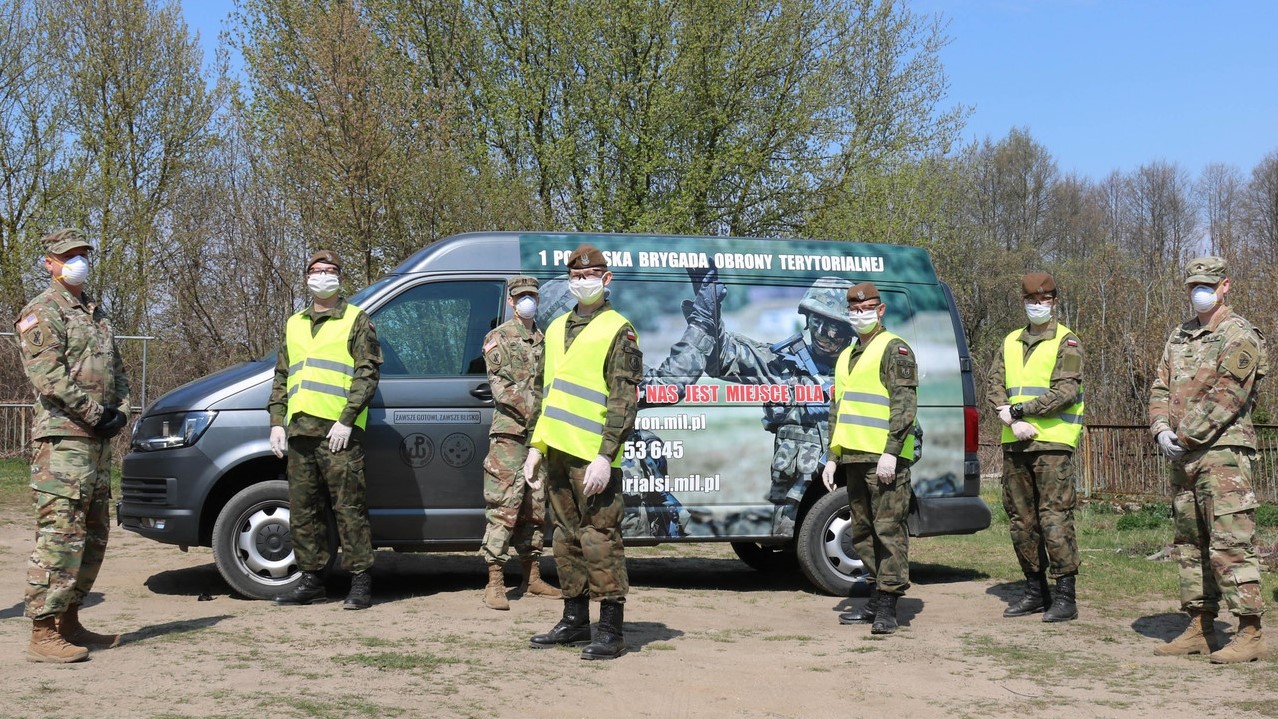
When the Berlin Wall fell, the National Guard began forming relationships with former Soviet and satellite countries in Eastern Europe to help their fledgling democracies. With a vibrant Polish American community in Chicago separated by 50 years of communism, it was only natural that the Illinois National Guard would seek a relationship with the Polish military.
That strong cultural connection led a team of nine Polish military doctors to spend a week in Chicago hospitals treating COVID-19 patients and providing lessons learned in Poland and Italy.
Recommended Stories



“Our relations last 30 years, and in this period, we fight against our enemies arm by arm, and we adjust to the type of threat which we are fighting,” Polish Military Medical Corps Capt. Jacek Siewiera told Pentagon journalists this week. “Today, the threat is the COVID-19.”
The bonds between the two countries go back more than a century, when a million Poles began emigrating to the United States in the mid-19th century and became an integral part of their communities.
Today, on the streets of Avondale in Chicago’s West End, one can still smell Polish kielbasa cooking and hear Polish spoken.
On the battlefield, the bonds have continued in America’s wars in Afghanistan and Iraq, where Polish service members have fought and died alongside Americans.
“During Poland’s transformation from a former Warsaw Pact member to an indispensable U.S. ally and NATO member, the Illinois National Guard has been engaged with their Polish counterparts in every step,” said Brig. Gen. Thomas Hatley, underscoring a relationship that has existed since the inception of the state partnership program in 1993 and has included more than 400 exchanges.
Some 7.3% of Chicago natives have Polish ancestry, among about 900,000 Illinoisans.
The Polish team of medics, doctors, and nurses, as well as an EMT technician from the Polish Ministry of Defense, arrived April 23 and have worked with the Stroger Medical Center, the Cook County Emergency Management Center, and the Army Corps of Engineers’s alternative hospital at the McCormick Center. The team finishes its tour Saturday.
“It was very exciting to have the opportunity for sharing our lessons learned from Lombardy in the time of the biggest threat in that region of northern Italy,” said Siewiera.
The doctor described being on the front lines of a vertical curve and an overwhelmed medical system in northern Italy, followed by a flattening.
“We have been the partners in the problem, so we have some experience in how it was accomplished,” he said.
Siewiera compared the European Continental and American approaches to the infection, from patient selection for limited space in intensive care units to facilitating home services and describing the two phases of the disease and its 40 known mutations.
In Poland, changes to the ventilation of COVID-19 patients has been employed, a best practice he shared with Chicago doctors.
Having seen a flood of patients in Lombardy, Siewiera could also describe the protocol used in Italy for which patients can go home and which patients need to be hospitalized based on X-ray readings.
“We also have seen that one of the most important vectors of this disease might be the clothes, which were taken from the hospital to the homes, to the families,” he said, adding that he described best practices for decontamination used in Europe.
But what he saw in the U.S. was unlike anything he saw in Italy.
“Here, we don’t have collapse of the administration, of the medical services. We experience extending of the capacity of hospitals, and we are amazed how it was done, how it was done by the National Guard in the McCormick,” he said. “We are amazed how data are supporting the decision-making process. It should look like this all the time.”
Siewiera said the pandemic is under control in Poland, which experiences about 300 new cases per day in a country of 40 million.
As for the military, Siewiera said he was skeptical about whether things will go back to normal before a vaccine is widely available in Poland.
“I’m skeptic about that and have to be prepared for expanding this pandemic for months and maybe years, each time when the restriction on social distancing will be lowering down,” he said.
Siewiera also gave little hope to recent drug interventions.
“The hydroxychloroquine is disappointing. The remdesivir, maybe in some groups, maybe in some cases, could be providing some improvements,” he said.
Army Brig. Gen. Richard R. Neely, Illinois National Guard adjutant general, acknowledged that the Guard did not ask the Polish doctors to come to the U.S. They volunteered.
“It’s the relationship that’s built over so many years, where that friendship is there,” he said.
Neely described how diplomatic and customs officials worked hard to figure out how to bring the team in over the presidential ban on travel from Europe in order to allow the fraternal connection to materialize in a time of crisis.
“We are all learning how to respond during these challenging times. I believe sharing best practices, understanding how one country may approach it, or you know, even a European approach compared to the U.S., I think we all have things to learn from this,” he said. “We’re deeply touched by their gratitude.”
