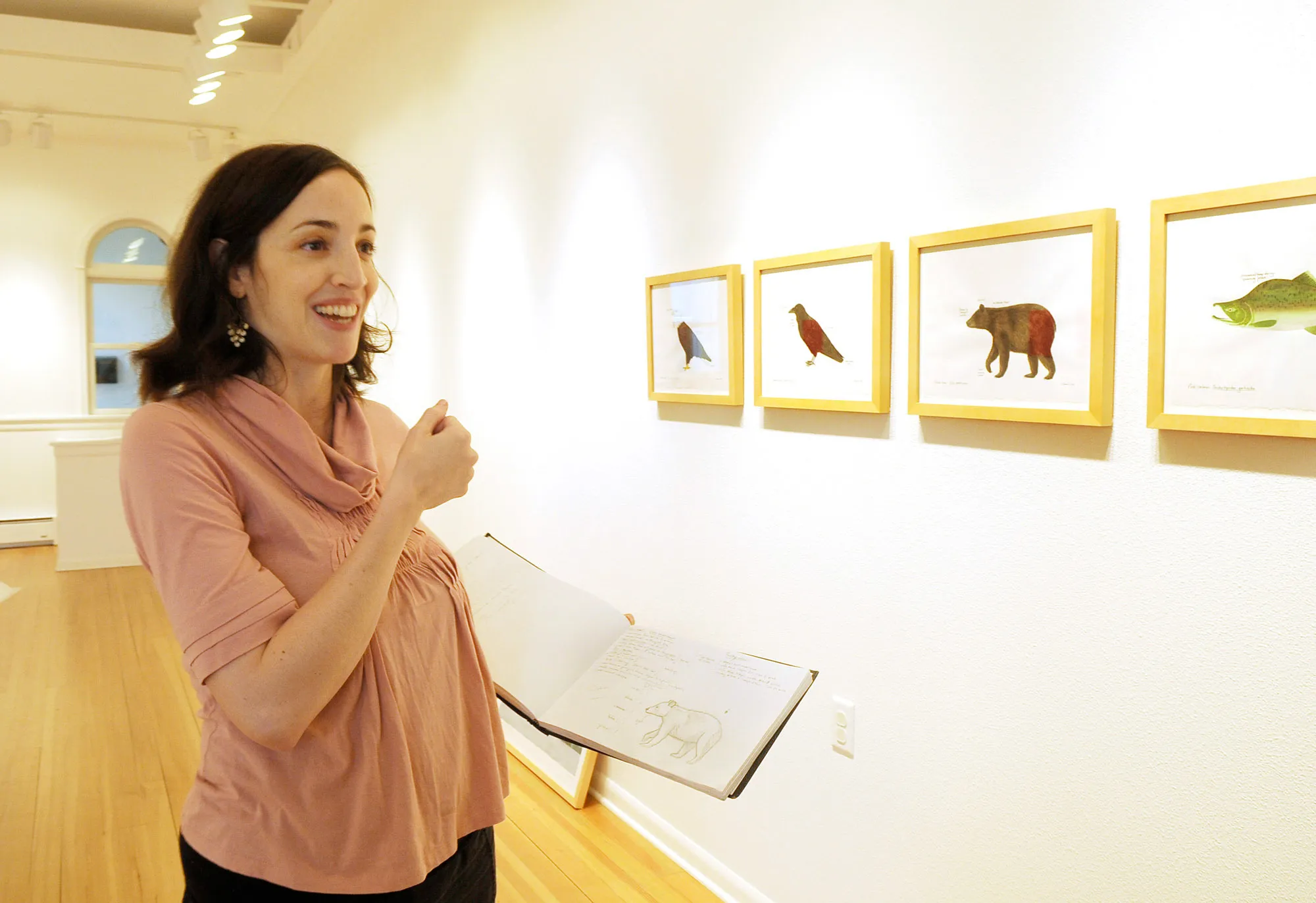
KETCHIKAN, Alaska (AP) — As its name implies, the new exhibit at the Ketchikan Area Arts and Humanities Council Main Street Gallery pairs art and science to produce educational material that also is beautiful enough to hang on the wall.
Artist Jennifer Kane has worked professionally as a scientific illustrator, using her skill with watercolors to create detailed images for field guides, textbooks and museums. She came to Ketchikan from Washington, D.C., two years ago for U.S. Forest Service fellowship, which is about to end, and said she wanted to share her artistic exploration of the area with the community before going back to D.C.
Recommended Stories
“The Art of Scientific Illustration” opened Friday, May 31, and is on display through June 29.
Kane said she was drawn to scientific illustration because of her interest and background in biology and visual art.
“Scientific illustration seemed like the perfect nexus,” she said, combining precise scientific detail with artistic expression.
Kane said scientific illustration is an old-fashioned skill, and not many people focus on it anymore. In her exhibit statement, Kane wrote, “In the 1600s, 1700s, and 1800s, scientific illustration was widely employed by the artists who accompanied Western explorers on their ‘voyages of discovery’ to document New World, Pacific and Eastern landscapes, and plant and animal species. Today, scientific illustration can be found in use in medical and biology textbooks, scientific journal descriptions of new species, and natural history museums and publications.”
Although it is less common now, scientific illustration has some benefits over photography, Kane said, because through a detailed illustration, the artist can choose to emphasize certain aspects of a subject.
“You can also add an element of expression,” she said, while staying true to the subject.
Kane said that when she moved to Ketchikan for the two-year fellowship, she wanted to get a better sense of the natural world here. The way she does that, she said, is through painting it. She chose species common to Southeast Alaska to research, study and eventually paint, including trees, a bear, a raven and a pink salmon.
“For each painting, there’s a long process behind it,” she said.
Kane consulted field guides and other research material, took notes and — for the black bear, especially — studied a skeleton of the animal to learn where the joints were located and how they moved.
“Then I figured out what I wanted to emphasize in the painting,” she said, drawing each in her sketch book before sketching it onto the paper.
After all that, she gets out her watercolors.
Before painting the subjects, though, she made a color chart for herself, painting a swatch from each watercolor onto a sheet of the same paper she uses for her paintings. That way, she explained, she could better match the colors to what her subjects look like in nature.
Kane admitted it’s an “intensive” process, but detail is important to get a true scientific illustration.
She said much of the work for her exhibit was done over the winter, so she wasn’t able to do as much sketching from life as she would have liked, and instead worked primarily from photographs and field guides.
In addition to the new work depicting Southeast Alaska wildlife — all watercolor and ink — her exhibit includes pen-and-ink museum-style illustrations, illustrations made with ink on scratch boards, and computer-rendered graphics.
A section of the exhibit will offer a series of “process panels,” photographs that pair sketches, research material and the illustration, to show her creative process.
Kane’s husband, Luis Fernandez de Cordoba, made the frames for her paintings, she said, and for the tree illustrations, he used wood from that tree species.
In her exhibit proposal submitted to the Arts Council gallery committee, Kane wrote that she has painted and sketched on both U.S. coasts, as well as in Panama, Brazil and Ecuador.
Kane is scheduled to give a public presentation about her exhibit, starting at 5:30 p.m. June 20 at the gallery.
She said she plans to discuss her process for new art pieces, and different styles of scientific illustration.
___
Information from: Ketchikan Daily News, http://www.ketchikandailynews.com
