

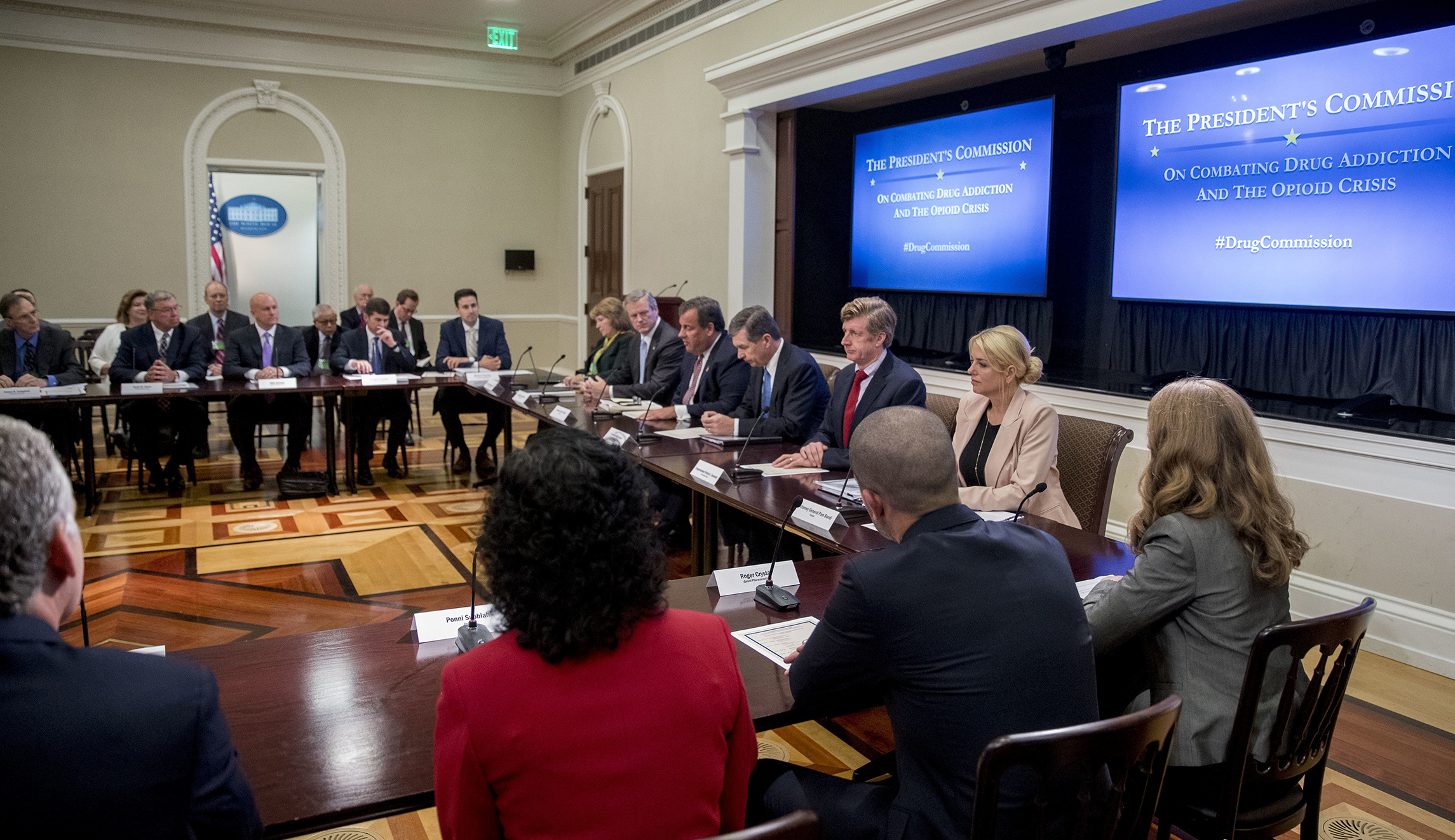
President Trump’s opioid commission is recommending that the federal government roll out an aggressive multimedia campaign that would tell children about the dangers of drugs, and frame addiction as a disease rather than a moral failing.
Recommended Stories



“People need to be aware of the health risks associated with opioid use, and they must stop being afraid or ashamed of seeking help when facing their addiction,” wrote New Jersey Gov. Chris Christie, chairman of the president’s commission on Combatting Drug Addiction and the Opioid Crisis. The commission recommended a similar campaign to the one issued during the AIDS epidemic.
The 56 recommendations, released Wednesday, are part of the commission’s final report on how the Trump administration should tackle the drug epidemic. Trump last week directed his health secretary to declare the opioid crisis a “public health emergency.” Opioid-related deaths involving drugs such as heroin and prescription painkillers killed at least 33,000 people in 2015, according to latest available data from the Centers for Disease Control and Prevention.
Trump in his speech about the declaration stressed the need to have children avoid using drugs in the first place. Drawing on the experience of his brother Fred’s death due to alcoholism, the president spoke about how his experience taught him to avoid alcohol and smoking. The president, who does not consume alcohol, said he never had a desire to drink or use drugs due to his brother’s early insistence.
“The fact is, if we can teach young people, and people generally, not to start, it’s really, really easy not to take them,” Trump said.
The commission appeared to support sending a similar message to young people.
“Having a nationwide campaign will serve to reinforce the message and ensure, for example, that youth and young adults no longer believe that experimenting with pills from a doctor is safer than experimenting with illegal substances from a drug dealer,” Christie wrote in his letter.
The commission recommended that young people as well as adults be screened for substance use through state programs, but the document does not say whether it would recommend drug testing. The type of screening recommended in the report leaves discretion up to providers, and it typically involves at least a question and answer session with a healthcare provider, which in some cases can also involve referral to an addiction specialist.
The commission also recommended that school nurses and counselors teach children about addiction, and that the federal government give funding to states in the form of block grants. Distributing funding this way allows states to decide how to spend the money, but also limits it to a specific amount rather than providing open-ended amounts. The programs, the commission recommended, should be reviewed by federal agencies to make sure they are producing results.
The commission did not specify how much funding should be allocated, and Trump’s declaration did not add additional federal funding to the effort. In a press conference last week, Christie told reporters that Congress should be the federal body to allocate the funding, and said Sunday that he expects for the president to ask for “billions” of dollars to fight the epidemic.
For healthcare providers, the commission recommended that agencies develop regulations for prescriptions, and find ways to better educate doctors and pharmacists about the addiction risks of prescription painkillers. It said federal research agencies should research non-addictive ways to treat pain as well as medications to treat addiction.
The commission called for better access to drug courts, which divert people with addiction struggles into treatment rather than into jails and prisons. According to the commission report, 44 percent of the 93 federal court jurisdictions in the U.S. currently have such systems, largely because they don’t have adequate funding.
Christie specifically opposed the use of medical marijuana for pain in his letter to Trump, despite some studies suggesting that increasing access to marijuana may reduce deaths from opioids.
“There is a lack of sophisticated outcome data on dose, potency, and abuse potential for marijuana,” he wrote.
The commission did not address needle exchange programs or safe injection sites where people who use drugs can be revived and have access to sterile equipment.
