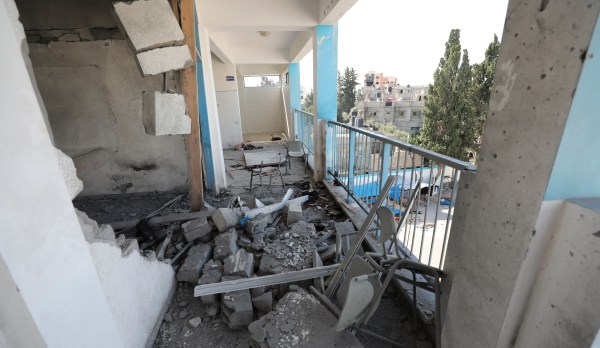
One aspect of the three-week-long conflict in Gaza between Israel and Hamas that has gotten curiously little play is the Egyptian angle, especially the Rafah Crossing, controlled by Egypt. The conflict was in a sense largely about this issue. Hamas’s war was intended to create a situation whereby the new regime in Cairo, headed by former general and now president Abdel Fattah al-Sisi, was to find itself increasingly embarrassed and forced by public opinion, both in Egypt and the wider region, to re-open Rafah as a commercial terminal.
Hamas took its strategy right out of the Arab regime playbook. For the last six decades, Arab leaders have frequently attacked Israel to achieve political goals that are completely unrelated to the Arab-Israeli conflict. When Saddam Hussein launched missiles on Israel during Operation Desert Storm, he wanted to divert attention from his aggression against Kuwait and sought to mobilize the Arab street behind the cause of liberating Jerusalem. His bid was doomed to fail, since very few Arabs were convinced that the road to Jerusalem goes through Kuwait. Throughout the spring and summer of 2006, Hezbollah general secretary Hassan Nasrallah tried to lure Israel into war, as he eventually did in July of that year, to improve his position in Lebanese politics and reverse the gains of the Sunnis after the Cedar Revolution and the withdrawal of Syrian troops in 2005. He managed to emerge from the July 2006 war as the ultimate powerbroker in Beirut.