Over the weekend, New York Times reporter Michael Barbaro wrote the following squib, “In 1 Unscripted Moment, Hillary Clinton Finds Joy in the Rain,” which for reasons both unsurprising and only known to the editors, the Grey Lady saw fit to print:
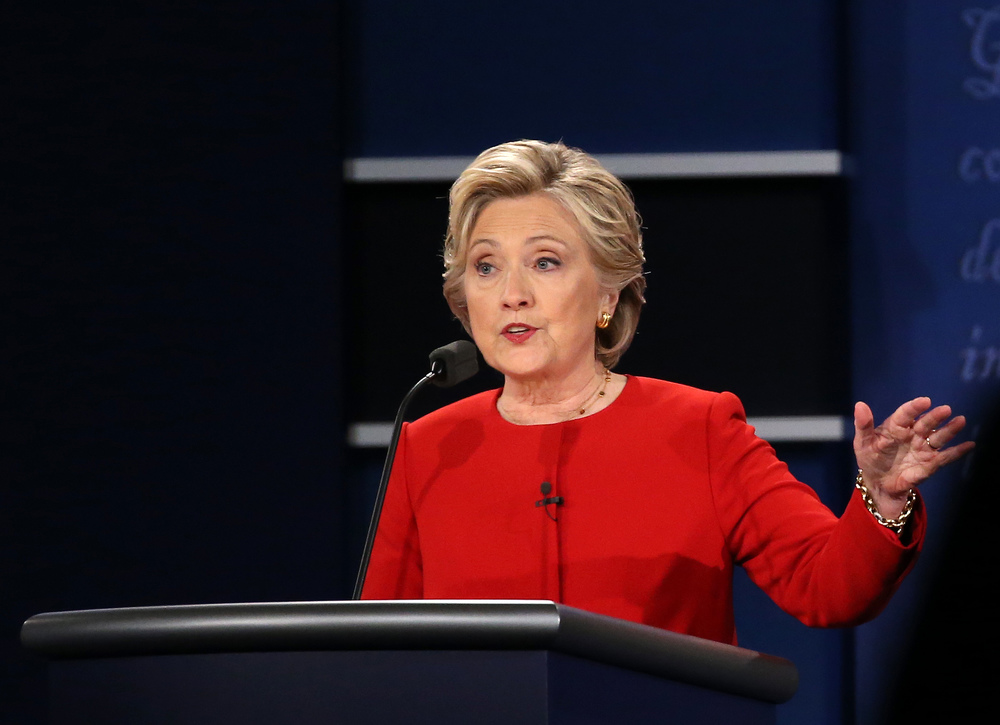
The moment lasts about 45 seconds. But in it, so much of the cautious stagecraft that surrounds and inhibits Hillary Clinton appears to break away. Mrs. Clinton, pelted by a driving rain and seemingly overcome by exhaustion, exhilaration and a swirling wind, lets loose with her hands and relinquishes her script. She skips past a critique of Donald J. Trump, flipping the page in her binder, and races to her closing lines. “Here’s what I want you to remember,” she tells the crowd at a rally on Saturday in Pembroke Pines, Fla. “I want to be the president for everybody: everybody who agrees with me, people who don’t agree with me, people who will vote for me, people who don’t vote for me.” Her arms thrust skyward, one after the other, in what starts to feel like a dance. There’s an unfamiliar sense of abandon and joy. The rain grows heavier. Her wet clothes turn a shade darker. She cracks a wide smile. She takes in the scene around her and laughs before she finishes her sentence. She’s drenched now, her voice hoarse. The storm is mussing her hair. It’s time to leave the stage. But just before doing so, she turns and raises both arms, giving herself up to the storm and the moment — and the looming end of this adventure.
This, well, whatever you want to classify this story as, makes a good companion piece to this Atlantic piece from Thursday: “What Hillary Clinton’s Fans Love About Her: Her supporters are drawn to her intelligence, her industriousness, and her grit.” The whole article is begging to be read, mostly to process the incredulous awe inspired by the headline, but also for this summation of Clinton’s email scandal:
A conservative writer labeled her a congenital liar when she was first lady, and the label stuck because it was repeated over and over—and it was a convenient label to harness misogyny. If she was a liar, then the hostility she engendered could not possibly be because she was a first lady who refused to be still and silent. “Liar’ has re-emerged during this election even though Politifact, a respected source of information about politicians, has certified that she is more honest than most politicians—and certainly more honest than her opponent. … Because she is already considered guilty in a vague and hazy way, there is a longing for her to be demonstrably guilty of something. Other words have been repeated over and over, with no context, until they have begun to breathe and thrum with life. Especially “emails.” The press coverage of “emails” has become an unclear morass where “emails” must mean something terrible, if only because of how often it is invoked. The people who love Hillary Clinton know that the IT system at the State Department is old and stodgy, nothing like a Blackberry’s smooth whirl. Hillary Clinton was used to her Blackberry, and wanted to keep using it when she became secretary of state. Hackers could have broken into her system, which was not as secure as the State Department’s. But an exhaustive investigation has found no hacking and no nefarious intent—and intent is what matters above all else. Hillary Clinton has apologized. She made an understandable mistake. She did not commit a crime, and did not intend to commit a crime.
Indeed, I think we can all agree that not since the venerable Atlantic published “Letter From a Birmingham Jail,” has the magazine so captured the essence of injustice in America.