


The number of people shot and killed by guns increased by 31 percent from 2014 to 2016, according to the Centers for Disease Control and Prevention.
The agency combed through its mortality data to compile information on homicides from 2010 to 2016, finding that for the first four years, gun homicides remained relatively stable, at between 11,008 and 11,622. The number increased gradually after 2014, to 14,415 by 2016.
Recommended Stories


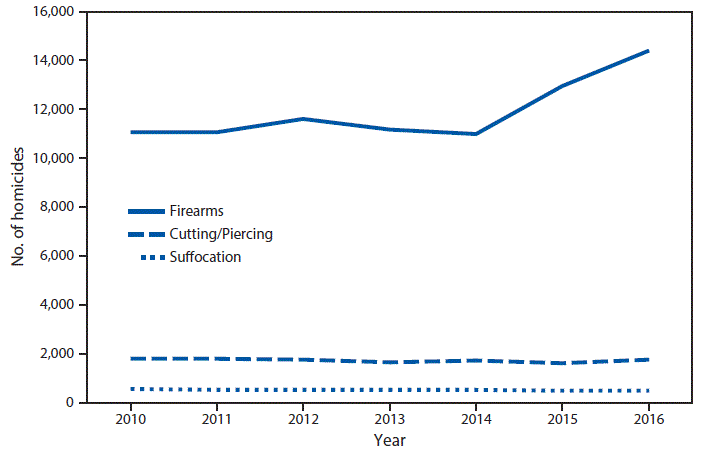
Gun deaths accounted for the highest share of homicides from 2010 to 2016. The second-most common method of killing involved cutting and piercing at just 1,781 deaths. The third-highest number came from suffocation, which accounted for 502 deaths, or a small fraction of the number of homicides committed with guns.
Members of Congress have been arguing over how and whether the CDC should be permitted to study gun violence, a topic the American Medical Association, the nation’s largest doctor group, in 2016 began referring to as “a public health crisis.” Following a mass shooting at a Florida high school earlier this year, lawmakers clarified language on gun violence research in a recent spending bill, but the research hasn’t been funded.
Those in favor of the CDC studying the issue say that there isn’t enough data collected on where guns come from and whether certain policies reduce suicides or homicides caused by guns.
Gun rights groups are concerned that the CDC will use government resources to advocate or promote gun control, something it is banned from doing by law. The CDC tends to not only compile reports and note trends, but to make recommendations to local public health officials and the medical community about how to improve health outcomes.
The latest report comes from the CDC’s database on mortality, which is publicly available on the agency’s website.
