

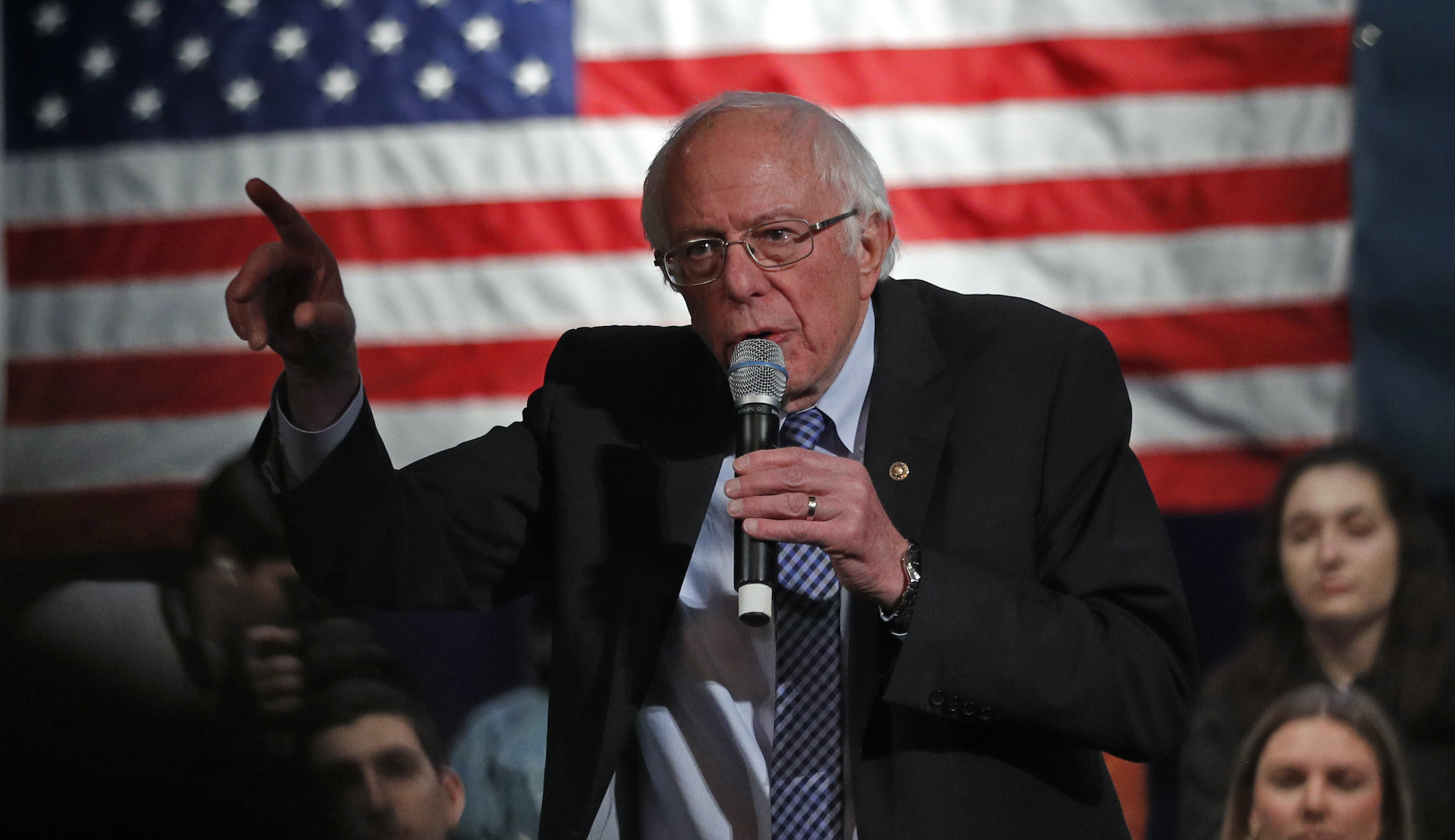
Though the 2016 Never Trump movement failed to stop the populist New York mogul from capturing the GOP nomination, it wasn’t from lack of effort. Democrats now trying to block socialist Bernie Sanders’s ascent have no comparable political infrastructure.
The Vermont senator is on the cusp of running up his delegate count to the point that a moderately center-left rival will find it difficult to catch up, including former Vice President Joe Biden, billionaire former New York City Mayor Michael Bloomberg, former South Bend, Indiana, Mayor Pete Buttigieg, and Minnesota Sen. Amy Klobuchar. Even a populist left-wing rival like Massachusetts Sen. Elizabeth Warren is far down in the delegate count after the Iowa caucuses and the New Hampshire primary.
Recommended Stories


Many are voicing concerns about the prospect of Sanders as the Democratic standard-bearer against Trump, fearing his calls for eliminating private health insurance and implementing a broader socialist agenda will sink the party’s chances.
Still, there’s no serious organized effort to stop Sanders. The furthest it has gotten is the likes of a Saturday New York Times column by moderately conservative writer Brett Stephens, “The Democrats Are in Trouble: The party’s riskiest bet is now its likeliest.”
That stands in stark contrast to Republican anti-Trump efforts four years ago.
National Review, a preeminent conservative magazine, dedicated an entire issue to opposing the future president. Its editors called Trump “a menace to American conservatism who would take the work of generations and trample it underfoot in behalf of a populism as heedless and crude as the Donald himself.”
In spring 2016, as Trump began steamrolling through the primaries, numerous donors and GOP operatives banded together to flood airwaves with advertisements attacking the party’s front-runner. Former advisers to Trump rivals such as Jeb Bush and business leaders such as Paul Singer, Hewlett-Packard CEO Meg Whitman, and Chicago Cubs co-owner Todd Ricketts funded an anti-Trump PAC called “Our Principles.”
Other conservative groups, such as American Future Fund and the Club for Growth, spent millions of dollars on anti-Trump ads.
On social media, “#NeverTrump” regularly trended on Twitter by conservatives vowing to never support Trump even if he secured the nomination. Lawmakers such as Sen. Ben Sasse of Nebraska said he’d support a third party if Trump earned the nomination.
None of that worked, of course. Trump handily earned the nomination after winning 44 voting contests, 30 more than Texas Sen. Ted Cruz, who placed second. The majority of Republican voters who opposed Trump’s candidacy in the primary ultimately held their nose and voted for him in the general election.
But as another outsider candidate, Sanders, sees his plurality of support deliver him wins in the Democratic primary, no opposition to him appears to exist outside of rival campaigns.
No magazine devoted to liberal, but not radical, thought such as the New Republic or the Atlantic appears ready to oppose his candidacy. Instead, popular liberal writers such as Jonathan Chait for New York magazine have floated concerns about Sanders’s electability, but nothing about his ideology.
No former staffers for the presidential campaigns of candidates such as Sens. Kamala Harris or Cory Booker are coming out warning about the potential damage a socialist leader could do to the Democratic Party’s reputation. Veteran Democratic strategists such as James Carville, who helped propel Bill Clinton into the White House on a relatively centrist platform, have sounded the alarm on Sanders’s rise but appears to have few influential allies.
Wealthy donors who fund Democratic Super PACs such as For Our Future or Priorities USA don’t appear ready to shift resources into a coherent “Never-Bernie” movement.
The paralysis is puzzling, consider Sanders has yet to break 30% of the vote in a primary. Even in Saturday’s Nevada caucuses, where he’s expected to handily earn the most delegates due to the state party’s convoluted counting system, it’s very unlikely he’ll earn a majority of the vote.
Polling shows a large majority of Democrats say they’re open to voting for a socialist, but 53% of the general public aren’t. Just 28% of adults have a favorable opinion of socialism, while 58% hold negative views. The numbers are even lower for political independents, of which 23% hold a positive opinion of Sanders’s ideology.
Exit polls from the New Hampshire primaries showed voters there didn’t believe Sanders was the most electable candidate, with 28% saying Buttigieg has the best shot at beating Trump in November. Sanders tied for second with Klobuchar at 21%.
In contrast to the 2016 warnings from the pronounced warnings from Republican establishment figures that nominating Trump would hand Democratic rival Hillary Clinton an easy general election win, only Bloomberg has explicitly said Sanders would lose in the general election. Bloomberg, worth more than $50 billion from his financial information and news company, is also the only candidate to consistently articulate an ideological opposition to socialism.
Other candidates, such as Klobuchar, have suggested that nominating a socialist would be a liability, but only said she was “troubled” by the proposition.
On Thursday, Joe Biden’s campaign co-chairman told the Washington Examiner that Sanders would lose to Trump, but the former vice president himself has refrained from using the same kind of language.
Concerns about Sanders’s electability are shared by virtually every candidate running for president, including members of his own campaign. Despite the internal chatter, Sanders’s rivals haven’t unified in making it their central message against him.
Hypothetical general election matchups suggest some of those concerns may be overblown, with a RealClearPolitics average of polls showing Sanders leading Trump in a general election by 4.6 points.
