

House Republicans reopened the partisan battle over the Jan. 6, 2021, Capitol attack on Wednesday, launching a new subcommittee aimed at reexamining security failures and federal law enforcement decisions that Democrats argue were already settled.
The Select Subcommittee to Investigate the Remaining Questions Surrounding January 6 held its first hearing, marking the GOP’s effort to reexamine years of criticism of the Biden Justice Department, the FBI, and the now-defunct Democratic-led Jan. 6 select committee. The panel is chaired by Rep. Barry Loudermilk (R-GA), who has spent years investigating the original investigation and its omissions.
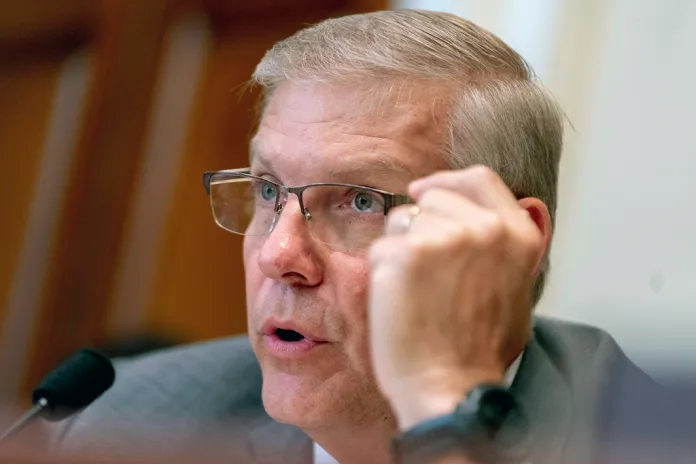
“My objective in this committee is to get the truth, without political bias, of what happened,” Loudermilk said during the hearing.
The stated focus of Wednesday’s hearing was the FBI’s handling of the pipe bombs placed outside the Republican National Committee and Democratic National Committee headquarters on Jan. 6, devices discovered near then-Vice President-elect Kamala Harris’s route and rendered safe by Capitol Police. Federal authorities arrested 30-year-old Brian Cole Jr. in December, accusing him of planting the explosives.
Republicans have long argued that the pipe bomb investigation was sidelined while Democrats focused their attention on President Donald Trump and his supporters. More than 1,500 arrests of protesters were made during the four years of former President Joe Biden‘s term, including two federal criminal cases levied against Trump, all while the pipe bomber case remained unsolved.
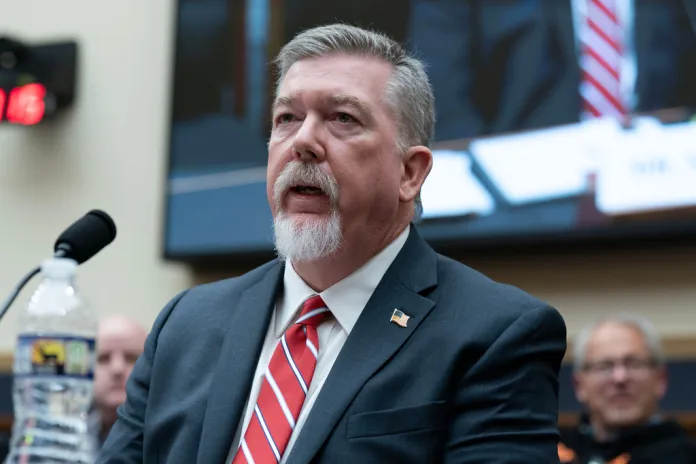
“The obsession with persecuting Trump supporters left no institutional impetus to get to the bottom of the pipe bomber mystery,” said witness John Nantz, a retired FBI special agent who now appears frequently in conservative media.
During questioning by Loudermilk, Nantz went as far as to claim it was “likely” that the FBI knew Cole’s identity far earlier than the December arrest, pointing to cellphone data, license plate reader information, and financial records. He argued that leadership under then-Attorney General Merrick Garland and FBI Director Christopher Wray may have influenced investigative priorities.
Watch as a 20 year veteran of the @FBI with a background in counter intelligence gives his opinion on whether or not he believes Wray's FBI identified the suspected pipe bomber. pic.twitter.com/roWkDTvfTB
— Select Subcommittee on January 6th (@J6Select) January 14, 2026
“I don’t think it’s just plausible,” Nantz said. “I think it’s likely.”
Several Democrats on the committee countered that the hearing was premature, given the ongoing prosecution.
Rep. Jamie Raskin (D-MD), the ranking member of the eight-member panel and a former member of the original Jan. 6 select committee, called Cole’s arrest a “rare bright spot for federal law enforcement” under the Trump administration but said the GOP-led hearing risked interfering with an active criminal case.
Despite the narrow topic, much of the hearing was devoted to a broader relitigation of Jan. 6 itself, including the legitimacy of the previous select committee, the conduct of federal agencies, and the delayed deployment of the D.C. National Guard.
Rep. Raskin: “There are some lingering questions. Most of them could be answered by Donald Trump, who’s never once testified under oath about what he did on January 6th, other than sit on his hands…while he watched the whole scene unfold on TV.” pic.twitter.com/c8U6yglXs1
— The Bulwark (@BulwarkOnline) January 14, 2026
“There are some lingering questions — most of them could be answered by Donald Trump, who’s never once testified under oath about what he did on Jan. 6,” Raskin said. “The truth is a resilient thing. We’re not going to put up with a pack of lies in this subcommittee and a bunch of conspiracy theories.”
Former DOJ attorney Michael Romano, who prosecuted Jan. 6 rioter cases, testified that some protesters had planned in advance to disrupt Congress, citing evidence such as an “Occupy Congress” image circulating before the attack. Romano also criticized claims promoted by the White House and conservative outlets that Capitol Police instigated the violence.
Meanwhile, Rep. Troy Nehls (R-TX) attacked the legitimacy of the original Jan. 6 select committee, noting that then-Speaker Nancy Pelosi rejected two of then-Minority Leader Kevin McCarthy’s Republican appointees — a move that led McCarthy to withdraw all GOP selections and left the panel without any Republican-appointed members.
“The previous select committee established by Speaker Pelosi was a sham from the start,” Nehls said. “It was a total sham.”
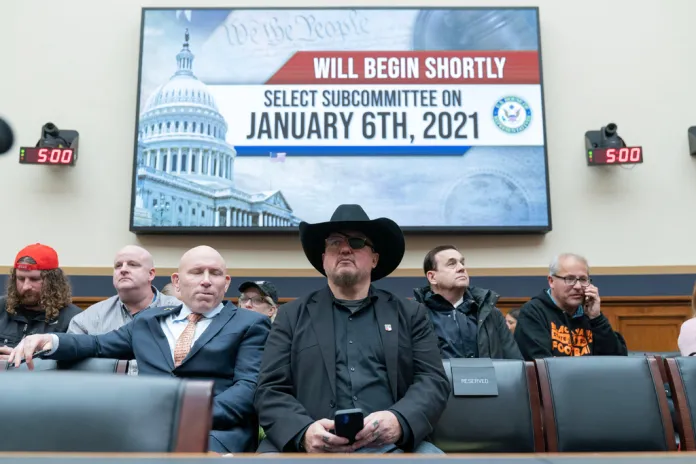
The hearing drew an audience deeply tied to Jan. 6 controversies. Oath Keepers founder Stewart Rhodes, whose sentence was commuted by Trump, sat in a reserved front-row section alongside Ivan Raiklin, a right-wing activist who supports Jan. 6 defendants.
At one point, Raiklin held up a piece of paper bearing the name of a Capitol Police officer previously accused by a conservative outlet of planting the pipe bombs.
Legally, morally, and ethically.
— Ivan Raiklin (@IvanRaiklin) January 14, 2026
tune into https://t.co/ISoQ7doJ0Z now! pic.twitter.com/kxz8PZDbJc
Also present was Micki Witthoeft, the mother of Ashli Babbitt, who was fatally shot by a Capitol Police officer while attempting to enter the Speaker’s Lobby.
Rep. Thomas Massie (R-KY), who is not a member of the subcommittee, observed the hearing and later said he remained unconvinced that the FBI had arrested the correct suspect in the pipe bomb case.
“I was hoping to learn more details about the pipe bomb,” Massie said. “I think they’re going to just try to sweep this under the rug and say we got our guy and move on.”
Raskin, meanwhile, raised the political implications of Cole’s prosecution, repeatedly highlighting Cole’s support for Trump and questioning whether Trump’s sweeping pardon for Jan. 6-related offenses could apply to the pipe bomb defendant if he is convicted.
“Is it their position that the pardon extends to Mr. Cole?” Raskin asked, calling the possibility “unprecedented” and “corrupt.”
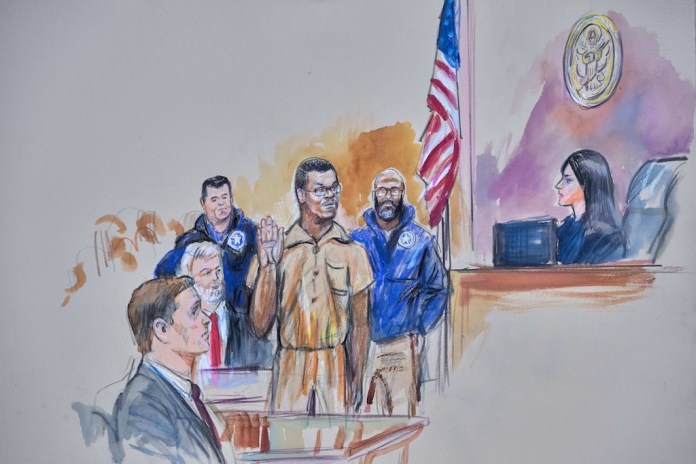
DC PIPE BOMB SUSPECT SAYS HE SHOULD BE COVERED BY TRUMP JAN. 6 PARDON
Raskin’s remarks come just days after Cole’s attorneys spoke to Fox 5 DC, indicating they plan to challenge the indictment against their client in novel ways, including by arguing that Trump’s broad pardon of the Jan. 6 protesters should apply to him.
Cole is still in the early stages of his criminal case and is fighting to obtain pretrial supervised release with his grandmother after a magistrate judge sided with prosecutors over their effort to keep him behind bars pending the trial. The next public court hearing for Cole is slated for Jan. 28.
