

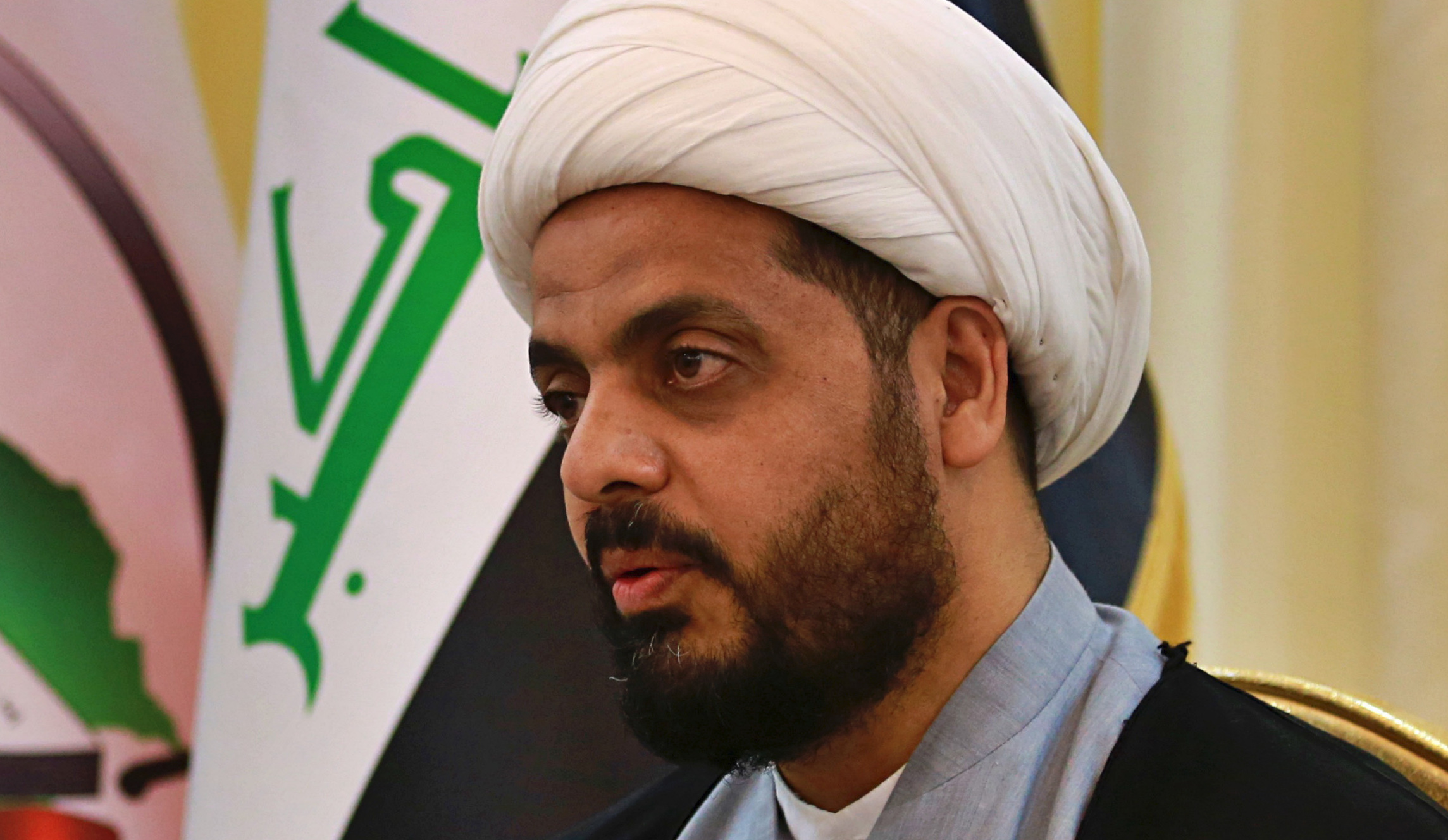
A longtime Iran-backed Shiite terrorist group leader turned Iraqi politician reemerged as one of the ringleaders of the massive New Year’s Eve attack on the U.S. Embassy in Iraq.
Qais al Khazali, 44, is one of Iran’s key allies in Iraq as the founder of the Asaib Ahl al Haq militia responsible for hostage-taking and the killing of U.S. soldiers, but which recently won seats in Iraq’s controversial 2018 parliamentary elections. He showed up Tuesday with his supporters at what the U.S. government condemned as a violent Iranian-fomented protest.
Recommended Stories


Khazali is known as a former acolyte of Shiite cleric leader Muqtada al Sadr, whose Mahdi Army played a deadly role in the Shiite-Sunni civil war involving al Qaeda in Iraq a decade ago. Khazali’s savvy and connections with Iran, though, made him a powerful player himself.
“Americans are unwanted in Iraq,” Khazali told Reuters on Tuesday. “They are a source of evil, and we want them to leave.”
Khazali was captured by British special forces in 2007 and held by the NATO-led coalition at Baghdad International Airport. Declassified interrogation reports show he shed light on a number of issues. These include Iranian influence, the Sadr movement he splintered from, his hostage-taking strategy, financial assistance Iran gave to Shiite militias at war with the United States, the existence of Iranian training camps in Iraq, and weapons smuggled from Iran into Iraq. The latter include penetrator bombs that killed hundreds of Americans.
Dale “Chip” McElhattan, who had years of experience dealing with Khazali while director of U.S. hostage affairs in Baghdad, told the Washington Examiner that Khazali’s role in the protest was a foreboding indicator of the hand of the Iranian Revolutionary Guard Corps.
“He thinks for himself. He’s a smart guy,” McElhattan said. “But he is also under the influence of the IRGC, and he has taken a lead now. He’s always been involved, but he’s become a lot more involved in Iraqi politics and as a vector for the Iranian services that have influence in Iraq.”
Khazali’s connections to Iran “go well beyond guilt by association,” McElhattan said. “It’s much more real than that.”
The storming of the U.S. Embassy’s grounds followed the Iraqi government’s condemnation of U.S. airstrikes earlier this week targeting Kataib Hezbollah, an Iranian-backed militia that is part of the broader pro-Iran Popular Mobilization Forces umbrella group. The group is run by Abu Mahdi al Muhandis, an adviser to Qasem Soleimani, the commander of Iran’s Quds Force. The U.S. blamed Kataib Hezbollah for attacks on U.S. bases in Iraq, including one resulting in the death of a U.S. contractor. Muhandis’s men showed up in droves on Tuesday, along with members of other Iranian-aligned groups.
“The Department of Defense is working closely with the Department of State to ensure the security of our Embassy and personnel in Baghdad,” Secretary of Defense Mark Esper said. More than 100 U.S. Marines arrived as reinforcements. President Trump spoke with Iraq’s prime minister about the need to protect U.S. personnel and facilities in Iraq.
“The Iranian-backed demonstrations in front of the U.S. Embassy should not be confused with the Iraqi protesters who have been in the streets since October to decry the corruption exported to Iraq by the Iranian regime,” a State Department spokesperson told the Washington Examiner.
Earlier in December, the Treasury Department sanctioned Khazali for his “involvement in serious human rights abuse in Iraq” during the anti-corruption protests that swept Iraq. The U.S. government also called out Khazali’s group for years of “widespread forced disappearances, abductions, killings, and torture, targeting Sunni Iraqis with impunity” and for Khazali’s leading role in a January 2007 attack on an Iraqi government compound in Karbala which killed five U.S. soldiers.
“His prominence has only grown, and it grows with the influence that Iran continues to put into Iraq,” McElhattan said. “A very strong case can be made that Qais and AAH and the other special groups that have never wanted the U.S. in Iraq have been treated basically like surrogates to assist in what Iran’s goals are in Iraq.”
Iran increased its influence and footing in Iraq following the Obama administration’s military withdrawal from the country and the subsequent invasion by the Islamic State, with Iran backing Shiite militias like Khazali’s to fill the power void, and Iran received a much-needed influx of cash as a result of the Iran nuclear deal, which the U.S. has since left.
“It used to be every waking moment spent with Qais and his guys, because when I was there from 2009 to 2010 as the last director of hostage affairs at the embassy, most of my clients — and my clients being those who were isolated, detained, missing, or captured — were being held by Qais and his group,” McElhattan said. “The concern at the time was, hey, so, you want to join the political process, but you still are holding hostages, and you’re still shooting rockets at the Green Zone… And it was less than a month after Qais was released that he resorted to kidnapping again. This is a warning of what’s to come.”
McElhattan worried the protests at the embassy could be just the beginning of escalation.
“I expect to see more hostage-taking events. This is a time for us to reevaluate where the U.S. is from a personal recovery standpoint. We’re going to run the risk after we did the operation of an increased threat of kidnappings. And they’re pretty good at it. They’re one of the more successful kidnapping groups in Iraq. The concern I have is that they’re going to go back to kidnapping and to making our troops a lot more vulnerable.”
McElhattan said that “the specter of kidnappings of Americans and others in Iraq is getting worse, and the next hostage that’s taken in Iraq, we’ll know who did it — very likely to be Qais’s boys.”
