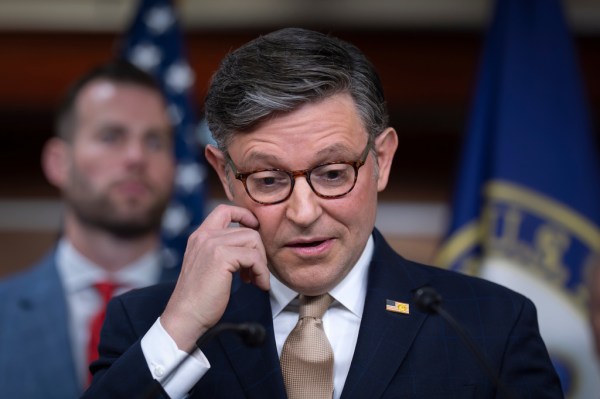
Sometimes the legislative process is ugly, Speaker Mike Johnson (R-LA) conceded Thursday after a chaotic week in the House that saw several votes derailed due to GOP infighting but also several major wins for the Louisiana Republican.
In a jam-packed legislative week, the House passed the reauthorization of Section 702 of the Foreign Intelligence Surveillance Act, a party-line budget resolution, a Senate-passed funding deal, and the long-awaited farm bill.
But those pieces of legislation did not pass through the House floor without conflict and controversy. Earlier this week, the House Rules Committee was twice forced to postpone a vote on a procedural motion bringing the bills to the floor as GOP leadership tried to strike a deal with rank-and-file members over the FISA reauthorization and farm bill disagreements.
Johnson told the Washington Examiner that the legislative process is often equated to “making sausage.”

“You don’t want to see it made,” Johnson said. “And sometimes it’s an ugly process. Sometimes it’s a long process.”
On Wednesday, the House floor was brought to a standstill twice, first on the procedural motion to bring to the floor FISA renewal, the farm bill, and the party-line reconciliation bill. At various points in the hourslong vote, eight Republicans cast a “no” vote. Johnson kept that vote for two hours and could be seen actively working GOP opponents on the floor himself.
Rep. Lauren Boebert (R-CO) was a target of the speaker’s lobbying. The Colorado Republican was refusing to vote for the measure over disagreements with the farm bill. At the start of the vote, Boebert was even seen by reporters yelling at House Majority Whip Tom Emmer (R-MN) and House Agriculture Committee Chairman Glenn Thompson (R-PA).
After speaking with Johnson, Boebert voted for the measure. She told reporters it was because the speaker had told her the Senate would make changes to the farm bill before passing it themselves. That would force the House and Senate to set up a conference committee, made up of representatives of both chambers, to iron out the details.

“I will be a conferee, and I will make sure, no matter what, that my farmers and ranchers get exactly what I promised for them,” said Boebert.
Rep. Zach Nunn (R-IA) was another House Republican upset over the farm bill. The second-term lawmaker, who is facing a tough reelection battle this fall, was heard shouting at Johnson that they needed to have a “conversation” after the procedural motion passed.
A GOP staffer told the Washington Examiner that Johnson informed Republican holdouts they would delay a final vote on the farm bill to hammer out the details. But the potential delay angered rural Republicans who wanted to see the farm bill passed.
Nunn, who previously pushed for the year-round sale of an ethanol gasoline blend known as E-15, explained to reporters that there was a “miscommunication” over whether or not the farm bill was being delayed as disagreements about E-15 surrounded the legislation.
“If there was ever a situation where we feared that a rule had passed, the farm bill or E-15, for that matter, was not going to be included, I think it absolutely needed to be addressed at that time,” Nunn explained. “That’s why we went aggressively after recognizing that we felt there had been a miscommunication, and so we communicated clearly with the speaker and his team.”
Complicating matters is that while negotiations were underway, GOP leadership sent out a notice that votes on the farm bill would be taking place Wednesday night. The schedule change led to frustration boiling over, and a vote on a budget resolution to fund border enforcement was held open for more than five hours because hard-liners and farm state Republicans refused to vote. Johnson diffused the situation by agreeing to hold a stand-alone vote on E-15 on May 13.
A GOP source told the Washington Examiner the group was frustrated with the speaker because he was trying to “make everybody happy and it’s not happening.”

When asked about frustration over perceived breaking of his word over the course of negotiations, Johnson said he has “never broken my word to a single person in this building.”
“There was a lot of emotion and frustration yesterday because sometimes when you have a small margin, as we do — we’re currently working on a one-vote razor-thin margin because of absences and the rest — and people have, you know, different ideas, different priorities about very contentious pieces of legislation,” Johnson said. “The equations that we solved on legislation this week were virtually impossible.”
Even lawmakers that held up passage of FISA, the farm bill, and reconciliation agree with Johnson.
Rep. Keith Self (R-TX), a Freedom Caucus hard-liner who voted against FISA, defended Johnson, saying the speaker was in a “tough spot” and an “almost impossible situation.”
“A lot of critics of Speaker Johnson, but dadgummit he wins,” Rep. Tim Burchett (R-TN) similarly told the Washington Examiner. “It’s just like a wrestling match the whole time.”
Self and Burchett were two of the “no” votes Johnson flipped earlier in the week to bring FISA, the farm bill, and the reconciliation measure to the House floor.
The week ended with the lower chamber sending the farm bill to the Senate, sending a bill to reopen the Department of Homeland Security to the president’s desk, and passing a 45-day extension of FISA.
HOUSE ADVANCES $70 BILLION IN ICE AND CBP FUNDING VIA RECONCILIATION
For now, Johnson remains in the clear from the wrath of House members as they direct their anger at the Senate.
“I think we should be clear, we’re very unhappy with the Senate,” Rep. Warren Davidson (R-OH) told reporters as they ran out of town. “That’s what today was about, and that’s the macro theme.”