

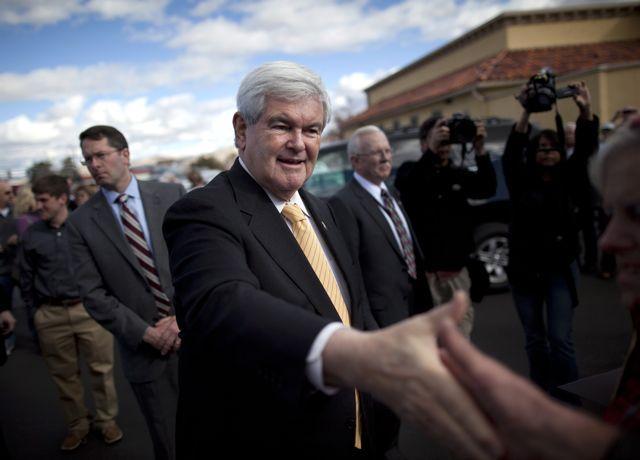
TAMPA, Fla. — He lost Florida overwhelmingly, but Republican presidential hopeful Newt Gingrich did well enough among key GOP groups in the Sunshine State, particularly the party’s most conservative voters, that he remains a continuing threat to front-runner Mitt Romney, particularly in the crucial South.
Romney won the majority of Florida’s 67 counties and demonstrated rather broad support among the party’s rank and file. But the former Massachusetts governor, viewed as too moderate by party conservatives, lost in areas of Florida that are considered more conservative and more closely aligned with Republicans across the deep South.
While Gingrich is not expected to fare well in the February contests in Nevada and Michigan, Florida’s results suggest Gingrich could regain momentum when the race turns south in March, with contests in Mississippi, Alabama, Tennessee and his home state of Georgia.
“That’s the only way for him to win delegates to stay in the race, to use a so-called Southern strategy, where he has his greatest appeal,” said G. Terry Madonna, director of the Franklin & Marshall College Poll.
Gingrich already demonstrated his strength in the South, beating Romney by 12 points in the South Carolina primary last month, a victory that thrust him temporarily to the front of the pack and helped him raise much needed campaign cash.
“The evangelicals will be stronger in the Southern primaries and strong conservatives will be a larger group than in Florida, so he still has part of the Republican electorate he can carry,” Emory University political science professor Merle Black told The Washington Examiner.
Political experts say this Southern strategy is Gingrich’s best and possibly last chance to continue his campaign.
Romney is better financed and organized in the upcoming primaries and caucuses, though a handful of victories in the South could help Gingrich secure the campaign cash he needs to remain competitive.
“It’s a long path but about the only one he has left at this point,” Whit Ayres, the former pollster for Jon Huntsman’s aborted presidential bid, told The Examiner.
Exit polls explain Gingrich’s victory in these counties: While Romney was able to win the Tea Party and evangelical vote by a modest margin, he lost badly to Gingrich among those who consider themselves “very conservative.”
And the loss was substantial. Gingrich picked up 41 percent of very conservative voters while Romney won just 30 percent of this group, exit polls show.
Despite losing the Florida primary to Romney 46 percent to 32 percent, Gingrich didn’t limp out of Florida the next morning. Instead, he moved to reposition his campaign as the most conservative alternative to Romney.
“Gov. Romney successfully won Democrat-leaning urban areas, while losing in critical primary rural districts,” Gingrich spokesman R.C. Hammond told supporters in an email soliciting campaign donations.
The Gingrich campaign is also trying to recast the campaign as a two-man race, with the hope that conservative candidate Rick Santorum, who is trailing Gingrich in the polls, will drop out.
Madonna said it would be premature to dismiss Gingrich, given how often the lead in the race has shifted and the lingering possibility that Romney will make a serious mistake.
“Then logic is that Gingrich wins enough delegates in the South to stay in the hunt and hope that something happens to Romney,” Madonna said. “Romney implodes — or Santorum gets out.”
