

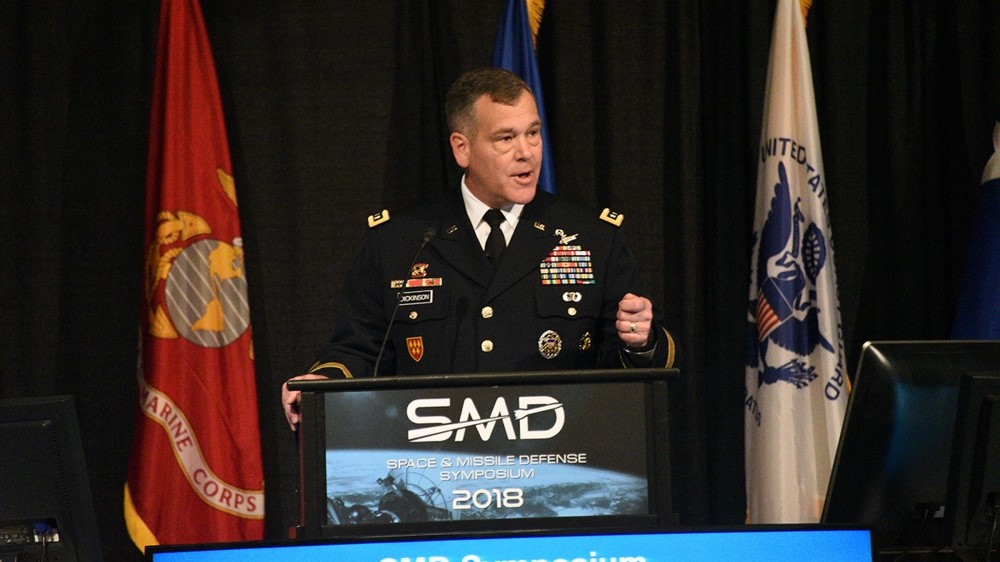
Politics will not get in the way of space defense, Army Lt. Gen. James Dickinson told members of Congress on Tuesday at his nomination hearing to be the commander of U.S. Space Command.
Dickinson said America dominates in the domain despite Chinese and Russian space weapons and more than a year’s delay in a decision regarding where Space Command will be situated.
Recommended Stories


“I support Secretary Esper in his concept for the basing decision that’ll be made,” Dickinson told Sen. Doug Jones, an Alabama Democrat, who is vying for Space Command’s location to be at Redstone Arsenal in Huntsville.
The former commander of U.S. Army Space and Missile Defense Command in Huntsville was cajoled into praising the location that was once a finalist and is now among a broader field of bases that includes options in California, Colorado, and Florida.
“It has a lot of capabilities there in terms of the space enterprise with NASA, Marshall Space Flight Center,” Dickinson added. “It is, in my opinion, a fair, transparent, holistic look that will be done, and it’s already underway.”
A decision on where U.S. Space Command will be based is due after the November election. In the meantime, the U.S. Space Force is playing catch-up with the offensive space-based capabilities of adversaries.
“The scope, scale and complexity of the threats to our space capabilities are real and concerning,” said Dickinson. “When I look across the spectrum of competitors that we’re looking at today, in particular, two of them, China and Russia are very active.”
The Army commander reminded the Senate Armed Services Committee of a Chinese anti-satellite jamming and directed energy test in 2007, and reflected on Russia’s recent testing of a satellite able to fire projectiles in space.
“We deter by a position of strength. And as I said in my opening statement, we are the best in space,” Dickinson said, noting Iranian and North Korean rocket technology is also of concern.
In recent weeks, Pentagon officials have made note of Russian activity but have been mum as to whether the United States has similar offensive capabilities.
Stephen Kitay, deputy secretary of defense for space policy, told the Washington Examiner in June that adversaries are advancing quickly.
“We are absolutely at risk with the pace that they are developing these capabilities, and these are very serious threats,” he said. “We are going to have space — we need to maintain our space superiority.”
A July article in Defense News by Adm. Dennis Blair and former Deputy Secretary of Defense Robert Work claimed duplication and stove-piping was the result of over-classification of space-related programs and intelligence.
Dickinson said he would ensure that no longer happens.
“Declassification, if you will, of some of the assets that we have has added to not only more soldiers being able to be trained and qualified on that capability, but providing that capability to the warfighter on the ground,” he said.
Dickinson also told the committee that a space-based, early warning system is necessary, especially in the era of hypersonic weapons possessed by China and Russia.
“We need to have a space based warning [early] detection capability that is absolutely critical to solve this problem with hypersonics,” he said. “Our ability to see that threat early in the kill chain of that is absolutely critical to our success in defeating it.”
