

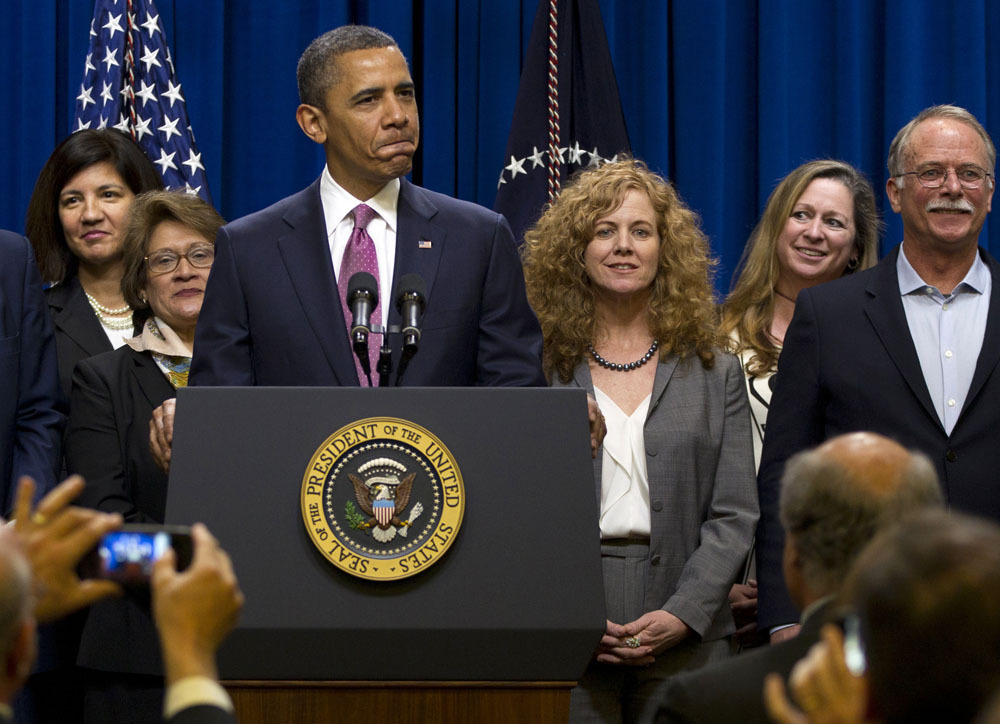
As Tax Day approaches, President Obama is embarking on his latest campaign to distort the English language in order to assert more federal government power over people’s lives.
With the economy still weak three years into his $831 billion economic stimulus package, and with the fate of his signature health care law in the hands of the U.S. Supreme Court, Obama has supercharged his class warfare campaign.
In a series of speeches this week, he promoted the Buffett Rule — a surtax on millionaires based around the anecdote that billionaire investor Warren Buffett pays a lower effective tax rate than his secretary. The gimmick is just the latest attempt by liberals to perpetuate the canard that we can solve our nation’s debt problem just by asking wealthier Americans to kick in a little extra money.
Though Obama claims that his policies are about math rather than class warfare, the Buffett tax would raise just $47 billion over a decade, or less than 1 percent of the $6.4 trillion in projected deficits during the same period under Obama’s budget.
But it’s more troubling than that, because the tax debate is more than a numbers game. It’s a moral issue that represents one’s views about the relationship between the individual and the government.
“Right now, we have significant needs if we want to continue to grow this economy and compete in this 21st-century, hyper-competitive, technologically integrated economy,” Obama said on Wednesday. “That means we can’t afford to keep spending more money on tax cuts for wealthy Americans.”
Describing cutting taxes as “spending” is as inaccurate as it is offensive. It’s true that, except for certain circumstances, lowering taxes will result in higher deficits if not offset by spending cuts. But to portray any tax cut as a cost to government is to assume that the government is the rightful owner of 100 percent of the wealth created in society, and that every dollar that isn’t spent by government is somehow a giveaway.
In the real world, when taxes are lower, individuals have more money to spend as they see fit. What Obama considers a cost to government is actually a savings for taxpayers. If you translate Obama’s words, what he’s really saying is that he wants people to keep less of their hard-earned money so that additional money will be available for him to spend on welfare state programs and more Solyndras.
Obama’s failure to acknowledge this distinction was hammered home in the same speech, when he suggested renaming the Buffett Rule the “Reagan Rule.” His remarks followed up on a video clip posted by the liberal group ThinkProgress in which Reagan, in a 1985 speech on the tax code, told a story about an executive paying a lower tax rate than his secretary.
Yet Reagan told the story as part of a larger pitch for tax reform. Unlike Obama, Reagan was interested in targeting loopholes so that he could lower rates, to allow people to keep more of their own money.
“Lower, flatter tax rates will give Americans more confidence in the future,” Reagan said in the speech referenced by Obama. “It’ll mean if you work overtime or get a raise or a promotion or if you have a small business and are able to turn a profit, more of that extra income will end up where it belongs — in your wallets, not in Uncle Sam’s pockets.”
The real Reagan rule recognized that because people spend time at work that they could otherwise spend doing something else, taxes are a claim on a portion of a person’s life. On this basis, the goal of lawmakers should be to keep government as small as possible so that individuals can keep as much of their money as possible.
Philip Klein is senior editorial writer for The Examiner. He can be reached at [email protected].
