

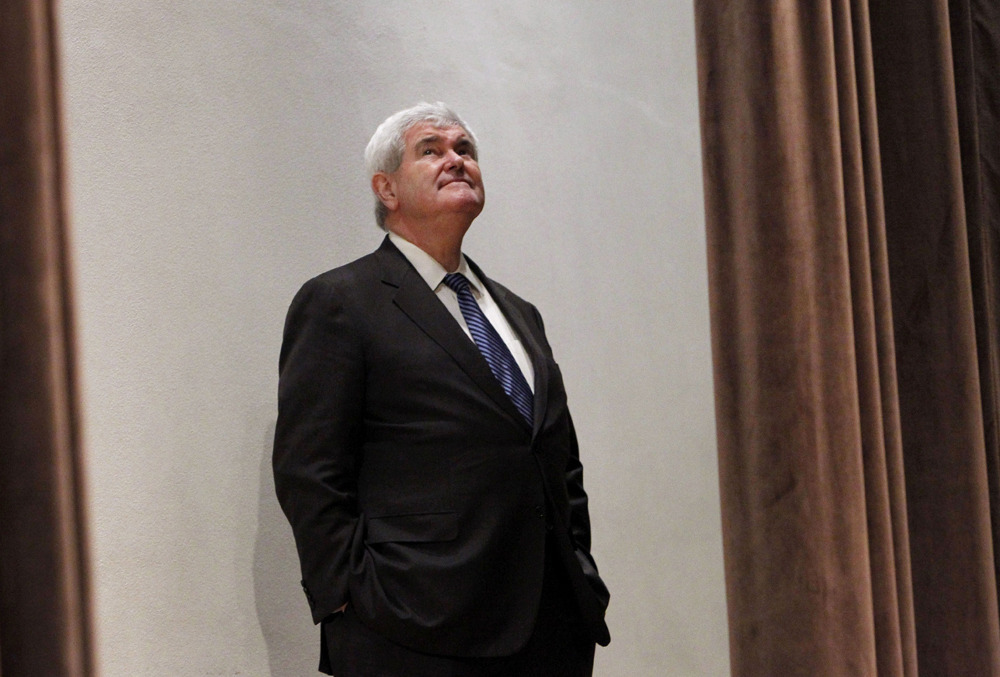
Newt Gingrich will drop his bid for the Republican presidential nomination, ending what many saw as a quixotic effort to beat Mitt Romney that was largely driven by Gingrich’s anger toward the race’s front-runner.
Gingrich announced the decision Wednesday, a day after finishing a distant second in the Delaware primary, one of five states Romney swept Tuesday. Gingrich will formally withdraw next week at an event to be held in Northern Virginia or the District and at the same time will announce his endorsement of Romney.
“Gingrich dropping out is a reflection of him finally bowing to reality,” Republican political strategist Matt Mackowiak told The Washington Examiner. “I suspect he wanted to stay in to try to reduce his $4 million [campaign] debt, but in fact, it is very hard to raise money nationally with the unification around Romney and given what Gingrich’s campaign had become.”
Gingrich campaign aides tell The Examiner that Gingrich’s decision to remain in the race despite a long losing streak dating back to Super Tuesday is unrelated to money woes and had “never been about anger” toward Romney, even though Romney crushed early Gingrich surges with barrages of negative campaign ads targeting the former speaker.
Gingrich won only two primaries — South Carolina and Georgia — and he blamed his failures in Iowa and other states squarely on the heavily funded negative campaign ads being run by a political action committee supporting Romney.
But the relationship between the two men had clearly softened in recent weeks, aides said.
Gingrich’s decision to finally quit followed a phone call by Romney early Wednesday after weeks of communication between the two men beginning in March, aides said.
“One of the reasons this sort of conversation could happen is that they have been talking at the candidate level for some time, starting with a backstage conversation at the [Arizona debate prior to Super Tuesday] and leading to phone calls and emails,” Gingrich spokesman R.C. Hammond told The Examiner.
The two met privately at least twice last month, including a sit-down at the New Orleans Marriott on the eve of the March 24 Louisiana primary.
Gingrich most recently concentrated his campaign on Delaware, one of five states voting Tuesday, and said he would reassess his entire campaign if he lost there. Romney won the state with 57 percent of the vote, compared to Gingrich’s 27 percent.
Now, say his aides, Gingrich will keep his schedule of events in North Carolina this week but hopes to soon hit the stump for Romney with the goal of helping to turn out conservative voters who have remained skeptical about Romney’s commitment to their priorities.
But Gingrich, who frequently labeled Romney a “Massachusetts moderate,” may be less welcome on the campaign trail than rising superstars like Sens. Marco Rubio, R-Fla., and Rob Portman, R-Ohio, who are popular among the conservatives Romney is courting.
“By staying in the race as long as he did, Gingrich may have devalued some of his early successes,” said Dan Schnur, director of the Jesse M. Unruh Institute of Politics at the University of Southern California and a former top campaign aide to Sen. John McCain. “Georgia and South Carolina are fairly distant memories now. Those victories are less likely to motivate voters.”
