

Samsung Heavy Industries announced Wednesday that it has completed the conceptual design for its Compact Molten Salt Reactor Power Barge, a floating offshore nuclear power plant, and has received early approval from the American Bureau of Shipping, putting it on track to begin commercial operations before the end of the decade.
Samsung Heavy, South Korea’s top shipbuilder, began developing the floating nuclear power plant last year after entering into an agreement with Seaborg, a Danish CMSR developer.
RUSSIA’S WAR HAS MOBILIZED $500 BILLION IN CLEAN ENERGY SPENDING
Once operational, the floating plants will be moored at an industrial harbor and connected to an existing electric grid, Seaborg said Wednesday. Each barge is designed to provide up to 800 MW of electricity.
The CMSR barges take just two years to build, Samsung Heavy officials said, and cost less than traditional nuclear power plants — making them a lucrative alternative to land siting.
The new units will be used both as an alternative to fossil fuel-powered energy sources and as an electricity and thermal energy source for industrial heating systems, hydrogen production, and saltwater desalination facilities.
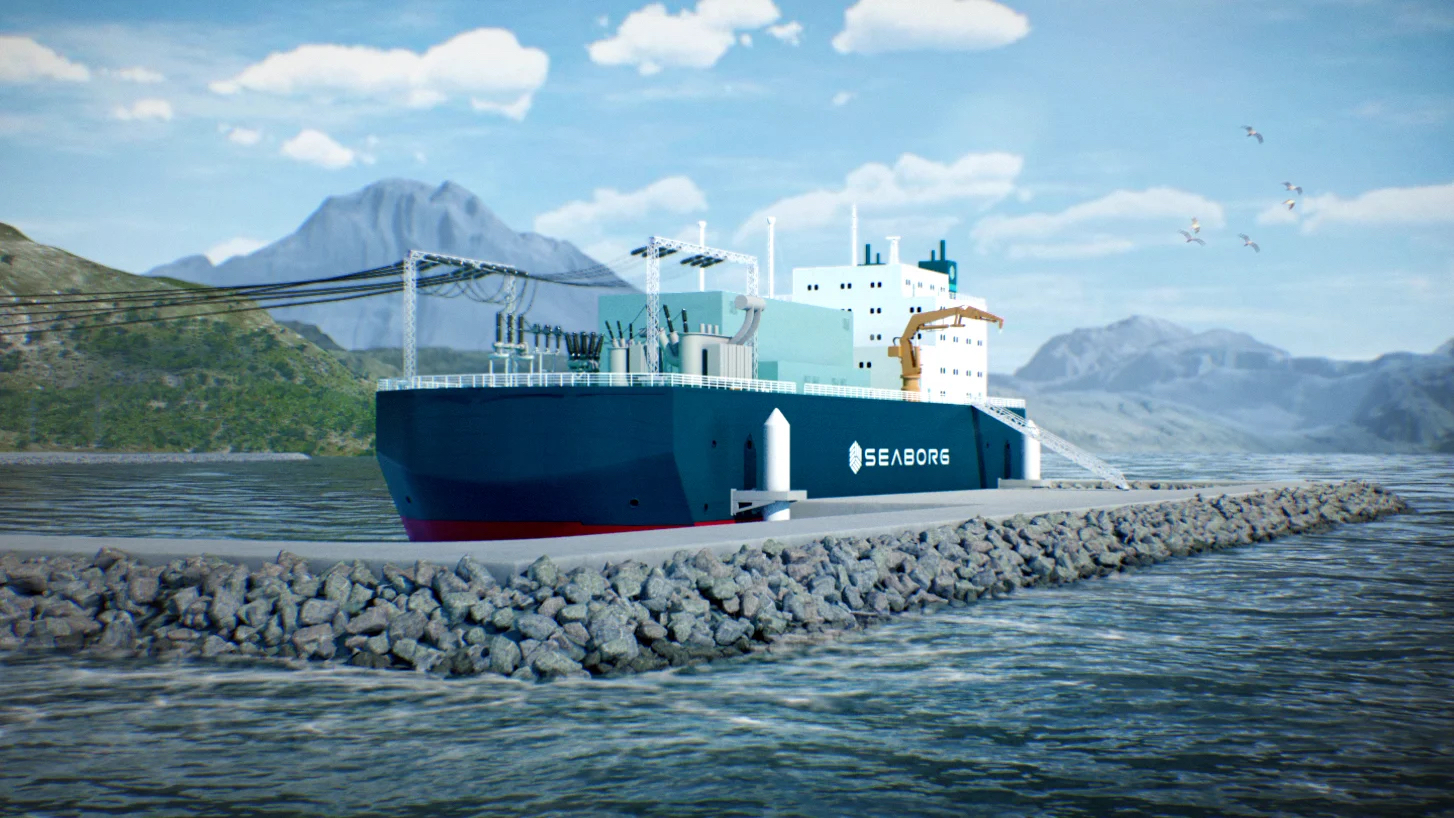
Samsung Heavy plans to commercialize the technology beginning in 2028. “We will continuously develop technologies for floating nuclear power plants, which will lead a new market,” Yeo Dong-il, Samsung Heavy’s head of marine design, said in a statement.
Solar farm barges have been around for years, and floating wind farm projects are being developed worldwide, but the idea of a sea-based nuclear power plant offers new and unique opportunities for carbon-neutral energy.
Importantly, the “nuclear power plant on the sea” solves the problem of siting, a major hurdle in the building of land-based nuclear power plants.
Unlike wind and solar projects, nuclear power plant developers must consider a long list of factors before deciding where to build a new plant — among them topography, accessibility, infrastructure, transmission lines, and availability of cooling water. That makes finding a new location for a nuclear power plant difficult.
The CMSR technology has also been hailed as an important safety feature for the nuclear barges.
If an abnormal signal were to occur inside a reactor, company officials explained in a briefing Wednesday, the molten salt, a liquid nuclear fuel, would solidify — thus preventing a serious accident at the source.
CLICK HERE TO READ MORE FROM THE WASHINGTON EXAMINER
Russia is the only country with an operational floating nuclear power plant. In 2019, it deployed the Akademik Lomonosov to the isolated community of Pevek as a means of supplying heat and power.
But the Russian vessel can produce just 70 MW of electricity, a fraction of the Samsung-Seaborg’s 800 MW capacity.
