

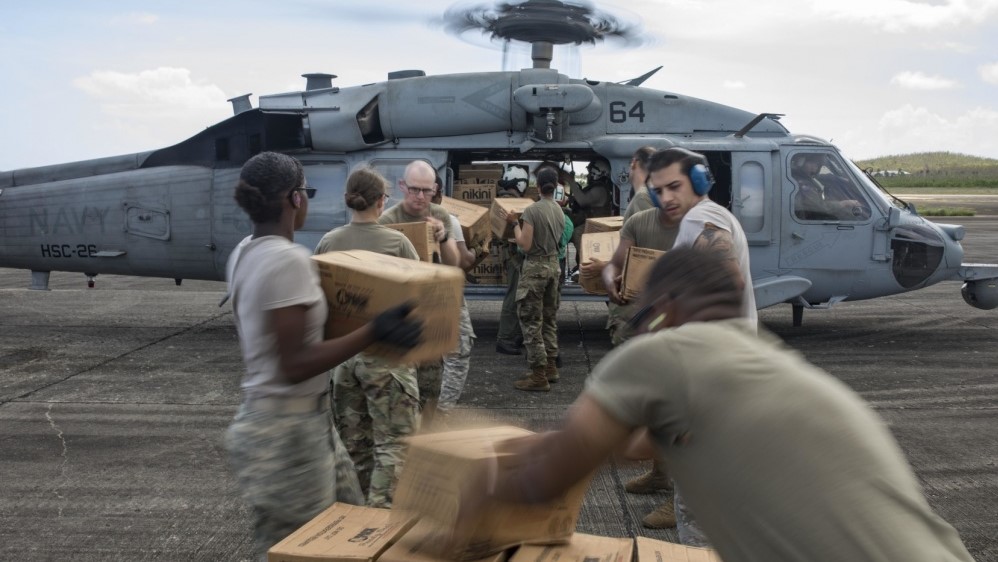
Weary National Guardsmen from Florida to Texas who have been on a continuous, four-month COVID-19 response mission may soon be tapped for emergency response in what is predicted to be an active hurricane season.
“It is a huge concern for us, the long-term impact,” said Air Force Maj. Gen. James Eifert, the adjutant general of the Florida National Guard, on a Monday media call briefing reporters on preparations for hurricane season.
Recommended Stories



The National Guard is expecting 30% more storms this year, or at least 16 named storms. State Guard units called up by governors in a hurricane response typically work with state disaster response offices to help with everything from search and rescue to managing evacuation centers.
“We are trying really hard to whittle down the numbers that we currently have on duty to reset,” said Eifert, who predicts that many guardsmen will be called for multiple duties this year, serving away from their families and jobs for months at a time.
Florida is planning to have 8,000 of its 12,000 guardsmen ready for emergency responses related to hurricanes. The state has reduced its coronavirus-related response to 1,731 guardsmen, principally serving at state testing sites.
At its peak, when national guardsmen responded to civil disturbances across the country while also responding to COVID-19, about one-quarter of the full guard force, 120,000 soldiers, were deployed overseas and in the 50 states, three territories, and the District of Columbia.
Still, in coastal states bracing for hurricane season, guardsmen will likely see multiple tours this year, including responding to civil disturbances related to the death of George Floyd, the national COVID-19 response, and hurricanes.
“In Florida, it’s almost impossible to not have people who have done all of those things,” said Eifert.
Army Maj. Gen. Tracy Norris, adjutant general of the Texas National Guard, added, “It’s highly probable.”
In Texas, 3,600 guardsmen are involved in the COVID-19 response out of a force of 24,000 people principally assisting with walk-up and drive-through coronavirus testing centers, food banks, and personal protective equipment storage and distribution.
Norris said a Category 3 storm could mean activating another 3,000 to 5,000 guardsmen and calling nearby states, including Louisiana, Arkansas, and Oklahoma, for increased capacity.
COVID-19 adjustments
Both Texas and Florida are already working with their state emergency services offices to prepare for evacuating people prior to landfall into facilities that would be suitable in a COVID-19 environment.
“It is all in discussion,” Eifert told the Washington Examiner. “They plan to manage the assistance of elderly populations and populations at risk and to prioritize those for the specialized shelters.”
Eifert explained to the Washington Examiner that for the first time, emergency planning includes pre-landfall evacuation to “noncongregate” facilities such as hotels, motels, and dormitories in addition to typical evacuation sites such as school gymnasiums, where groups of people stay in the same room. That way, individuals or families at risk can be isolated.
Texas has also stood up a “sheltering task force” to identify new types of facilities for evacuees.
Air Force Maj. Gen. Steven Nordhaus, director of the National Guard Bureau Operations, said three storms have already been named this season.
“We’re looking at all hurricanes as they are starting to develop way, way far out in the East Atlantic and then also as they begin in the Pacific,” said Nordhaus.
Nordhaus added that he witnessed the results of a powerful hurricane firsthand in 1992 as a first lieutenant serving at Homestead Air Force Base in South Florida.
“I know what it means to walk around your house and pick up only about 5% of what you think you have left and work your way out of that and back to a normal life,” he said of the destruction then caused by Hurricane Andrew. “We do anticipate the potential need for severe or significant destruction from a hurricane that would require the assistance of the National Guard.”
