

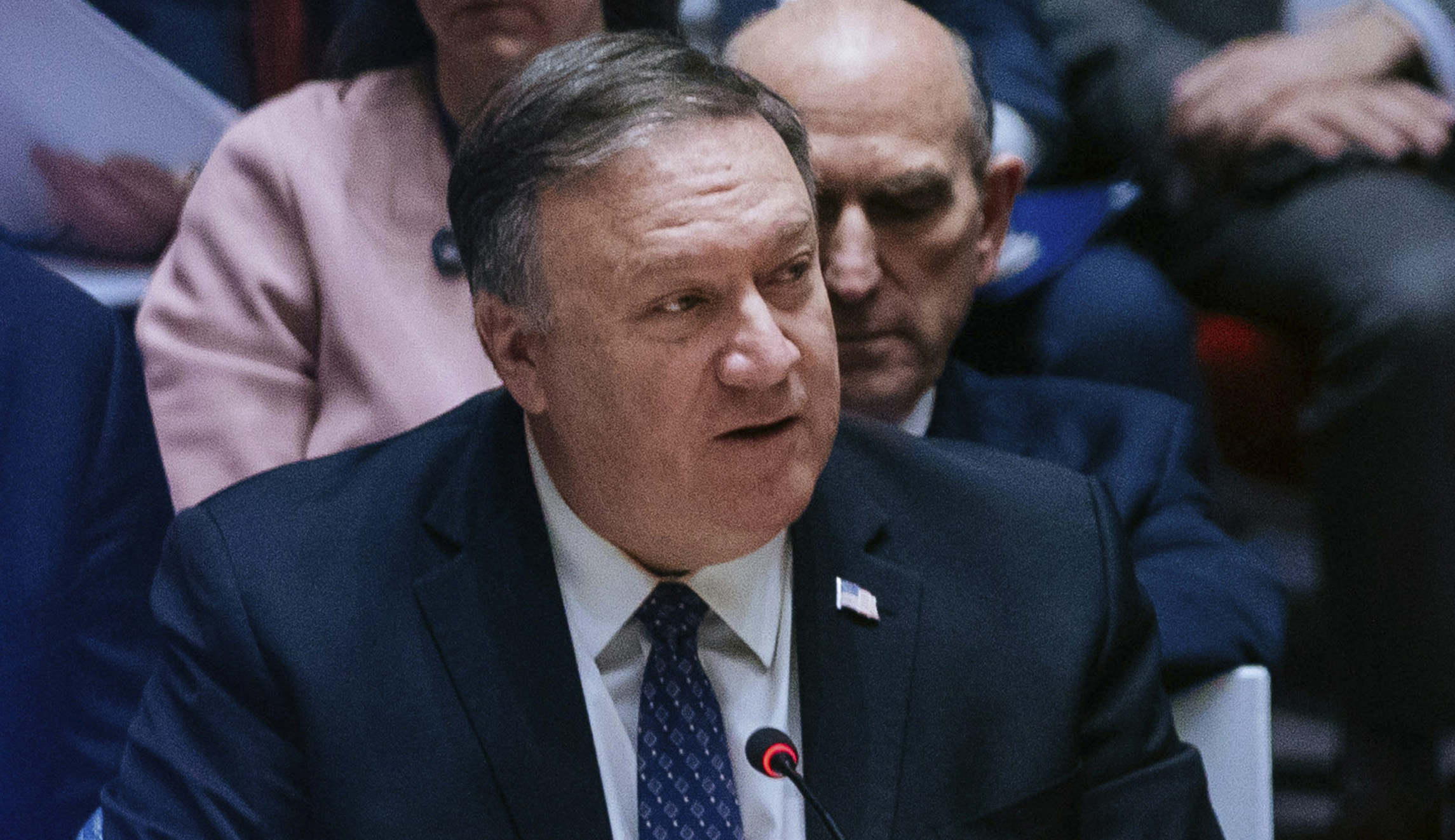
Secretary of State Mike Pompeo’s effort to orchestrate an Arab-Israeli partnership against Iran will take him to Lebanon and the doorstep of Tehran’s strongest terrorist proxy this week.
“There is going to be no skating around the challenges posed to Lebanon and its people by Hezbollah,” a senior State Department official told reporters while previewing Pompeo’s trip to the Middle East.
Recommended Stories


Pompeo’s visit to Beirut will cap a three-nation swing that also includes stops in Kuwait City and Jerusalem, where he will meet with Israeli Prime Minister Benjamin Netanyahu. He is heading to the region as President Trump’s administration is trying to broker a new regional alliance and preparing to unveil a new Israeli-Palestinian peace plan. The diplomatic tour comes at an especially delicate time, as voters in the Jewish state are weeks away from casting their ballots in a tight race that could upend Netanyahu’s political career.
“We have major U.S. interests with Israel,” the senior State Department official said Friday, rebuffing the suggestion that Pompeo might be engaged in a show of support for the embattled Israeli leader. “Those interests don’t go away. They don’t go into suspension because of the electoral cycle in Israel any more than they do for Israel and other states when we’re in an electoral cycle, and that is precisely how you should view the frame for this visit.”
The top U.S. diplomat will not meet with any of Netanyahu’s political rivals, who are hoping that an impending indictment on corruption charges will doom the prime minister’s bid to stay in power. “We have critical, important bilateral, regional, and transregional issues to discuss with the Government of Israel,” the official said. “That is the context for all of his meetings. He will not be meeting with candidates because the meeting with the prime minister is in his capacity as the prime minister of Israel.”
Pompeo, who is heading to the region from an international economic forum in his home state of Kansas, will face varying degrees of difficulty in advancing his agenda this week. Netanyahu will likely provide a warm welcome, while Hezbollah’s prominence in Beirut foreshadows a thorny set of meetings as he tries to undercut the militant organization’s Iranian patron. Kuwait could play an important role in the formation of the Middle East Strategic Alliance, the so-called ‘Arab NATO’ that Trump’s team hopes to use to bracket Iranian power in the region.
“The Kuwaitis, in general, are very suspicious of Iran but they don’t want to get out in front as much as the Saudis or the United Arab Emirates,” Jim Philips, a regional expert at the Heritage Foundation, told the Washington Examiner. “They tend to be more neutral — which makes sense, as it’s a small country. They should be supportive of the overall anti-Iranian coalition, but it’s not something they want to highlight because Iran is very close and they have their own Shia population [in Kuwait].”
Pompeo draws his most difficult assignment in Beirut, as Iran has provided thousands of missiles to Lebanese Hezbollah. The militant group is also fighting in Syria to establish a “land bridge” that would help provide supply routes to Iran and reportedly has positioned forces on the Syrian-controlled side of the Golan Heights, which overlook northern Israel. Hezbollah also gained political control of key ministries in Lebanon’s government after the 2018 elections, which U.S. officials worry will allow the group to direct public aid to militants.
“We have an overarching regional and trans-regional objective of constraining, throttling back, ultimately rolling back the malign adventures, influence, presence of Iran’s forces, as well as their variety of proxy and associated forces throughout the region,” the senior State Department official said. “But certainly that includes Lebanon, Syria, Iraq, Yemen most prominently. That’s an overall objective, and this trip should be seen in part as part of that process.”
