

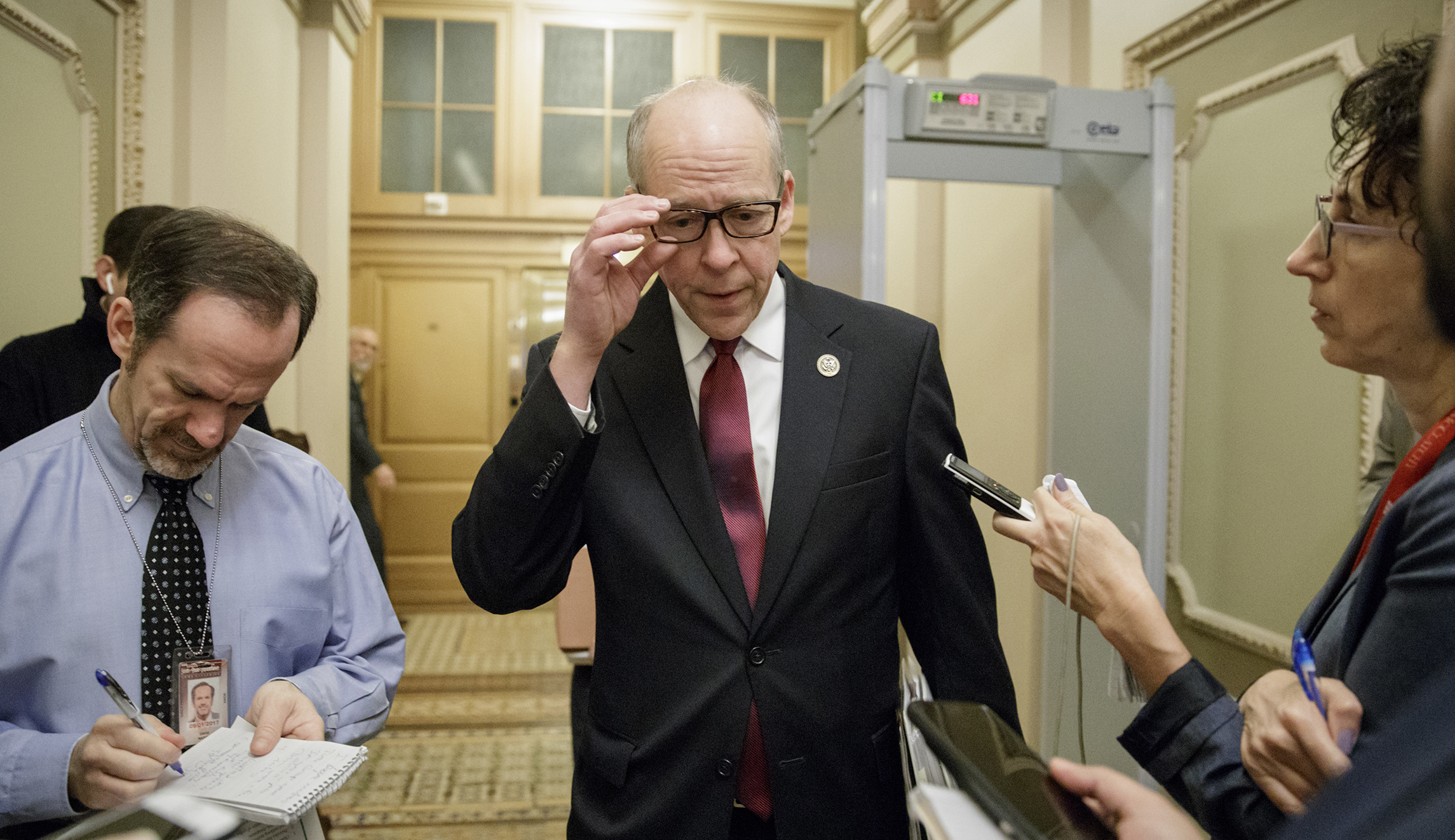
The chairman of the House Energy and Commerce Committee said Wednesday he is trying to get a series of bills aimed at clamping down on opioids to the House floor for votes by Memorial Day.
The House Energy and Commerce Committee held a legislative hearing Wednesday on eight bills aimed at tackling the opioid epidemic. Some of the legislation would give the Drug Enforcement Administration new powers to stem the tide of fentanyl, an opioid 100 times more potent than morphine.
Recommended Stories


Rep. Greg Walden, R-Ore., said he wants to get all of the bills through to the House floor by Memorial Day. More legislative hearings are expected on other aspects of the opioid epidemic, including access to treatment.
“No community is immune from the opioid epidemic,” Walden said Wednesday. “It is ripping apart the very fabric of our neighborhoods.”
Democrats on the panel urged more funding to go along with the new legislation.
“This conversation must be paired with significant resources to provide for patient funding,” said Rep. Doris Matsui, D-Calif.
She sponsored one of the eight bills. Her legislation aims to boost access to substance abuse treatment via telemedicine.
From 2010 to 2015, annual overdose deaths involving opioids increased by nearly 57 percent, according to the Centers for Disease Control and Prevention. The major reason for the spike was synthetic opioids, primarily fentanyl. Deaths from synthetic opioids rose from 3,007 in 2010 to 9,580 in 2015, a staggering increase of 219 percent, CDC found.
Overall, more than 64,000 overdose deaths were caused by opioids in 2016, CDC said.
“It is unprecedented, and it calls for unprecedented measures to get this done,” said Susan Gibson, deputy assistant attorney for DEA’s diversion control division.
Fentanyl is manufactured legally but can be illicitly made and sold on the black market. It is also often mixed with heroin or cocaine, sometimes without the user’s knowledge, CDC said.
The DEA has been working to schedule certain synthetic opioids such as fentanyl as schedule I controlled substances, the same category as illegal drugs such as heroin and cocaine. However, Gibson said that the agency is still playing catch up.
The problem is fentanyl is easy to buy online and ship to the U.S., primarily from China.
Once in the U.S., fentanyl can be combined with heroin and “pressed into counterfeit pills made to look like” regular opioid prescriptions, Gibson said.
One of the bills the committee is considering would give DEA the ability to regulate pill press manufacturing machines.
Gibson said the DEA would like “any kind of control” to keep those machines from getting into the wrong hands.
“We understand there are some people that bring that in for legitimate purposes,” she said. “It is a balance.”
Another major problem is that the existing process to schedule a new product is too slow to respond to the threat posed by fentanyl. The DEA can limit shipments, supply, and access of a scheduled drug.
However, a drug trafficker can circumvent enforcement by making a slight change to a schedule I controlled substance and make it lawful and easy to access. That has let them stay one step ahead of the DEA.
“When DEA has taken an action to temporarily schedule a substance, traffickers begin selling new versions of their products made from new, noncontrolled substances,” Gibson said in her written testimony.
One of the bills the committee is considering aims to improve the scheduling process to make it more nimble. The Stop the Importation and Trafficking of Synthetic Analogues Act of 2017 would clarify how controlled substance analogues, which are drugs similar to a controlled substance, are regulated by the FDA.
