

The Senate Judiciary Committee next week will look to advance the nomination two former George W. Bush administration appointees who President Trump has picked to help Attorney General Jeff Sessions run the Justice Department.
If confirmed, the two Harvard-educated lawyers could end up helping manage the department’s investigation into Russia’s influence in the 2016 election, an issue from which Sessions has recused himself after deciding with staff that he was too involved in the campaign to investigate any issues resulting from the campaign.
Recommended Stories


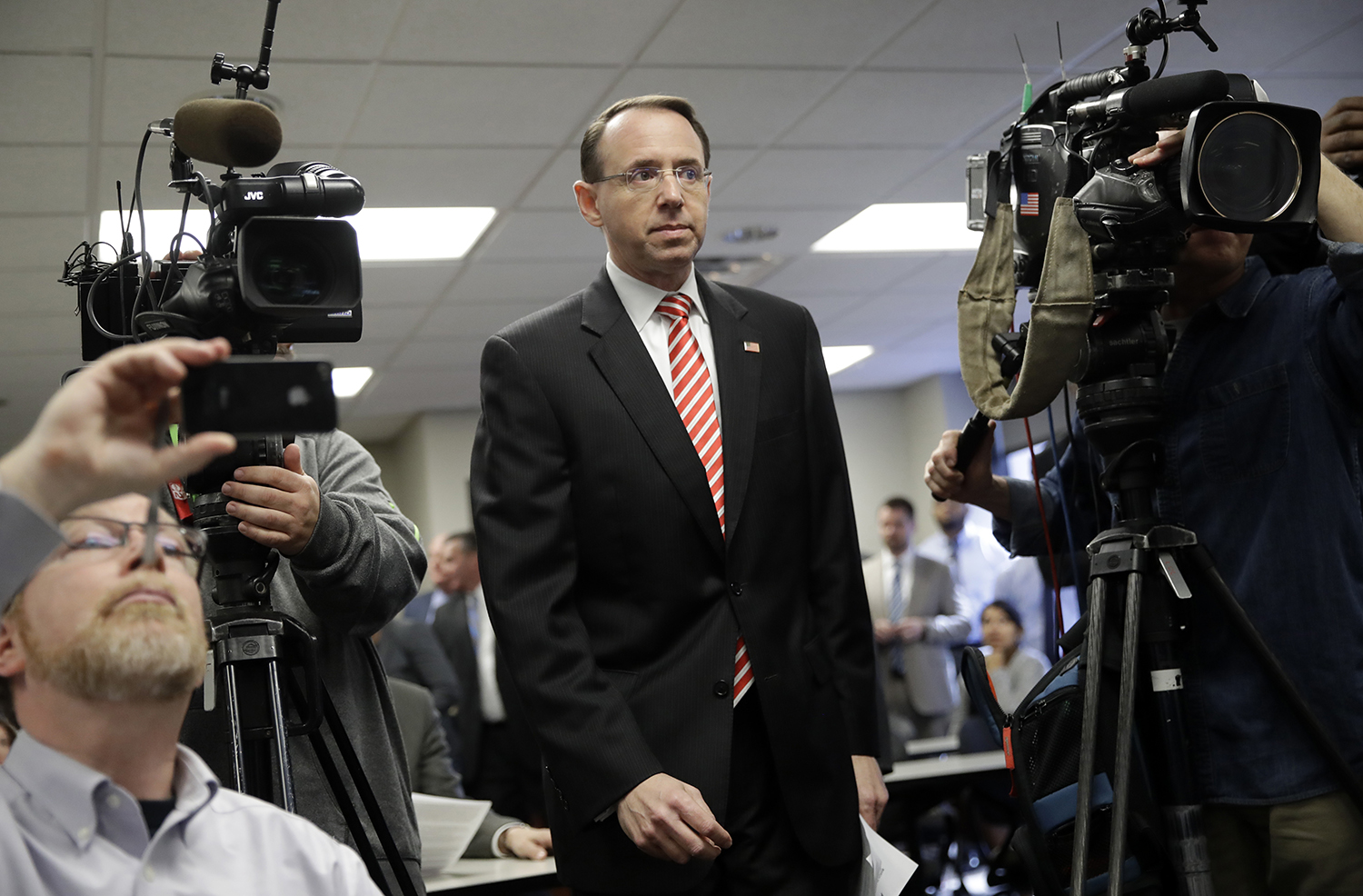
Rod J. Rosenstein is the current U.S. Attorney for the District of Maryland, and he was nominated by Trump to be deputy attorney general. Should he be confirmed, Rosenstein is expected to be in charge of the department’s investigation into Russia’s involvement in the election, unless a special prosecutor is appointed.
Rosenstein, who earned his law degree from Harvard Law School, has been part of the Justice Department for more than two decades. During the Clinton administration, Rosenstein was a counsel to Deputy Attorney General Philip Heymann. He also served as special assistant to Criminal Division Assistant Attorney General Jo Ann Harris.
He is one of three Bush-appointed U.S. attorneys out of 93 nationwide that were kept on by the Obama administration eight years ago.
Rosenstein was confirmed to be the U.S. attorney for Maryland by a voice vote in the Senate in 2005 after being nominated by former President George W. Bush. He was nominated by Bush again in 2007 to fill a vacant seat on the U.S. Court of Appeals for the 4th Circuit. However, Maryland’s two Democratic senators, Barbara Mikulski and Ben Cardin, argued he should stay in the state court, so he never got a hearing or vote in the Senate.
If Rosenstein decided against appointing a special prosecutor in the Russian investigation, it wouldn’t be the first time he dealt with a controversial political case. He served as both special assistant in the Justice Department and associate independent counsel under Kenn Starr, who oversaw the Whitewater investigation in the 1990s, an investigation into the business dealings of Bill and Hillary Clinton in Arkansas.
As a member of the U.S. Attorney General’s Advisory Committee of U.S. Attorneys, he currently focuses on intellectual property, sentencing, violent crime and white collar crime issues.
The second nominee, Rachel Brand, has been nominated to be the associate attorney general, the third-ranking official in the department.
Brand, also a Harvard Law School graduate, just finished serving on the Privacy and Civil Liberties Oversight Board, an independent, bipartisan agency within the White House that works to finds the balance between civil liberties and privacy during the fight against terrorism.
She’s been in the department before, having worked her way up to assistant attorney general for the Office of Legal Policy under former President George W. Bush.
As an assistant AG and member of the Office of Legal Policy, she had to be confirmed by the Senate, and she was approved easily by a voice vote.
Brand has also clerked for U.S. Supreme Court Justice Anthony Kennedy and Massachusetts Supreme Judicial Court Justice Charles Fried.
“Rachel Brand is well-known to Judiciary Committee members having been before us at least three times prior,” Senate Judiciary Chairman Chuck Grassley said in a statement following her nomination.
“In addition to being an Iowan, and a former intern of mine, she has a long list of impressive educational and professional accolades,” Grassley added. “She is well-suited to be the Associate Attorney General and I look forward to having her before the committee once again.”
The Office of the Associate Attorney General also oversees the following offices: the Antitrust Division, the Civil Division, the Environment and Natural Resources Division, the Tax Division, the Office of Justice Programs, the Community Oriented Policing Services, the Community Relations Service, the Office of Dispute Resolution, the Office of Violence Against Women, the Office of Information and Privacy, the Executive Office for United States Trustees and the Foreign Claims Settlement Commission.
Both Rosenstein and Brand declined to comment for this article.
