

The number of people deported by Immigration and Customs Enforcement continued to slowly increase under the Trump administration in the government’s 2019 fiscal year but remains much lower than average over the past decade.
ICE’s Enforcement and Removal Operations arm, which handles arrests and deportations of illegal immigrants, reported Wednesday it returned 267,258 people to their home countries between Oct. 1, 2018, and Sept. 30, known as fiscal 2019. Those deported were either arrested inside the United States by ICE or were transferred to ICE from Border Patrol custody after illegally crossing into the country. The number was up from 256,085 in 2018 and 226,119 in 2017, which included eight months in which President Trump was in office. Trump vowed as a candidate to go after people who violated federal immigration laws.
However, the tally under Trump has been significantly lower than annual rates over the past decade. In fiscal 2008, President George W. Bush’s final full year in office, 369,221 people were removed. That figure ticked up under President Barack Obama to 409,849 in 2012 then began dropping by tens of thousands each year to 235,413 in 2015.
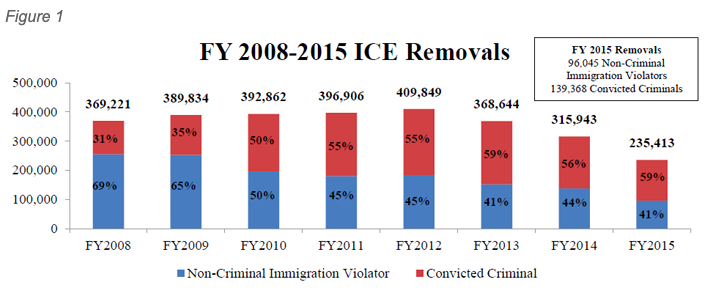
Over the past decade, ICE has increasingly focused on arresting and removing illegal immigrants who have criminal records. In 2009, two-thirds of people deported were noncriminal offenders, and one-third were convicted criminals. The Obama administration changed the standards, and over the past decade, 50%-70% of deportees were convicted criminals.
ICE, in 2019, deported 5,497 known or suspected gang members, roughly 2% of all removals. It also returned 58 people it identified as known or suspected terrorists, up from 42 last year. People from 140 countries were returned.
The greatest number of people deported went to Mexico — 127,492. Mexico was followed by Guatemala, which saw 54,919 deported, and Honduras with 41,800 returns.
Family arrivals were four times greater than a year earlier and the highest on record. Because families cannot be held by ICE for more than 20 days due to a court ruling, an undisclosed number were released into the United States. A small portion of family members — 5,702 people — were returned to their home countries.
ICE said it deported 6,351 unaccompanied children back home — almost double the 3,598 children it returned in 2017. More than 76,000 unaccompanied children showed up at the border and were taken into federal custody that year.
ICE uses its own airline to fly people home, as well as commercial flights.
