

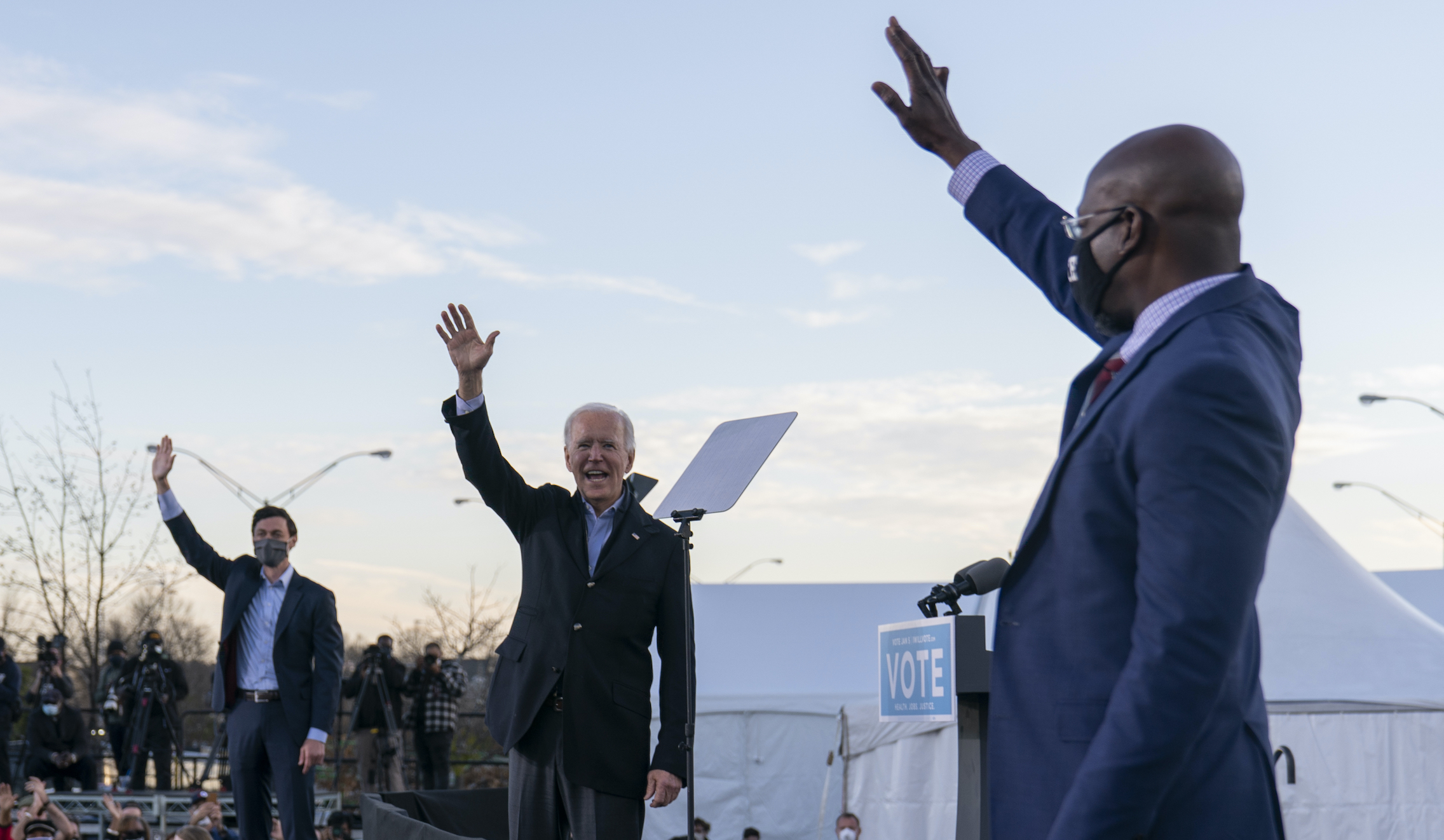
ATLANTA — Georgia Democrat Jon Ossoff on Wednesday defeated Republican David Perdue for a seat in the U.S. Senate.
The Associated Press declared both men had won their respective races one day after a record number of Georgians voted in the razor-thin runoff races.
Recommended Stories


Ossoff’s and Raphael Warnock’s wins will put Democrats in control of both chambers of Congress and in the White House for the first time in more than a decade. Both men finished more than 0.5% ahead of their opponents, outside the margin with which their opponent could request a taxpayer-funded recount.
The historic wins come on the same day protesters supporting President Trump stormed the U.S. Capitol, violently clashing with law enforcement officials in an attempt to halt the vote to certify Joe Biden’s presidential victory.
“The Republican messaging in Georgia was confusing and contradictory at best,” Scott Ainsworth, a political science professor at the University of Georgia, told the Washington Examiner on Wednesday. “Nearly every county moved toward Ossoff and away from Perdue. I think it was a fairly clear repudiation of the candidates and their electoral efforts.”
In Georgia, the wins were also seen as a second referendum on Trump, two months after he lost to Biden.
Trump wasn’t on the ballot, but he cast a long shadow on Tuesday’s topsy-turvy runoffs between incumbent Republicans Perdue and Kelly Loeffler and their Democratic challengers, Ossoff and Warnock.
Democrats defied history to flip not one but two Senate seats in Georgia, a state that hadn’t supported a Democratic presidential nominee before Biden since 1992 or elected a Democratic senator since 2000. Democrats now hold the balance of power in the Senate, making it easier for them to push a liberal agenda through Congress for the former vice president to sign into law.
Record early voting that Georgia Democrats were confident tilted in their favor, combined with election day turnout in liberal strongholds, such as Atlanta’s populous DeKalb and Fulton counties, that surpassed Nov. 3 participation, foreshadowed a good night for Democrats and rattled Republicans.
But it was the suppressed turnout in Georgia’s Republican-leaning, more rural counties that most clearly demonstrated the indictment of Trump after years of the GOP dominating the state’s runoffs.
The candidates’ closing pitches to Georgians, in particular, were overshadowed by disagreement over $2,000 coronavirus stimulus checks and a leaked telephone conversation between Trump and Republican election officials, including Secretary of State Brad Raffensperger. In the hourlong call, Trump pressured Raffensperger to help him “find” 11,780 votes that could buttress his efforts to overturn the 2020 Electoral College results.
The recording’s release Sunday capped Trump’s two-month attempt to rewrite the outcome in Georgia after a flurry of election audits, recounts, and lawsuits. And outrage over the Trump-Raffensperger call gave Democrats in the state another reason to vote, boosting Tuesday’s turnout and counteracting Democratic drop-off experienced in cycle’s past.
At the same time, Trump repeatedly told Republicans Georgia’s elections were “rigged” and the runoffs were “illegal and invalid.” The president opened a rally for Perdue and Loeffler in Dalton Monday, for instance, suggesting there was “no way we lost Georgia.” Listing his complaints, he added, “I don’t do rallies for other people. I do them for me.”
Trump’s preoccupation with his own legal disputes didn’t test Loeffler’s loyalty. Loeffler, plucked from obscurity by Republican Gov. Brian Kemp, announced Monday she would object to Georgia’s electoral votes during Wednesday’s congressional certification process. Perdue, whose term expired on Sunday, won’t be in Washington because he’s quarantining after being exposed to COVID-19.
Ossoff clinching a six-year term and Warnock winning the right to serve the remaining two years of retired Republican Sen. Johnny Isakson’s tenure means Democrats now control both the executive and legislative branches of government thanks to Vice President-elect Kamala Harris’s tiebreaking vote.
Ossoff, 33, will be the Senate’s youngest sitting member and Georgia’s first Jewish senator. Warnock, 51, will be Georgia’s first black politician elected to the Senate, representing a state with a tradition of elevating segregationists to public office.
Warnock outperformed Biden in almost all of Georgia’s 159 counties due, in part, to his ties with the black community, forged during the last 15 years as Ebenezer Baptist Church’s senior pastor. But he did just as well with the state’s college-educated white voters. His race against Loeffler, a wooden millionaire former businesswoman, was decided early Wednesday, when he had a more than 40,000-ballot lead on her, with 97% of precincts reporting. She is yet to concede.
Loeffler, 50, would have been Georgia’s first woman elected senator after she was appointed to the chamber by Kemp in January with the hope that she would appeal to the state’s suburban voters. Loeffler had to defeat popular Republican Rep. Doug Collins, another Trump ally, in her and Warnock’s 21-candidate, multiparty Nov. 3 general election to take on the preacher in the runoff.
Perdue, 71, notched a better showing than Loeffler, aided by his well-known Georgian last name and longer time in the political spotlight. Perdue’s profile, however, wasn’t enough to connect with voters in the state’s expanding suburbs. Perdue bested Ossoff, a filmmaker who unsuccessfully ran for the House in 2017, in their general election but didn’t meet the majority threshold required to avoid a runoff.
The four candidates raised and spent record amounts of money. The Democrats brought in $263 million to the Republicans’ $181 million, though Loeffler self-funded much of her campaign. The Democrats doled out more money than their Republican counterparts as well, $222 million to their opponent’s $144 million.
The Democrats’ investment in their get-out-the-vote strategy, paired with 2018 gubernatorial nominee Stacey Abrams’s organizing, has been credited with persuading Georgians who didn’t cast a ballot for the Nov. 3 races to go to the polls.
