

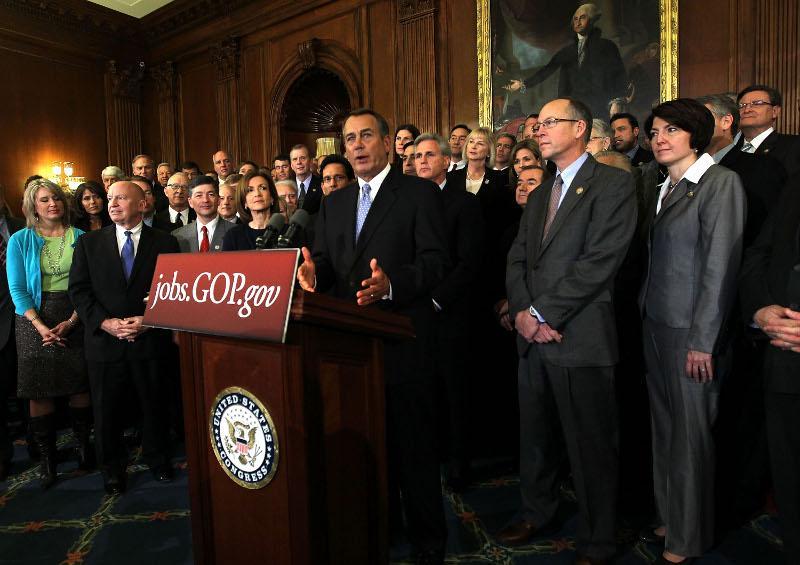
House Republicans on Tuesday rejected a short term, bipartisan Senate agreement to extend an expiring payroll tax cut and unemployment insurance, setting up their most politically risky showdown yet with Democrats and President Obama just days before Christmas.
The House voted 229-193 against the Senate plan, which would extend by two months a 2 percent reduction in payroll taxes for 160 million American workers as well as benefits for the unemployed. Both expire at the end of the month unless the Senate and House can agree on a new compromise.
It’s unclear whether a deal can even be worked out on the tax cut, which both parties say they want. The Senate left town Saturday for a month-long break and Democrats who control the chamber say they will not return to negotiate a new deal with House Republicans, leaving open the possibility that working Americans will begin paying 2 percent more in Social Security taxes on Jan. 1.
“Our negotiators are here, ready and able to work,” House Speaker John Boehner, R-Ohio, said.
Obama, in an unscheduled appearance at the White House after the vote, warned that a tax increase would devastate the economy.
“Our failure to do this could have effects not just on families, but on the economy as a whole,” Obama warned.
The Senate overwhelmingly passed a payroll tax cut extension 89-10 Saturday, after Democrats dropped a proposal to increase taxes on millionaires and accepted a Republican provision that would speed construction of the Keystone XL Pipeline project from Canada to Texas. In addition to extending federal jobless benefits, the Senate bill would also prevent a sharp reduction in Medicare reimbursements to doctors.
House conservatives dismissed as inadequate the short-term fix on which the Senate and White House agreed, risking that Obama and the Democrats could use the payroll tax cut that affects 160 million working Americans against the Republicans in 2012.
“Do you want to pass a bill for messaging purposes or do you want to pass a bill that works?” Rep. Jeb Hensarling, R-Texas, said.
Senate Democrats lambasted the House GOP for rejecting a proposal that was backed by most Senate Republicans.
“It is unconscionable that Speaker Boehner is blocking a bipartisan compromise that would protect middle-class families from the tax hike looming on Jan. 1,” Senate Majority Leader Harry Reid, D-Nev., said after the House vote. Reid said he would be willing to negotiate a long-term extension only if the House first passes the Senate version, “but not before then.”
House Republicans on Tuesday argued Congress should remain in session to craft a compromise bill, citing warnings from payroll processors that they would have difficulty implementing a short-term extension of the payroll tax cut.
“A two-month extension only gives uncertainty to this fragile economy,” Rep. Jack Kingston, R-Ga., said.
Both parties want to avoid public blame if no deal is reached by the deadline.
“Whoever can make the case more effectively will come out winning,” said Dan Holler, of the conservative Heritage Foundation.”I think you can see House Republicans are emboldened in their eagerness to show they can stand by their position. If they have that feeling and they are willing to commit to it through Christmas and up through New Years then I suspect they can actually win it.”
