

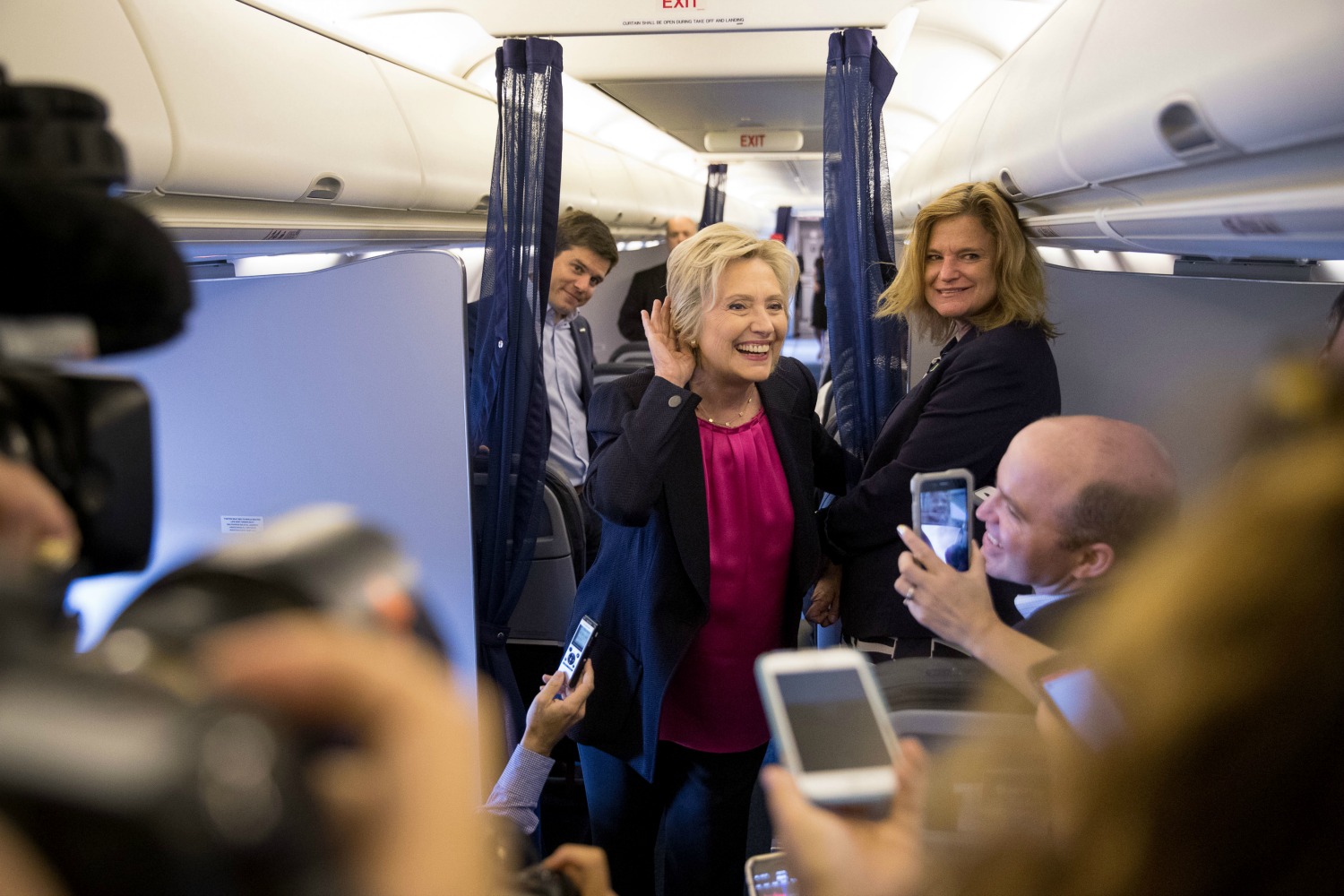
Hillary Clinton is appealing to Republican voters as part of a broader strategy to lock down the vote-rich suburbs that could swing the election.
The Clinton campaign is being selective in its outreach; her team has no illusions about pulling unusually high numbers of Republican voters.
Stay informed.Stay ahead.
Join Washington Examiner for unlimited access to the news, analysis, and commentary that matter most.
Already a member? Log in
But Donald Trump is historically weak with college-educated whites, a cohort that includes the sort of suburban swing voter that is inclined to pull the lever for Republican presidential candidates.
So in suburbs considered crucial to winning certain battleground states — for instance, those ringing Philadelphia in Pennsylvania and those outside of Washington, D.C., in Virginia — the Clinton campaign is targeting Republican voters with customized digital advertising and door-to-door contacts.
The aim isn’t necessarily to forge commonality from a policy standpoint. That might be a tall order. Rather, Clinton aims to exploit Republican voters’ insecurities about Trump and make it okay for them to vote Democrat this time around.
Her campaign is doing that by promoting not just high profile GOP endorsements, but those offered by otherwise unknown rank-and-file Republicans who describe in their own words how they decided to cast their first vote for a Democrat for president.
“This creates a permission structure to vote for Hillary Clinton — to break the habit from voting Republican,” said a Democratic insider, who requested anonymity in order to discuss the strategy. “It gets folks to say: ‘I’m breaking habit, you can too.'”
Most of the attention has focused on Clinton’s “Together for America” coalition, formed to feature the support she’s picked up from Republicans and independents. The title is a play on her campaign slogan, “Stronger Together.”
Endorsees include Meg Whitman, the Republican nominee for governor in California in 2010 and prominent backer of 2012 GOP presidential nominee Mitt Romney; Carlos Gutierrez, the former Commerce Secretary under President George W. Bush; and John Negroponte, a respected Republican advisor on national security.
But below the radar, the Clinton campaign is circulating testimonials from rank-and-file Republican voters. These stories, published as op-eds in local newspapers and first-person narratives on a Clinton campaign website, are then pushed out through her team’s digital platforms.
In August, the Clinton campaign tweeted out a “letter this Republican wrote his daughter” about the Democratic nominee.
“As a lifelong Republican, I have found that my party has moved into a direction that I cannot understand or digest with Donald Trump as our leader,” David Bershod, of New York City, said.
Clinton has tried to establish the predicate of disaffected Republicans like Bershod joining her campaign by agreeing with them that Trump represents a departure from traditional conservatism.
By not insulting rank-and-file Republicans by association, she is hoping to win converts, or subtly encourage them to sit on their hands. That was the point of a speech she delivered in late August attempting to tar Trump as associated with the racist elements of the far right fringe.
“Twenty years ago, when Bob Dole accepted the Republican nomination, he pointed to the exits and told any racists in the party to get out,” she said in that speech. “We need that kind of leadership again.”
Clinton’s Republican outreach strategy might be less viable than it was a few weeks ago.
The Democrat is under fire anew over her use of a private email server during her tenure as President Obama’s first secretary of state and how she interacted with her family’s charitable foundation, run by her husband, former President Bill Clinton, during that period.
Republican voters, disinclined to like Hillary Clinton to begin with, could react by deciding that their concerns about Trump’s competency and temperament don’t look as bad next to the Democratic nominee’s scandals.
The new CNN poll, which showed Trump narrowly edging Clinton nationally among likely voters, suggested as much.
“I don’t think it is possible for someone as liberal and crooked as Hillary Clinton to fake bipartisanship at the 11th hour of her political career. She has neither the centrist credentials nor the personal good will to pull it off,” GOP strategist Brad Todd told the Washington Examiner in a recent interview.
Yet the same CNN poll also showed that Trump remains vulnerable with college-educated whites.
Trump is on course to lose this bloc on Election Day, something no Republican presidential candidate has ever done dating back to 1952. College educated whites and suburban moderate Republicans aren’t necessarily one and the same, but do share key similarities.
The National Journal’s Ronald Brownstein, who has covered the this phenomenon extensively, said that the heart of Trump’s problem comes from the dangerously low support he is garnering from college educated white women that lean Republican.
Many in this subgroup hold white-collar jobs and live in the suburbs. These voters are particularly influential in the Denver suburbs; which probably explains why Whitman was deployed there by the Clinton campaign.
Conversely, Trump is strong with white voters without a college education.
“Even though Clinton is leading among college whites many of them don’t like her or trust her, it’s just that they loathe Trump and can’t imagine him as president. They are habitual voters,” Brownstein said. “If they vote in regular numbers, its really hard to imagine her losing if she wins them by 12-13 as CNN and NBC/Survey Monkey have.”
