
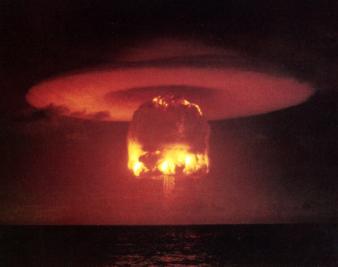
Many of my friends think Hiroshima was an unjustifiable atrocity. My usual course in atom-bomb disputes is to refer the belligerent to Donald Kagan’s brilliant 1995 piece in Commentary, “Why America Dropped the Bomb.” The reaction is consistent, and surprising: My friends do not challenge any of Kagan’s assertions as inaccurate, but they remain unswayed. The idea that atom-bombing a city could ever be necessary is too far outside their frame of reference. It is a concept from a different world, beyond believing.
During the war, my grandmother walked to school along Ocean Parkway in Brooklyn, and she saw gold stars in people’s windows. She was a young girl, but she knew what they meant—each marked a home to which a young man would never return. “You can talk about war theoretically,” she told me, “but seeing a gold star in the window . . .” she let the thought complete itself. I have never seen a gold star hanging in a window, and none of my friends even knew what one was. We are fantastically lucky: we have never had to worry about the draft. War, for most of us—even post-9/11—remains a distant and academic unreality. We owe it to those gold stars to understand how we got here.
Real journalism.Trusted by millions.
Unlimited access to in-depth reporting, expert analysis, and the stories that shape our country.
Already a member? Log in