

“The odds of making it past the front door? I’d say it’s 60-40,” says Rep. Mike Pompeo, R-Kansas. “To actually get to the Iranian Interest Section? Low single digits.” Pompeo is in the back of a black SUV cruising past the National Mall in Washington, on his way to the Pakistani Embassy. Since Iran doesn’t have diplomatic relations with the U.S., it maintains a small office in the Pakistani embassy to conduct any official international business that might be needed. Along for the ride are Rep. Lee Zeldin, R-N.Y., and Rep. Frank LoBiondo, R-New Jersey. Between the three men, they sit on three important congressional committees: Armed Services, Intelligence, and Foreign Affairs.
The three congressmen have a simple goal—they want to travel to Tehran to witness the country’s allegedly democratic elections on February 26, as well as investigate what’s happening there now that the U.S. and Iran have entered into a nuclear deal that is allegedly thawing relations. Of course, traveling to Iran as an American is not exactly easy. For one thing, the hardline Iranian government needs to approve your visa. And so each congressman is traveling to the Iranian Interest Section to present the detailed paperwork for their visa application.
Aside from the paperwork, they’re also sending a message. The congressmen are hand delivering a letter that makes their intentions perfectly clear to the Iranian government. You can read the full letter here, but it spells out five basic priorities.
First, they’re requesting to meet with Iranian leaders, including President Rouhani, Foreign Minister Mohammad Javad Zarif, and Mohsen Fakhrizadeh-Mahabadi, the head of the Iranian nuclear program. Second, they’re requesting to speak, in an unmonitored and lengthy meeting, with Americans who are still held hostage, including the businessman Siamak Namazi. They are also demanding information about the three Americans recently taken hostage by Iranian backed militias in Iraq. Third, they want to visit nuclear facilities at Parchin, Fordow, and Arak to independently gauge how Iranians are complying with the terms of the nuclear deal. Fourth, they want a briefing from the Iranian government on the country’s recent ballistic missile tests done in violation of U.N. Security Council resolutions. Lastly, they want another briefing to better understand the exact circumstances behind the capture of American sailors on January 12 and why Iran did several things to American servicemen in apparent violation of the Geneva conventions.
“We have been led to believe by the Iranian government and our president that there’s a new level of openness between the U.S. and Iran,” says LoBiondo. “Well, this is the opportunity for the Supreme Leader to report back to us.”
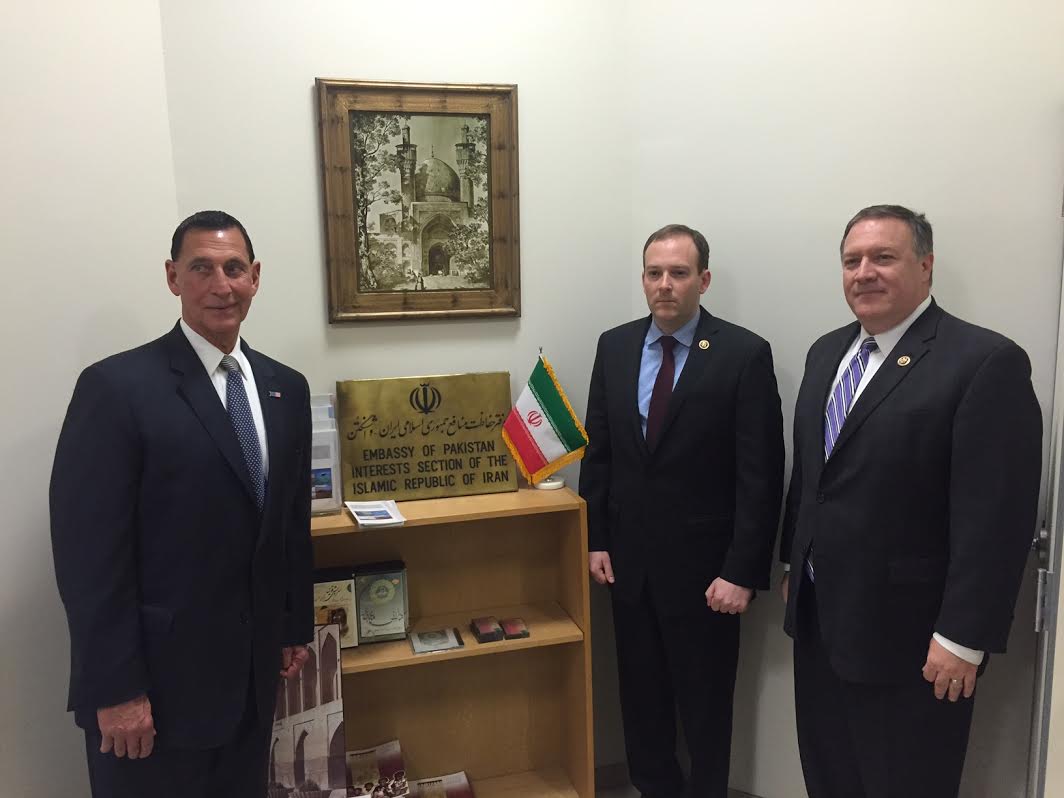
Waiting for a visa. (Credit: TWS)
Unlike the grand embassies of Washington, Pakistan’s embassy is a nondescript brick building downtown that looks like it could house any number of commercial enterprises. Inside, the Iranian Interest Section has a cramped lobby underneath a staircase that keeps the rest of the Interest Section out of sight. As expected, the lobby itself is sparsely decorated and sleepy—a single woman wearing a hijab waits on a plastic chair. Pompeo noted that, based on previous visits, there’s no guarantee that whoever is manning the desk will even speak English. Fortunately, the man today has passable language skills, though he seems alternately confused and alarmed by the sudden presence of three officious men and their entourage. Once he pieces together that this is about visa applications, the first question he asks is clichéd to the point of comical: “Do you have an authorization number?”
The three congressmen look at each other confused. A call is placed to upstairs. They are then informed that relevant parties are at lunch. (Which is almost plausible, since it’s 12:30 p.m.) Since they’re not leaving right away, the congressmen are encouraged to sit. They move a few steps aside and continue standing, making small talk, well aware they’re being observed. “If all goes well, we can all come back and inform the American people it’s all been a big misunderstanding,” says LoBiondo, while Pompeo and Zeldin nod.
Not long after they were informed everyone is out to lunch, a man descends the stairs. According to his business card, it’s Abolfazl Mehrabadi, Ph.D., Deputy Director of the Interests Section of the Islamic Republic of Iran. He’s clearly wary about what’s happening, but friendly nonetheless. He tells the congressmen that he’s hopeful they’ll receive some preliminary word about their visa applications by Monday.
At no point did the congressmen personally introduce themselves in any official capacity, but someone must have looked closely at the paperwork. “I think they figured it out,” Pompeo says dryly, on his way out of the building.
Across the street from the Pakistani embassy, the three congressmen debrief. Zeldin reiterates that he’s genuinely “hopeful that the visa applications will be approved.” He says he’s especially interested in witnessing the upcoming election. “Millions of Iranians are hoping for a freer and more stable Iran,” he says. That is certainly true, but Zeldin is well aware there aren’t many reasons to be optimistic about the Iranian election. Human Rights Watch recently noted, “The Iranian authorities have disqualified the majority of reform candidates based on discriminatory and arbitrary criteria.”
Similarly, Pompeo expresses his sincere desire to see the Iranians begin cooperating with the U.S. and keeping them better informed about the status of American hostages. Again though, he’s not yet holding out hope that Tehran will start acting reasonable. This week, it was reported that Iranian authorities arrested a former BBC journalist on the eve of a visit to London by Iranian foreign minister Zarif. Not coincidentally, the American sailors were arrested earlier this month right around the time the U.S. was to begin unfreezing $100 billion in seized Iranian assets. The Iranians aren’t shy about using hostages as leverage, and they’re unlikely to stop using these tactics anytime soon.
Still, the Iranians were polite, if awkward, and things could have gone much worse. The three congressmen pile back into their dark SUV and head back toward the Capitol. Later that afternoon, they’ll issue a firmly worded statement about their expectations of Iran. Still, the Iranians have been given a chance to act in good faith.
Now they wait to see if their visas are approved. Stay tuned.
