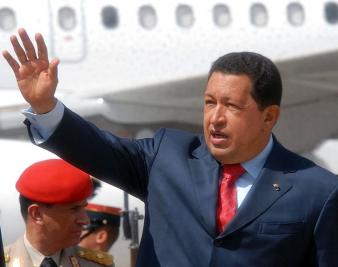
According to a leading Spanish newspaper, Hugo Chávez’s doctors have told his family that the cancer-stricken autocrat will not recover from his illness and will not be able to resume the Venezuelan presidency. Perhaps that’s why his return to Venezuela was a relatively subdued affair. Chávez reportedly arrived from Cuba—where he has now received four surgeries—in the pre-dawn hours on Monday, February 18. “There were no television images or photographs of him descending from the presidential plane in a track suit and greeting officials on the tarmac, as there were in the past,” observed New York Times correspondent William Neuman, “raising questions about whether the government was seeking to keep a severely weakened president out of public view.” For that matter, Bolivian president (and Chávez acolyte) Evo Morales was not able to meet with Chávez during his February 19 visit to Caracas.
Chávez came home to a nation in crisis—a crisis largely of his own making. To be more precise: There is no single crisis in Venezuela; there are multiple, interrelated crises that have transformed an oil-rich society into a dysfunctional, violent, inflation-plagued country with major food shortages and one of the highest murder rates in the entire world. Venezuela is a place where athletes are in danger of catching a stray bullet during their games. (Seriously: That actually happened to a Hong Kong baseball player in August 2010.) As Nick Allen of the Daily Telegraph recently pointed out, Venezuela now has more homicides than the United States and the European Union combined, even though its population is about 28 times smaller. Between 2011 and 2012, its already sky-high murder rate rose by another 9 percent, and its annual number of murders rose by 12 percent, according to the independent Venezuelan Observatory of Violence. Its capital city of Caracas has been “the deadliest capital in the world” since 2010.