

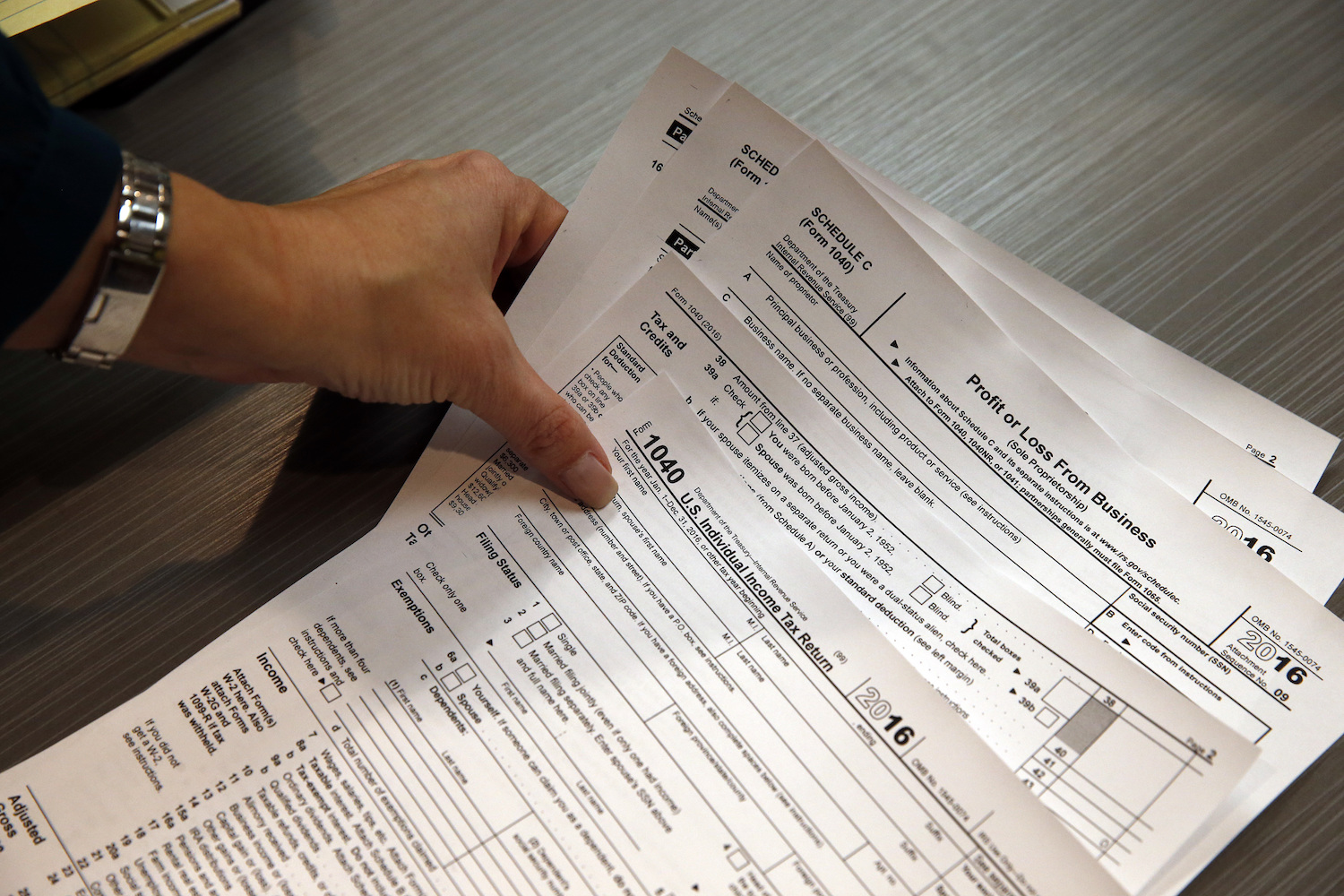
Congressional Republicans want a revolutionary system for calculating businesses’ taxable income, but getting from here to there will be a major challenge.
Recommended Stories


Transitioning from the current tax base to the one favored by congressional Republicans would require a transition with little or no precedent, creating a headache for companies across the U.S. The challenges of writing such transition rules are just one of the many obstacles to tax reform, one of President Trump’s stated top priorities.
“That’s the thing that all of us are a little leery about — the code is always changing,” said Jason Duff, a business owner in Bellefontaine, Ohio.
Duff, the CEO of Bellefontaine Ohio Properties Limited, recruits and starts small businesses in the small city about an hour northwest of Columbus. Like many business owners around the country, who generally are absorbed in running their business, he is just now beginning to think through the implications of the Republican tax plan for his company.
Some of the House GOP proposal is straightforward, such as the reduction in the corporate tax rate to 20 percent, universally favored by businesses.
But other aspects are tricky. One relatively new concept is the border-adjustment feature, which would tax sales within the U.S. and exempt sales elsewhere. That provision has proved controversial as oil refiners, retailers and other industries that rely on imports realize it could mean higher costs for them.
Another issue is the move to tax businesses on a cash-flow basis, meaning that taxable income would be simply cash received minus expenses paid out.
That would be a major switch away from the accrual basis that most companies use now, in which they try to match up revenues and expenses that occur at different times. For example, if a pizza place adds a new oven, it does not get to immediately subtract the full cost of that expensive oven from its taxable revenue. Instead, as it begins cooking more pizzas and generating more revenue for the restaurant, the business must write off its cost in increments over the years, according to a complex schedule.
Basing taxable income on cash flow would be a major simplification, eliminating a lot of big businesses’ ability to game the tax code and easing the tax collection process for overburdened small businesses.
Under the current code, “it can get really confusing if you’re a small business,” said Duff, adding later that the law has “created an industry of consultants that many small businesses have to use just to navigate the process.”
The goal — simplification — is a noble one. And a cash-flow system is thought to promote growth because it lowers taxation on investment, making it more rewarding for businesses to expand.
But making the change is tricky.
In the GOP vision, businesses would be allowed to immediately write off all new investments but would have less ability to deduct interest payments from taxable income. Those two changes constitute the cash-flow system.
However, they create a major problem for businesses that just invested in big capital assets or took out big loans, which would face double taxation. That pizza place, for instance, would face the prospect of losing future years of write-offs on the oven, while also being fully taxed on all pizza sales.
Any executives considering a major capital expenditure or debt issue might consider holding off on doing so to avoid a tax hit if they believe the GOP tax plan is going to become a reality, said Barbara Weltman, a tax attorney and author of J.K. Lasser’s Small Business Taxes 2017. The transition effects will “influence decision-making,” she said, even as she counseled against making taxes the overriding consideration.
To protect businesses from being hurt by the transition, lawmakers will have to come up with transition rules. Tax economists, who generally love the idea of the cash-flow tax, have been thinking through how to write those rules for over a decade.
There are ways to do it, on paper. But it hasn’t been done before at the scale it would be in the U.S.
“I can’t think of any other major nation that has done such a radical corporate tax reform as this,” said Chris Edwards, a tax expert at the Cato Institute whose ideas helped shape the GOP plan.
Only Estonia and Macedonia have implemented cash-flow taxes, according to a 2015 European Commission review of the idea. Mexico tried to introduce one alongside its business income tax, but gave up on it after a few years.
There are two main possibilities for pulling off the transition: One would be to hand out deductions to companies that have existing un-depreciated assets — essentially, giving refunds to utilities that recently built out huge networks, oil companies that recently commissioned new rigs, and so on, and to real estate firms that just issued bonds to construct new skyscrapers. Another would be to allow the two systems to run in parallel or to hand out deductions offsetting the tax hit over time.
Congress always has to write transition rules for major tax changes. It did in 1986 and has the ability to do so again. “I don’t think that’s important,” Edwards said. “The transition issue is something that lawyers and accountants are all over.”
“That’s where a lot of the negotiations will be, where the special interests come in,” said one tax lobbyist. The expectation is that congressional committees’ efforts to write transition rules, which would come after all the major provisions — the tax rates, the loophole closures and everything else — have been hammered out.
So, business executives won’t know the rules of the road until that last minute.
But if the outcome is lower rates and simpler filing, that’s a “type of uncertainty business wants,” said Ray Keating, the chief economist for the Small Business and Entrepreneurship Council, an advocacy group for small businesses.
Many business owners are on the same page. Todd Kriegel, the CEO of Global Precision Parts, an Ohio and Indiana parts manufacturer, said that he’s not looked into the effects of the cash-flow tax on his business. Yet he has pressed his congressman to support tax reform and lower rates. “We’re just very optimistic that the outcome is going to be positive,” he said.
