

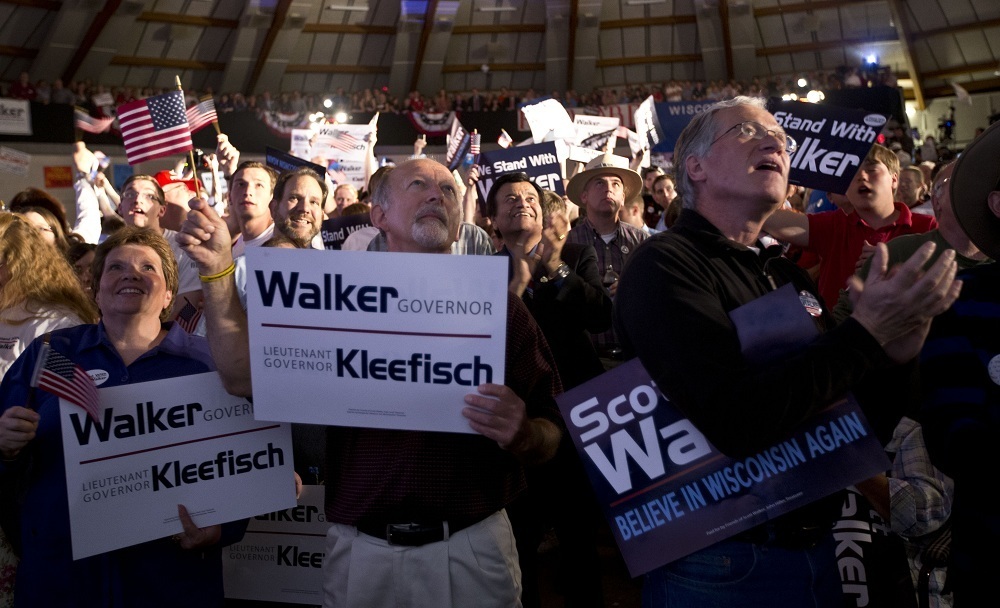
Republican Gov. Scott Walker’s victory in Wisconsin on Tuesday was bad news for President Obama, both in that Midwest state, which appears to have swung from solidly Democratic to an election battleground, and for what it says about GOP voter intensity heading into November, analysts said.
And the vote could prove damaging for public-sector unions, with Republican, and even some Democratic, governors deciding that voters are willing to see pensions and other union benefits cut to help balance budgets, said political observers.
Walker, who inspired equal doses of admiration and indignation after limiting collective bargaining rights for public workers, survived a challenge from Democratic Milwaukee Mayor Tom Barrett.
Mitt Romney, the likely GOP presidential nominee, framed the outcome as a mandate for his party’s policies. “Tonight’s results will echo beyond the borders of Wisconsin,” he said. “Governor Walker has shown that citizens and taxpayers can fight back — and prevail — against the runaway government costs imposed by labor bosses.”
The White House dismissed the results well before the polls closed, and downplayed the notion that Republican furor in the battleground state foreshadowed similar problems for Obama in the fall.
“A race where one side is outspending the other by a ratio of at least 8-to-1 probably won’t tell us much about a future race,” said White House press secretary Jay Carney. “I know the president is aware of the election. I think he’s got some other responsibilities.”
Obama stayed away from the Wisconsin recall, opting not to campaign for Barrett, even though some progressives pined for a presidential visit they believed would propel the Milwaukee mayor to victory. Instead, the president sent out a tweet in support of Barrett the night before the election and an email urging supporters to vote on Tuesday.
Some analysts said the damage to both Obama and the Democratic Party was clear heading into November.
“Wisconsin now looks a lot more like 2000 than 2008,” said Arnold Shober, a government professor at Lawrence University in Appleton, Wis., pointing to an election in which Democrat Al Gore narrowly bested then-Texas Gov. George W. Bush in the state. “That has got to make Obama very nervous.”
Some political observers said the recall effort allowed conservatives to lay the foundation for a similar push in November when Obama and Romney face off in the Badger State.
The repercussions of Tuesday’s recall election, seen by both parties as the year’s most crucial contest before voters head to the polls in November, extend well beyond the presidential race.
If Wisconsin is any indication, Republican and even some Democratic governors could easily surmise that public employees unions lack the political clout they once enjoyed, allowing statehouses to focus on cost-saving measures detested by labor leaders, analysts said.
“It’s an indictment of labor unions as a political force in American politics,” said Shober. “To be blunt, the power of the labor movement in elections is diminished because Walker was made out to be such an evil icon and voters didn’t see it that way. It really has to create questions for Democrats and Obama on how much they want to focus on a shrinking part of the electorate.”
