

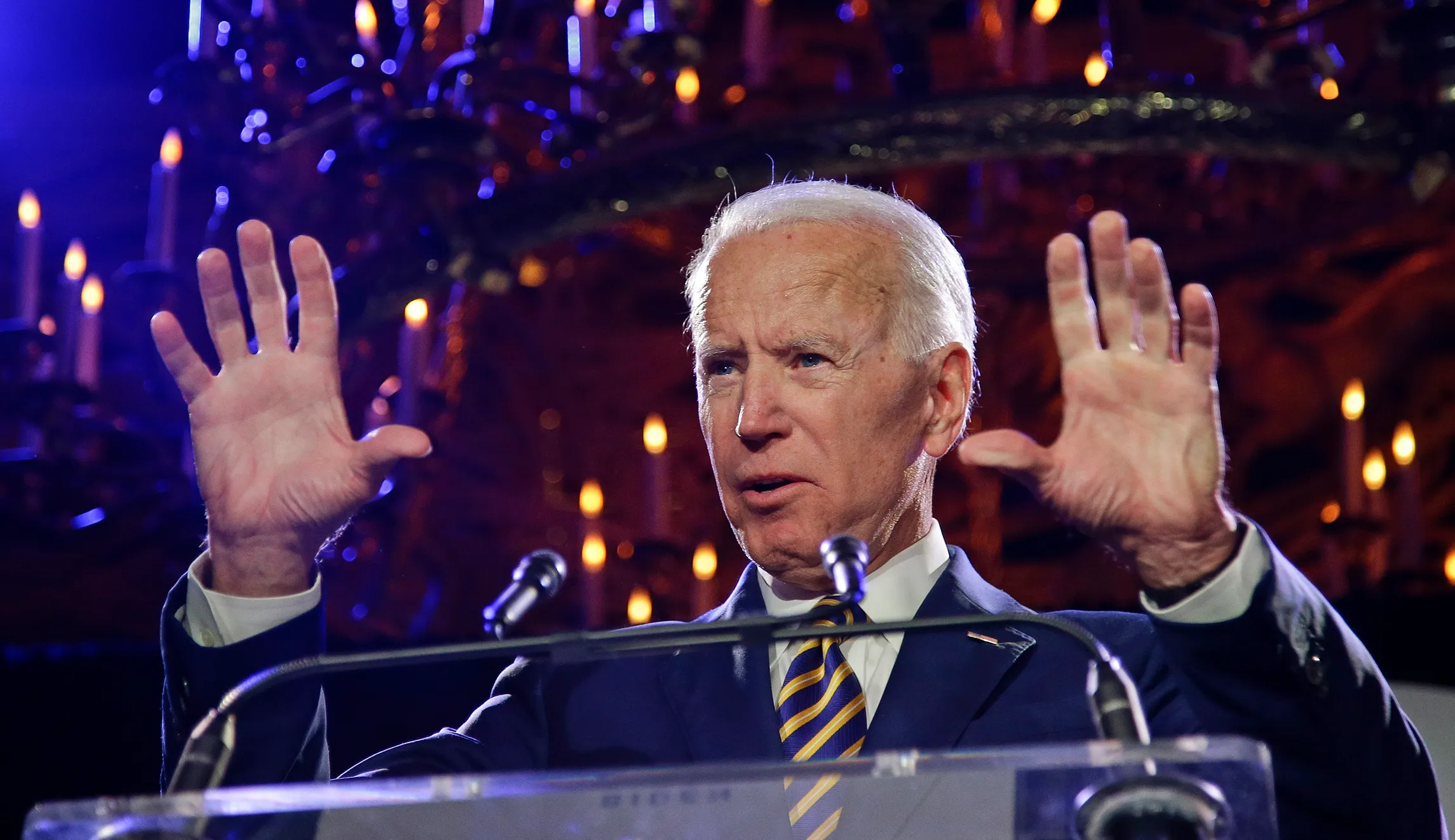
Joe Biden has a political imperative as he embarks on his 2020 presidential bid — to be more like Ronald Reagan circa 1980 and less like Jeb Bush in 2016.
Biden this week became the 20th major Democratic candidate to announce he’s contesting the right to challenge President Trump to the White House next year, a clear favorite in early polls thanks to the national profile he’s built over three decades in the Senate and eight years as President Barack Obama’s No. 2.
Recommended Stories


But both former President Ronald Reagan and ex-Florida Gov. Jeb Bush were front-runners in their crowded primary fields before their races for the Republican Party’s nomination ended up going in opposite directions when votes were counted. Reagan, the former California governor, beat nine Republican opponents, including then-former CIA Director George H.W. Bush and ex-Sen. Bob Dole of Kansas, a lion of the Senate. Jeb Bush, unlike his father and brother, former President George W. Bush, stumbled and became one of 16 Republican rivals vanquished by reality TV star and real estate mogul Donald Trump’s bombastic campaign style.
University of Pennsylvania professor Brian Rosenwald said it was obviously ideal to be the leading candidate, but top contenders aren’t immune to controversy. He cited Reagan’s loss in Iowa in 1980 ahead of his win in New Hampshire as an example of how candidates sometimes “get punched in the mouth” before “they have rebounded.”
“Another element of that is that campaigns have gotten longer and longer. The campaigns now are almost going to be two years. That’s a very long time for someone to dominate,” said Rosenwald. “In most cases the front-runners survive, but it’s not preordained or easy. Even in some of those eventual presidents, you’ve got front-runners where they certainly go through some period of turmoil, or they certainly go through some period of question of whether they are going to win the nomination.”
Rosenwald confessed though that his argument wasn’t infallible, using former Vice President Walter Mondale’s disappointing turn in 1984 as an instance of a favorite faltering. Mondale’s situation was unique, though. In the 1984 Democratic primary season, Colorado Sen. Gary Hart won six of the first ten primaries and 17 primaries overall. So, even as the former vice president, Mondale had a really tough fight that portended Reagan’s landslide in the general election, said Rosenwald, author of Talk Radio’s America: How an Industry Took Over a Political Party That Took Over the United States, set for publication on Aug. 13.
He added his theory may also be undermined by shifts in modern politics where traditional power structures such as unions and interest groups hold less sway.
“As politics becomes more decentralized and changes in the media environment, and social media, and the internet have democraticized politics, it may be that we look back in 20 or 30 years and say being a front-runner stops being worth what it once was somewhere in the 2000s,” he said. “Being a front-runner means you have access to more resources, it means you have better infrastructure, it means you’re probably getting the first shot at better tier staffers who want to work for the front-runner, but it’s a long, exposed process. It’s a marathon, it’s early, and a lot of times it’s name recognition and not political skill necessarily.”
Mason Williams, an assistant professor at Williams College, however, warned Biden may be hamstrung by another historical hurdle: He was vice president.
“Vice presidents who haven’t inherited the presidency upon the death of a predecessor have a dismal track record,” Williams told the Washington Examiner. “Since the turn of the 20th century, only George H.W. Bush in 1988 has been elected president in his own right. Theodore Roosevelt, Calvin Coolidge, Harry Truman, and Lyndon Johnson were elected after serving out their deceased predecessors’ terms. Five vice presidents — Henry Wallace, Richard Nixon, Hubert Humphrey, Walter Mondale, and Al Gore — have lost.”
Nevertheless, this trend could dissipate as the role becomes more influential and less ceremonial or if large swaths of the country demand change, experts say.
According to RealClearPolitics, Biden on average attracts 29% support in early polls. His closest competitor is Sen. Bernie Sanders of Vermont, who pulls an average 23% of the vote. Sen. Kamala Harris of California, South Bend, Ind., Mayor Pete Buttigieg, Sen. Elizabeth Warren of Massachusetts, and former Texas Rep. Beto O’Rourke round out the list of top-tier hopefuls, with more than 5% of the electorate a piece less than a year before Iowa’s caucuses.
