

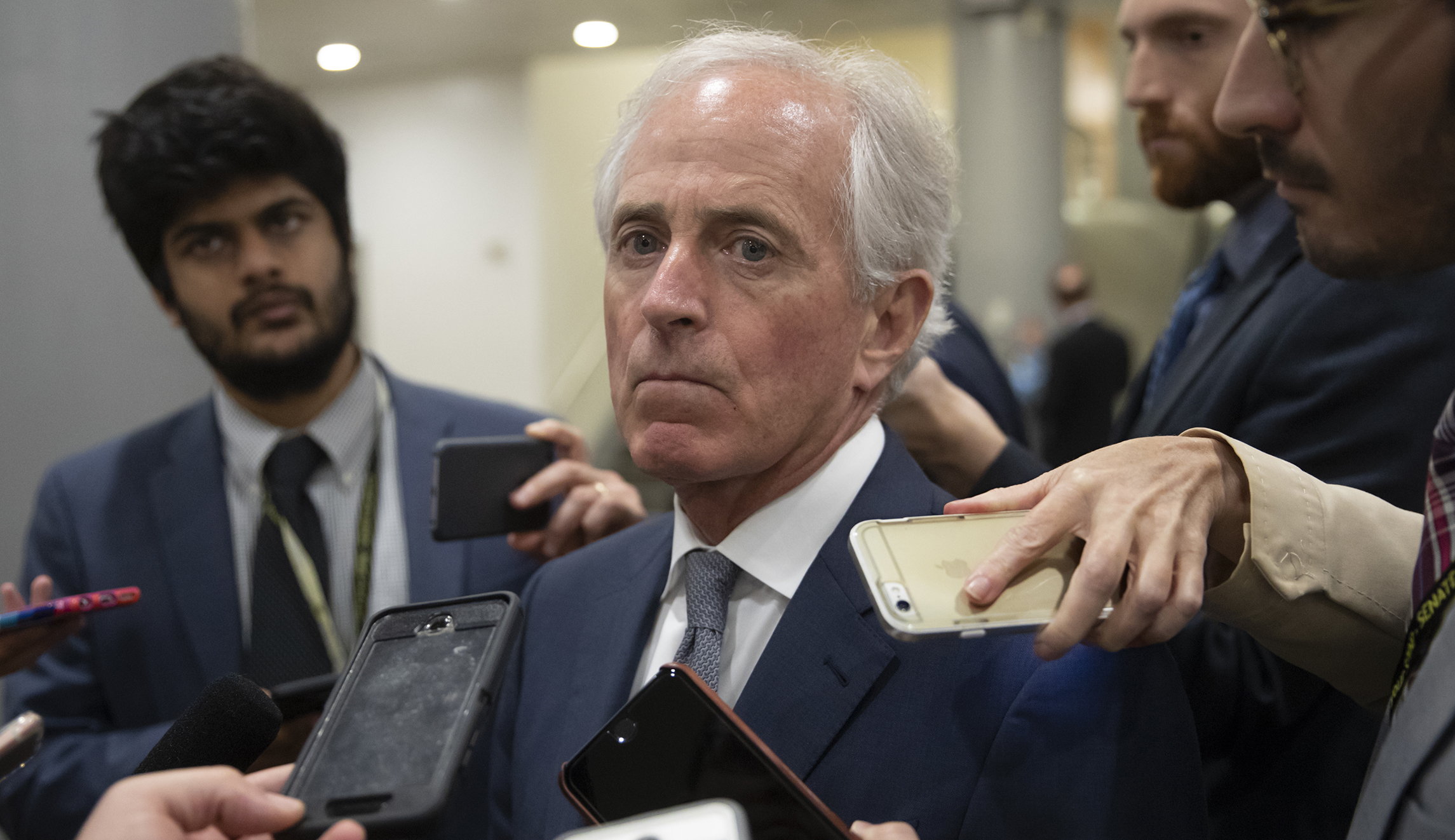
President Trump has “absolutely no plan” for winning a trade war with China, according to a top Republican critic of the administration’s tariff policy.
“There is no strategy; none whatsoever,” Senate Foreign Relations Chairman Bob Corker said Thursday during a committee hearing. “There absolutely is no plan, and in the mornings, people wake up and make this up as they go along.”
Recommended Stories


The Tennessee Republican offered that assessment during an exchange with a senior State Department official responsible for economic diplomacy. The diplomat argued that the aluminum and steel tariffs address a legitimate national security interest and suggested that tariffs on Chinese products could jolt the regime into good-faith economic negotiations.
“President Trump has determined that tariffs are the most effective means to achieve this goal,” Manisha Singh, assistant secretary of state for economic affairs, told the committee. “For the last several decades, we have been having many conversations with the Chinese — you’ll recall our economic dialogues in which we tried to make progress — and this problem has not been solved. So President Trump has determined that tariffs are the right tool to be used in this situation to get the Chinese to change their behavior.”
But the lawmakers wanted a more specific plan of action than Singh could provide. “I don’t think that you’re really in the mix here, on this issue, and you were sent here as cannon fodder,” New Jersey Sen. Bob Menendez, the top Democrat on the panel, said.
Corker concurred that the administration had deployed a witness who doesn’t play a lead role in setting the tariff policies.
“I’m really saddened that you are the person that’s up here today,” he said. “I think we all like working with you. And I know that you do a good job in the areas that you really spend most of your time … you are going to be cannon fodder this morning and I don’t think that you’re really prepared to defend the policies in an appropriate manner.”
The senators pressed Singh repeatedly about whether Trump has the legal authority and policy justification to use a national security provision of trade law to impose aluminum and steel tariffs that hit allies such as Canada and the European Union.
“Canada is not a national security threat,” Singh allowed. “However, the global steel and aluminum overcapacity that currently exists in the marketplace is affecting the ability of our domestic companies to adequately produce aluminum and steel. The viability of these industries does constitute a national security issue for us.”
Multiple senators suggested that the imposition of tariffs on allies might undermine Western unity in a trade war with China, but Singh maintained that the dispute wouldn’t trump broader agreement about China’s wrongdoing. “Our allies and partners share our frustration about China’s economic coercion,” she said. “They are as concerned about China as we are.”
But the question of how Trump intends to break the cycle of the U.S. and China imposing retaliatory tariffs was a repeated stumbling block.
“There are people around this nation that are hurting, farmers are losing money as they harvest right now,” Corker said. “And many of them, unfortunately, have faith that there is a plan, that there is a strategy. Now I know senators have been up there to meet with [Trump] a zillion times. I’ve not heard a single senator come back with any earthly idea, any earthly idea, cannot articulate a sentence as to why they’re doing this.”
Singh tried to elaborate, referencing improved trade deals and a reform of the World Trade Organization, among other broad goals. “So the president has very carefully laid out an economic strategy,” she said. “It is contained within the National Security Strategy, which is our blueprint for how this administration is operating.”
That wasn’t specific enough for Corker. “That enlightened us in no way,” the Tennessee Republican replied.
