

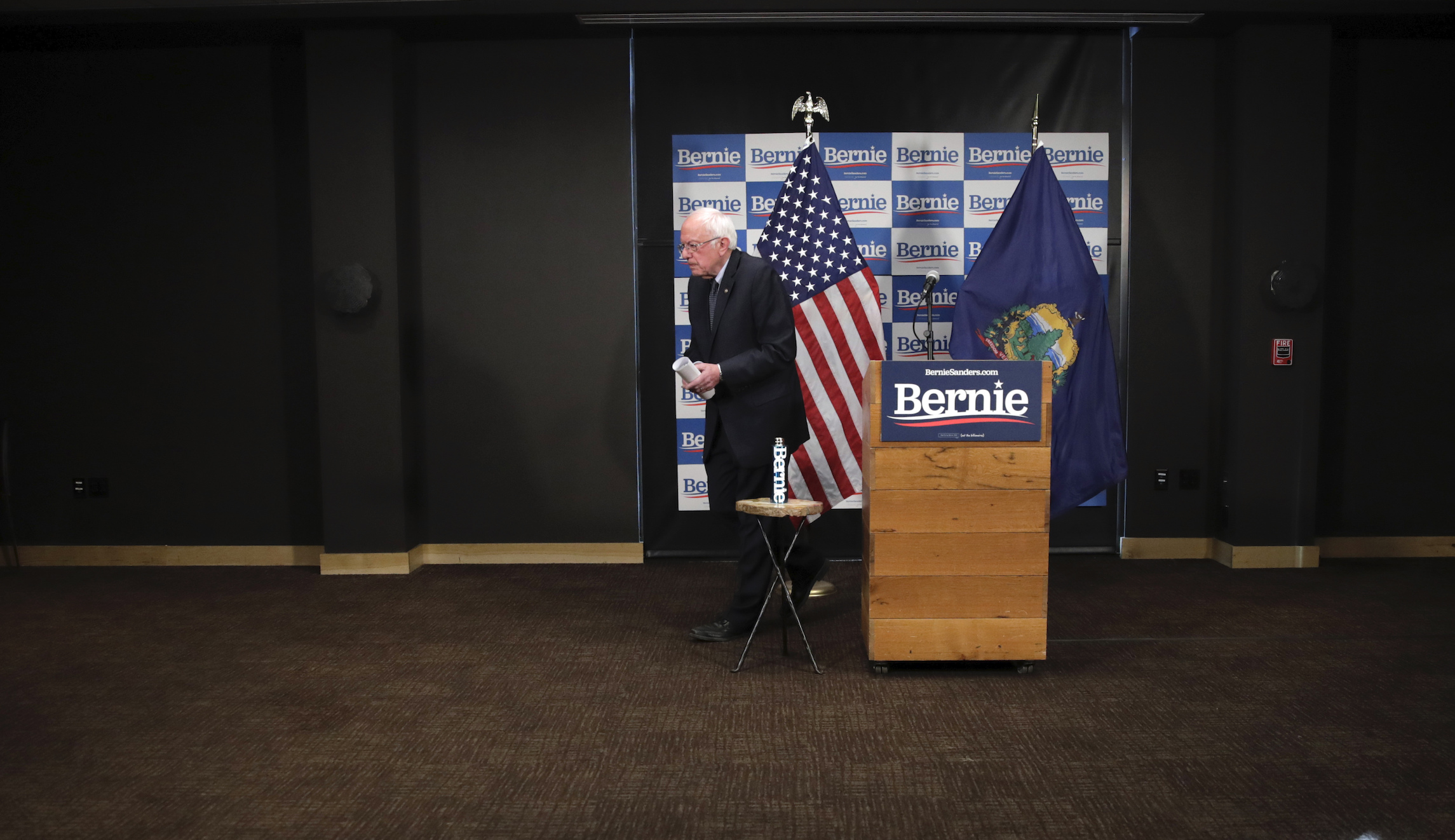
The Bernie Sanders campaign isn’t dead yet, but coronavirus disruptions are infecting it with life-threatening complications.
Much of the Vermont senator’s success has been credited with his large rallies and intimate meetings with voters. The global pandemic reshaping the world economy and basic social interactions has forced Sanders’s campaign to operate through less-effective phones and screens.
Recommended Stories



“In light of concerns about coronavirus and out of an abundance of caution for our staff, volunteers and supporters, the Sanders campaign has asked all staff to work from home and will no longer hold large events or door-to-door canvasses, instead moving to digital formats and outreach wherever possible,” said Sanders campaign communications manager Mike Casca on Thursday.
The announcement came after Sanders and former Vice President Joe Biden each canceled campaign rallies in Ohio hours before their scheduled start times on Tuesday following the state of emergency declared by the governor. One of his directives was discouraging large gatherings.
“Bernie is the better rally speaker,” said Democratic strategist Steve Rabinowitz, a Biden supporter and former Clinton White House aide who designed and produced the president’s public events. “It is a disadvantage for him. If he could keep doing these big rallies, they work better for him.”
Those changes largely undermine one of Sanders’s principal electoral arguments: that only his campaign generates the necessary enthusiasm to drive voter turnout in November. Studies also find that door-to-door canvassing, another key strength of Sanders’s campaign operation, is the most effective and efficient way to turn out voters for a candidate.
Wall-to-wall news coverage of the coronavirus pandemic already makes it more difficult for a candidate to get his message out.
As the coronavirus complicates operations, the biggest problem is that the Sanders campaign has an underlying condition: He keeps losing primaries.
Sanders, who often has to explain why his controversial “Medicare for all” proposal that outlaws private insurance in favor of a single-payer system is superior to Biden’s, is already at a disadvantage of winning new voters over because of poor performance in recent primaries.
Biden has a lead of about 156 pledged delegates over Sanders and needs 1,110 more in order to secure the Democratic presidential nomination. The next major primary states — Arizona, Florida, Illinois, Ohio, and Georgia — favor Biden, and Sanders has little chance of closing that gap.
A New York Times analysis found that Sanders would have to perform 21 percentage points better to take a delegate lead over Biden and 12 percentage points better to keep Biden from earning a majority of pledged delegates, forcing a contested convention.
“With all due respect to Sen. Sanders, his problem is he’s losing, not that he’s losing to coronavirus,” Rabinowitz said.
But some say Sanders still has a chance, no matter how small.
“He has a very effective other means of communicating, and so do his leading surrogates and his supporters,” said independent pollster John Zogby. “He has the capacity to use social media to a large degree.”
Rabinowitz noted that Sanders could keep supporters engaged by livestreaming small events.
“If I was trying to help, I would say go fly to the coming primary states and visit with just a handful of people who are comfortable seeing you in an old-fashioned parlor meeting,” Rabinowitz said, “and stream the meeting.”
The Vermont senator, though, is returning to the Senate next week rather than spending his days campaigning — unlike Biden, who replaced in-person campaign events with “virtual” town halls in Illinois and Florida.
Sanders is widely thought to be waging a campaign about the future of the Democratic Party rather than trying to win the nomination. Any setbacks are unlikely to push him to the point of dropping out.
“He’s in it for the long haul. The debate over the heart and soul of the party,” Zogby said. “It makes sense for him to go to Milwaukee with as many delegates as he can.”
Zogby mentioned the 1980 Democratic presidential primary when Sen. Edward M. Kennedy of Massachusetts challenged President Jimmy Carter from the left. While Kennedy did not defeat Carter, after early defeats, he got a surge in momentum and won some later states in the primary.
And national focus on health measures gives Sanders an opportunity to rally support for his own agenda.
“He may get a boost on ‘Medicare for all,’” Zogby said, referring to the Vermont senator’s single-payer healthcare plan that would eliminate private insurance. Voters may believe that “drastic times call for drastic measures.”
Some of his die-hard supporters are remaining positive, saying Sanders’s existing campaign infrastructure allows his staff to work remotely.
“Cancelling upcoming campaign rallies doesn’t mean that communication with supporters, get out the vote efforts, or Sanders campaign fund-raising will necessarily be hampered. Sanders has been very adept, in the past, at holding ‘town hall’ meetings, via telephone conference calls, with large numbers of activists at the same time,” said Steve Early, who co-founded the group “Labor for Bernie.” “In 2016, and before recent primaries, campaign volunteers and staff have maintained contact with thousands of likely voters via texting and phone calling.”
