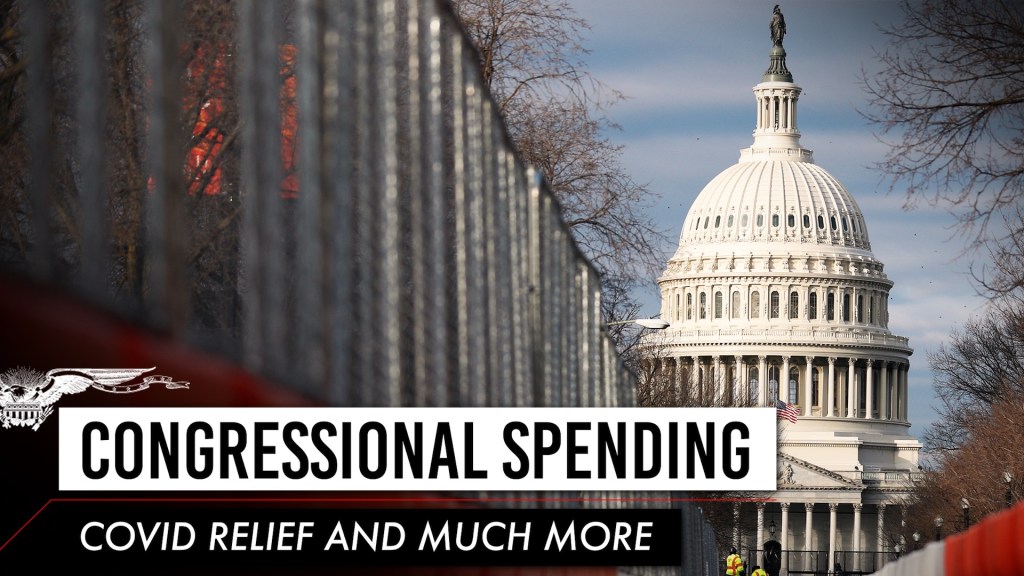
Congressional spending: COVID relief and much more

Published February 23, 2021 7:29pm ET


As the president marked the somber milestone of 500,000 U.S. COVID-19 deaths, congressional Democrats forged ahead with his 1.9 trillion dollar coronavirus relief bill, despite unanimous Republican opposition.

“The suggestion that Congress do nothing and let relief run completely dry before taking additional unnecessary action is just reckless, because we know what happens when you wait and see — when you do nothing. That is what republicans did for most of last year. It sat on their hands instead of making investments needed to ensure a successful vaccine rollout,” said Rep. John Yarmouth, chairman of the House Budget Committee.

Republican objections center around the sheer size and scope of the bill at a time when money remains unspent from previous relief bills.

Republican Missouri Rep. Jason Smith said, “I’m not trying to kill your legislation. I’m just urging you to consider having the administration document and show us the amount of enacted stimulus funding that remains unspent before we use hard-working American taxpayer dollars to spend another $1.9 trillion in stimulus funding.”

The bill includes:

  • Another round of $1,400 stimulus checks for individuals.
  • Extends federal unemployment checks of $400 per week through August.
  • Expands the child tax credit.
  • Provides 130 billion for schools.
  • $160 billion for COVID-19 testing and vaccines.
  • $350 billion for state and local governments.

In an email to colleagues, House Republican Whip Steve Scalise warned that Democrats want to “jam through their liberal wish list agenda, little of which pertains to COVID relief.”

Scalise said, “Less than 10% of the money in this $1.9. trillion bill is for public health, and in fact, if you look at the school’s money, we ought to be opening up every school in America right now the money’s there to do it there’s over $60 billion still out there from the previous bipartisan bills to safely reopen schools.”

Worse, say Republicans, very little of the $1.9 trillion goes to the actual vaccination program.

Political consultant Karl Rove said, “If you look at it, there’s $46 billion in there for testing contact tracing, etc. There’s $14 billion for vaccine research and distribution. And then there’s $20 billion for a national vaccination program. So, in other words, if all of this is really needed this sort of seems some of these seem duplicative, but if it’s all really needed — that $70 billion — that’s less than 4% of the total amount of money that they’re asking for $1.9. trillion.”

Also included in the Democrats’ wish list:

  • A national $15 minimum wage.
  • $1 billion for coronavirus public relations and advertising.
  • Money for blue states running budget surpluses.

“California has got a $10 billion surplus. Gavin Newsom was bragging about that last week — a $10 billion surplus in California. This bill is going to borrow money from our kids to give Gavin Newsom billions more,” said Scalise.

Democrats believe public opinion is on their side.

“Even a slight majority of Republicans support this plan. That’s because the American people know, regardless of party, that it is badly needed,” said Democratic Pennsylvania Rep. Brendan Boyle.

A recent Rasmussen poll found 57% of likely U.S. voters approve of the relief bill. Only 33% are opposed.

The bill is expected to pass in the House by Friday. Passage in the equally divided Senate may be more difficult with at least two Democrats, Joe Manchin of West Virginia and Kyrsten Sinema of Arizona, voicing some reservations.

Another Senate obstacle is the Budget Reconciliation process through which the bill is being passed. It requires every part of the bill have a significant effect on the federal budget. It may be hard for Democrats to make that case for the $15 minimum wage. The Senate Parliamentarian will make that final call.