
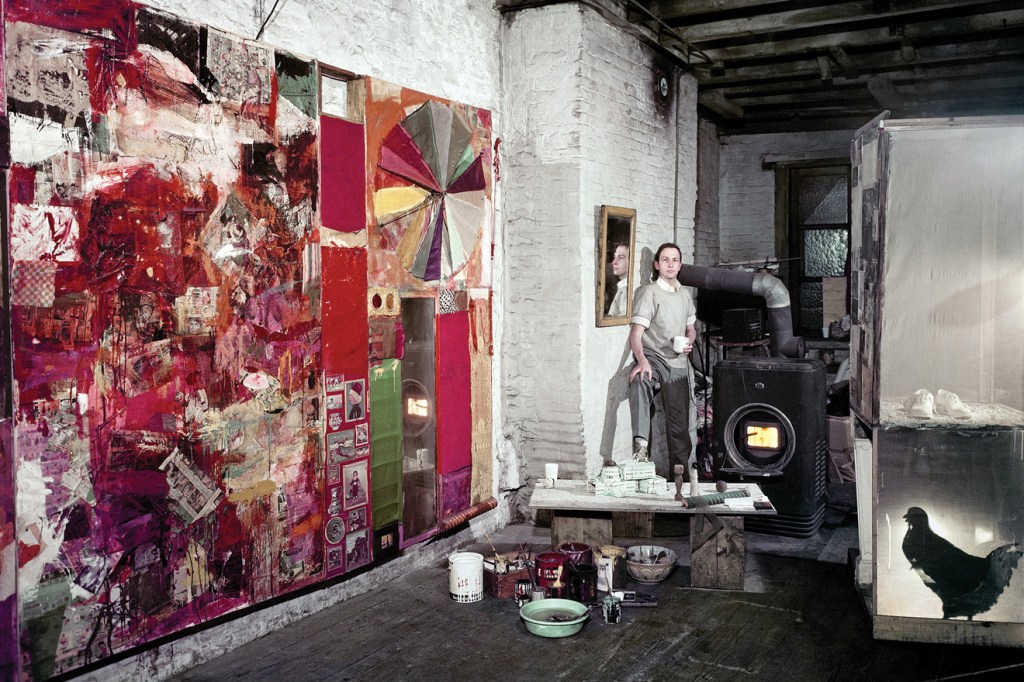
If an award were given for winning awards, it would surely go, by acclamation and universal consent, to Robert Rauschenberg, the most beribboned figure in the history of art. Not only did he win almost every award you can think of, but others were invented so that he could win those as well. Had the Nobel Prize been given to painters or sculptors, he would have won it, and because it wasn’t, the magniloquently named Praemium Imperiale came into being, and then he won that.
Let it be said on Rauschenberg’s behalf that he does not seem to have sought out these awards or even to have valued them unduly, and if he continued to accept them long after he ceased to need the money or acclaim, that was largely because he was an affable extrovert who didn’t like to say no to anyone. But there is a paradox at the heart of his career, and it is implicit in every work on view in his retrospective at the Museum of Modern Art (a show that began at the Tate Modern and moves hereafter to the San Francisco Museum of Modern Art). Rauschenberg (1925-2008) was, if nothing else, the most sincerely radical figure in the history of American art. Inspired in equal measure by Dada and the hyperformalism of the New York School, he seemed game for anything in his quest to expand the accepted boundaries of visual culture. In the 1950s his embrace of chance and spontaneity led him to drive a car over some sheets of typewriter paper and declare that the residual tire tread was a painting. On another occasion, with the consent of Willem de Kooning, he took one of the older painter’s drawings and erased it and then claimed the erasure as a new work of art. A decade later he was pioneering performance art by racing around a stage in roller skates and a spacesuit, with a parachute flapping at his back.
Real journalism.Trusted by millions.
Unlimited access to in-depth reporting, expert analysis, and the stories that shape our country.
Already a member? Log in