“Proclaim Liberty throughout all the land unto all the inhabitants thereof.” Note that these powerful words, inscribed on the Liberty Bell, don’t say “except Puerto Rico.”
Yet, today, the great Republic that came about from a rebellion of a people who refused to be deprived of its most basic freedoms as citizens, seems intent on holding 4 million of its own citizens in the island of Puerto Rico without their full civil and political rights.
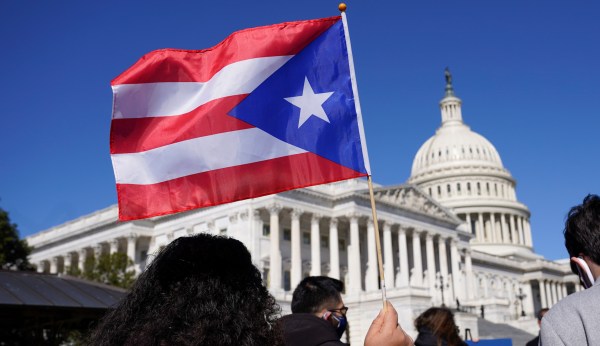
The issue is very simple. The people of Puerto Rico were granted U.S. citizenship in 1917. However, 93 years later, they haven’t been allowed to vote for the presidents who have sent thousands of their children to war and haven’t had voting representation in a Congress that passes laws that apply directly to them. Puerto Rico has only one non-voting delegate in the House of Representatives.
The irony could not be more evident. Our forefathers fought a war of independence because England did not want to afford to the subjects of the colonies the same rights as their English brethren. They would have never imagined that the new nation would subject other people to the same kind of injustice they had undergone.
That’s why, as the nation began to expand westward, the U.S. government ensured that the inhabitants of the new territories acquired were afforded the same rights as the citizens of the original thirteen colonies and that the territories were eventually made states. Anything else would have been inconceivable; would have been viewed as a betrayal of the principles of the revolution.
This changed with the Spanish-American War through which the U.S. acquired several territories, including the Philippines, Cuba and Puerto Rico, whose population was not Anglo-protestant. While Cuba was let go a few years later after the war and the Philippines became independent in 1946, Congress held on to Puerto Rico and has kept it since then under territorial status.
Through an act of Congress, in 1950 the citizens of the island were allowed to draft a constitution to establish their internal self-government. The congressionally approved document describes the political body of the Island as a “commonwealth” just like four of the 59 states.
This title has no political meaning, however: The states are still states and the territories are still territories. In Puerto Rico, however, the long ruling Popular Democratic Party (PDP), branded it in Spanish “Estado Libre Asociado” (ELA), (“free associated state”) and told Puerto Ricans that the Island now had a “quasi-sovereign” status and was no longer a territory.
Under U.S. constitutional law, a populated land within the borders of the country, like Puerto Rico, is either a territory or a state. You will waste your time looking for an “ELA” in the Constitution or in the Federalist Papers. It just doesn’t exist.
Sadly, the ELA public relations strategy helped confuse the Puerto Rican people and stopped their natural progression towards full citizenship under statehood. Puerto Ricans are proud Americans, but, sadly, many have bought the ELA myth and don’t realize that, instead of having a unique political status that gives the island more advantages than statehood would, under the current arrangement they actually lack the most basic rights inherent to citizenship.
Recently the House of Representatives passed HR 2499, the Puerto Rico Democracy Act, which sets up a fair process that would allow the U.S. citizens of the island the opportunity to attain the same rights as their fellow citizens of the 50 states. The ELA leadership has already blasted the bill, saying it’s unfairly biased in favor of statehood, which is frankly a non-argument.
What do they expect? Any process that is consistent with our constitutional principles and clearly unmasks the territorial situation of Puerto Rico will shed the spotlight on the full benefits of citizenship that statehood guarantees.
The Senate should act swiftly to pass the House bill. It is time that we extend the promises of liberty to all of the citizens in our land.
Alfonso Aguilar is executive director of the Latino Partnership for Conservative Principles.