
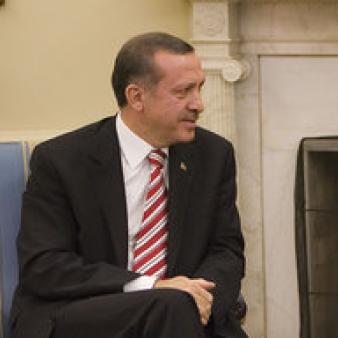
Turkish prime minister Recep Tayyip Erdogan has a habit of shifting positions toward his country’s neighbors, while pursuing the “soft Islamist” political agenda of his Justice and Development party (AKP). Erdogan’s Turkey was a close ally of Assad’s Damascus clique until the Syrian massacres, and the escape of at least 17,000 Syrians across the border into Turkey, compelled the Turks to oppose Assad’s grip on power. On Sunday, April 1, the “Friends of Syria” will hold their second meeting, grouping 80 countries, in Istanbul—the first was held in Tunisia in February. Turkey’s current leaders are anxious for action on Syria, according to The National, a newspaper based in Abu Dhabi. Erdogan has suggested that a “buffer zone” be established on the Turkish-Syrian border to handle an anticipated surge in refugees. As the Assad regime keeps its hold on the state, and continues slaying Syrian citizens, Turkey appears stymied, notwithstanding its anti-Assad rhetoric.
Erdogan has turned his frustrations over Syria against Turkey’s heterodox Alevi religious community. Alevism represents a fusion of pre-Islamic Turkish shamanism, Shia Islam, and spiritual Sufism. Its followers are known for their commitment to gender equality and secular governance. Although the pre-Erdogan Turkish political system was militant in its secularism, it controlled Muslim observance by recognizing Sunnism as the only legitimate form of Islam in Turkey. Alevis, as non-Sunnis, have long been victims of discrimination in Turkish education, social services, and religious life.
Real journalism.Trusted by millions.
Unlimited access to in-depth reporting, expert analysis, and the stories that shape our country.
Already a member? Log in