

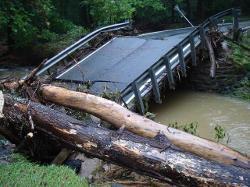
Region’s crumbling infrastructure reaching crisis Years of shuffling money around and narrowly avoiding transportation funding gaps have led to a Washington region with crumbling roads and projects years behind schedule.
Now, as lawmakers are again forced to consider slashing budgets or raising taxes, major and unexpected repairs from this month’s flooding have added millions of dollars to the problem in just a few days.
| Pain in the gas | |||
| Md., Va. gas taxes rank in middle of Eastern seaboard levies. | |||
| State | Gas tax (cents) | Gas sales tax (cents) | Total |
| Maine | 29.5 | 1.5 | 31 |
| New Hampshire | 18 | 1.6 | 19.6 |
| Massachusetts | 21 | 2.5 | 23.5 |
| Rhode Island | 32 | 1 | 33 |
| Connecticut | 25 | 26.9 | 51.9 |
| New York | 8.1 | 42.7 | 50.8 |
| New Jersey | 10 | 4 | 14 |
| Delaware | 23 | 0 | 23 |
| Maryland | 23.5 | 0 | 23.5 |
| Washington, D.C. | 23.5 | 0 | 23.5 |
| Virginia | 17.5 | 2.7 | 20.2 |
| North Carolina | 32.5 | 0.3 | 32.8 |
| South Carolina | 16 | 0.8 | 16.8 |
| Georgia | 7.5 | 21.7 | 29.2 |
| Florida | 4 | 30.4 | 34.4 |
| Source: virginiagasprices.com | |||
| Roads washed away | |||
| Road | Damage | Estimated cost | |
| MD 234/Budds Creek Road | bridge collapsed | $3 million | |
| La Plata, Md. | |||
| Ritchie Hwy. ramp at MD 100 | sink hole | $500,000 | |
| Severna Park, Md. | |||
| Crain Hwy at MD 6 | pavement | $850,000-$1 million | |
| La Plata, Md. | compromised | ||
| Brandywine Road over Timothy Branch | sunken | short term: ~$150,000 | |
| Brandywine, Md. | bridge | permanent fix: $TBD | |
| Lorton Road over Giles Run | bridge collapse | n/a* | |
| Lorton, Va. | |||
| Beach Mill Road over Nichols Branch | bridge collapse | n/a* | |
| Great Falls, Va. | |||
| Towlston Road | bridge collapse | n/a* | |
| Great Falls, Va. | |||
| *total road/bridge damage assessed at $10 million | |||
| Source: Maryland State Highway Administration, Virginia Department of Transportation | |||
In Northern Virginia, floods from Tropical Storm Lee and Hurricane Irene caused at least $10 million in damage in Fairfax County, according to Garrett Moore, Virginia Department of Transportation’s district administrator for Northern Virginia. In suburban Maryland, Prince George’s and Charles counties sustained the brunt of damage, with initial estimates as high as $4.65 million, according to the Maryland State Highway Administration.
The unexpected repairs, which state highway administrations estimate will take more than a year to permanently replace, come at a time when cash-strapped Maryland and Virginia have been putting off road fixes and ways to shore up their transportation coffers.
“It’s hard to overstate the seriousness of the problem,” said Richard Parsons, spokesman for the Suburban Maryland Transportation Alliance. “In part it’s because we’re dealing with a legacy of 30 years of not spending what we should have been spending. And now on top of that we have a budget crisis.”
According to the transportation alliance, roughly $20 billion in infrastructure projects around the region are unfunded. In Maryland, analysts say the state needs to raise $800 million more in annual transportation funding to shore up the state’s depleted Transportation Trust Fund. Virginia has made a practice of taking money from highway construction to pay for road and bridge maintenance.
“Since 2002, $2.5 billion in construction dollars has been transferred out to pay for maintenance. And our highways are still poorly maintained,” said Bob Chase, president of the Northern Virginia Transportation Alliance.
It’s not just a regional problem. Nationwide, interstate highways — now more than a half-century old — are crumbling, and maintenance can’t keep up with the wear and tear they get every year as more drivers take to the roads.
Funding for federal highway and transit programs in recent years has been accomplished through a haphazard series of short-term extensions as Congress declines to take more permanent action. The general rift falls between those who say that transportation budgets should be re-tailored to fit the existing funding mechanism — namely the gasoline tax — and those who say the gas tax is becoming less effective as cars become more fuel-efficient. Therefore, the only way to keep up is to tax those who use the roads.
The same arguments have been heard in Maryland and Virginia, where the gas tax has held steady since 1992 and 1986, respectively. But now the states are also dealing with a federal spending outlook that is mired in uncertainty, causing lawmakers to slash budgets yet again. Maryland, for example, is bracing for the potential loss of one-third of its federal transportation funding, forcing the state to slow down work on $4 billion in mass transit projects.
It could push lawmakers who have been unwilling to touch the gas tax to the breaking point.
“[There hasn’t been] the political will to be honest with the people to say, ‘This is what we need, this is what it costs,’ ” Chase said. “Is there a way to pay for it without asking the public to pay for it? No.”
