

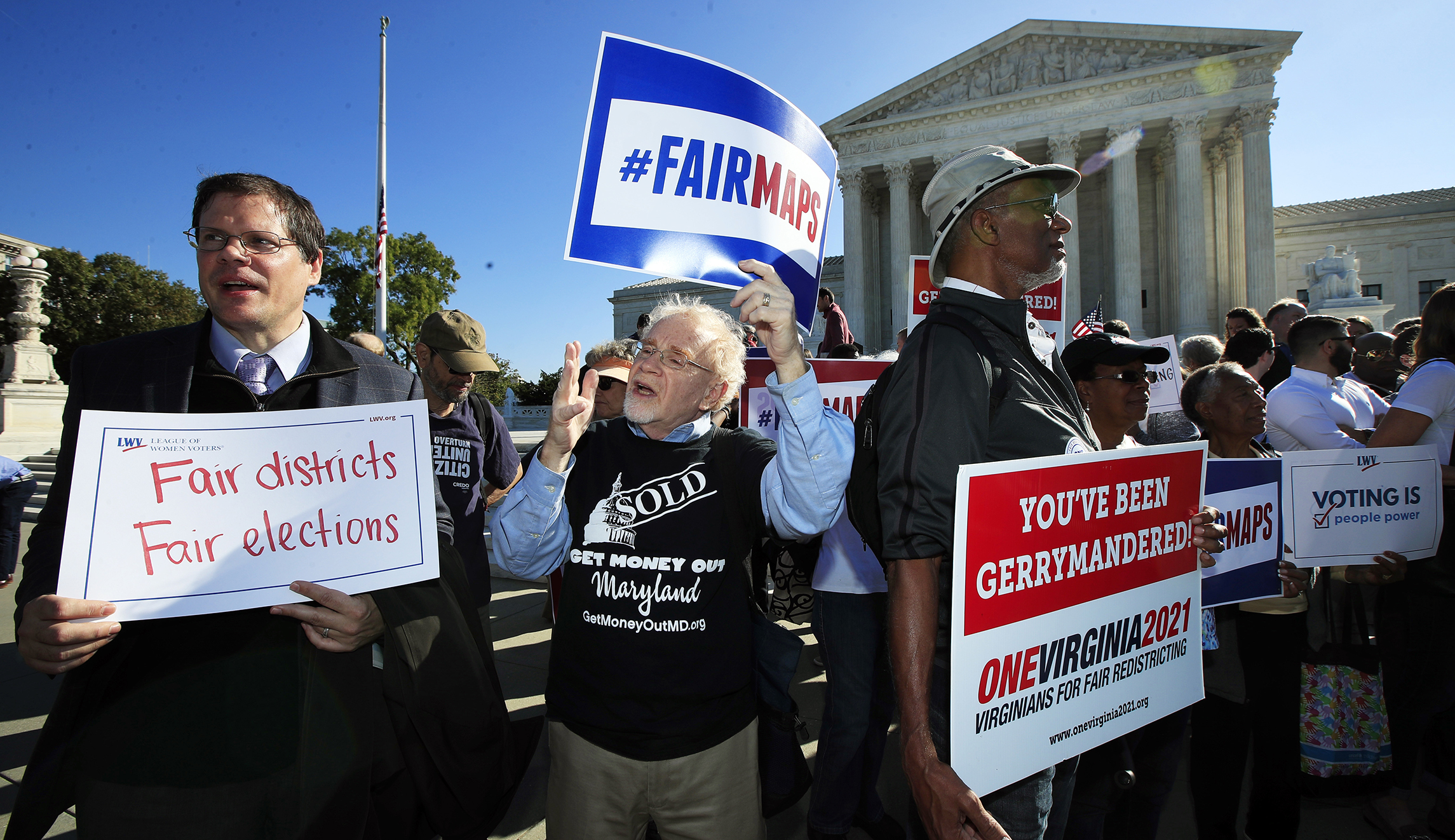
The U.S. Supreme Court on Monday declined to take action to address when partisan gerrymandering goes so far that it violates the Constitution, and instead sent two cases back to lower courts.
In a challenge to the Wisconsin legislative map drawn by state Republicans, the court ruled that the challengers, Wisconsin Democrats, lacked the legal standing to bring the case.
Recommended Stories


The court did not dismiss the case, but sent it back to the district court “so that the plaintiffs may have an opportunity to prove concrete and particularized injuries using evidence — unlike the bulk of the evidence presented thus far — that would tend to demonstrate a burden on their individual votes.”
Justices Clarence Thomas and Neil Gorsuch agreed with the other seven justices that the plaintiffs in the case did not have standing. However, they said they would have remanded the case with instructions to dismiss.
The justices on Monday made a similar decision in a case involving Maryland voters who challenged a single congressional district, the lines of which were drawn by state Democrats. The justices ruled against the challengers, Maryland Republican voters, in an unsigned opinion.
In both legal disputes, the court addressed technical issues. The current maps at issue will stand, at least for now.
The Supreme Court has been stumped for at least a decade on the question of how to address claims that a voting map was drawn to entrench the political party in power in violation of the constitutional rights of voters.
Court watchers had hoped the court was closer to finding a workable standard when it agreed to hear first the Wisconsin case and then, later in the term, the challenge from Maryland.
But instead, the Supreme Court declined to take action on the partisanship in the redistricting process.
Writing for the majority in the case involving the Wisconsin legislative map, Chief Justice John Roberts wrote “we express no view on the merits of the plaintiffs’ case.”
“It is a case about group political interests, not individual legal rights,” Roberts wrote of the plaintiffs’ case. “But this court is not responsible for vindicating generalized partisan preferences. The court’s constitutionally prescribed role is to vindicate the individual rights of the people appearing before it.”
That legal dispute before the high court stemmed from a lawsuit filed by Wisconsin Democratic voters after state Republican lawmakers created and enacted a redistricting plan in 2011.
The new legislative boundaries were swiftly challenged in court, as the Wisconsin Democrats argued the map constituted a partisan gerrymander in violation of their constitutional rights.
In 2016, a split three-judge district court panel ruled the state legislative districts advantaged Republican state lawmakers and violated the First Amendment. With that ruling, the federal district court became the first in decades to invalidate a redistricting plan on the grounds of partisanship.
Wisconsin Republicans then appealed to the high court, and the justices agreed in July to consider the case.
Months later, in December, critics of partisan gerrymandering were encouraged when the high court said it would consider the challenge from Maryland Republican voters to the boundaries of the state’s 6th Congressional District.
Rep. Roscoe Bartlett, R-Md., had held the seat for nearly 20 years, but statements made by Democratic officials during depositions indicated the district was targeted with the intent on flipping it.
After the new district lines were drawn following the 2010 Census, Bartlett lost the seat to Democratic Rep. John Delaney.
Republican voters living in Maryland’s 6th argued in court that election officials gerrymandered the district to retaliate against them for their support of the GOP in violation of the First Amendment.
The Supreme Court has never struck down a voting map on partisan gerrymandering grounds.
But in a concurring opinion, Justice Elena Kagan said she expects the issue to be before the justices again. Kagan was joined in her concurring opinion by Justices Ruth Bader Ginsburg, Stephen Breyer and Sonia Sotomayor.
“Courts — and in particular this court — will again be called on to redress extreme partisan gerrymanders,” Kagan wrote. “I am hopeful we will then step up to our responsibility to vindicate the Constitution against a contrary law.”
She warned that while the 2010 redistricting cycle “produced some of the worst partisan gerrymanders on record,” the upcoming redistricting cycle following the 2020 census will see maps that are worse as technology improves.
“Indeed, the need for judicial review is at its most urgent in these cases,” Kagan continued. “For here, politicians’ incentives conflict with voters’ interests, leaving citizens without any political remedy for their constitutional harms.”
In a statement following the court’s rulings, Dale Ho, director of the ACLU’s Voting Rights Project, said other partisan gerrymandering cases will continue in light of the court’s action.
“The Supreme Court missed an opportunity today to lay down a firm marker as to when partisan gerrymandering is so extreme that it violates the constitutional rights of voters,” Ho said in a statement. “But the court permitted lawsuits against unfair maps to continue. Cases around the country — including our challenge to Ohio’s gerrymandered congressional map — will remain ongoing to ensure that voters’ voices are heard.”
