

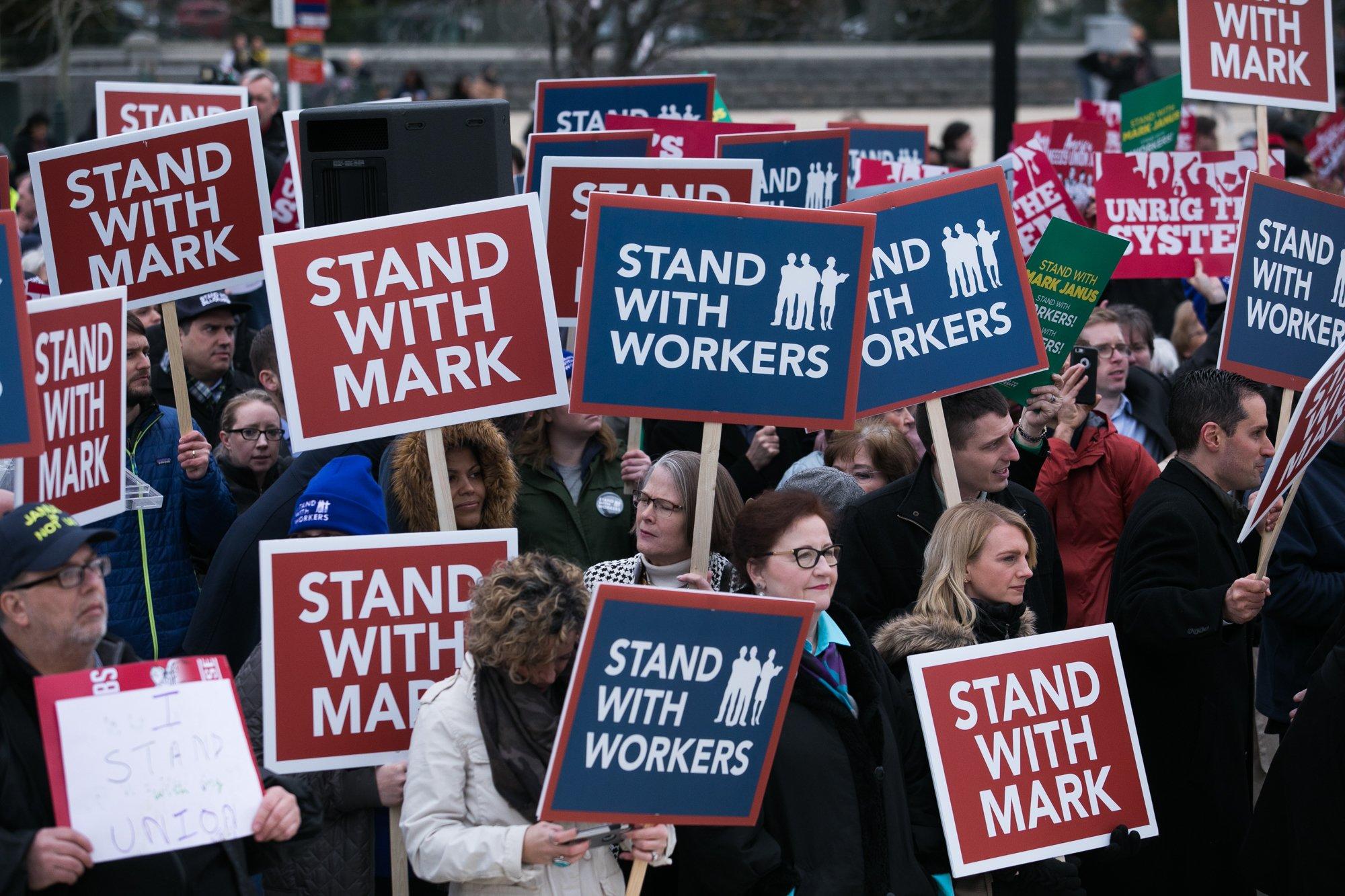
The Supreme Court ruling this summer that barred government unions from collecting “fair-share” fees from nonmembers was as harshly criticized by organized labor as it was hailed by conservatives.
On at least one aspect of the 5-4 majority’s decision, however, the two sides’ perspectives are reversed. The conclusion in Janus v. American Federation of State, County and Municipal Employees that the Constitution’s First Amendment guarantee of freedom of speech is violated when governments collect so-called agency fees from non-consenting workers doesn’t cover commercial businesses.
Recommended Stories



Under longstanding Supreme Court precedent, “the Constitution is generally held to apply to things the government does, not things that private-sector employers do,” said Benjamin Sachs, a labor professor at Harvard University who filed a brief urging the high court to reject the claim in Janus.
Indeed, the opinion authored by Associate Justice Samuel Alito points out in a footnote that there’s no question of government action in an agreement between businesses and unions to deduct fees for non-members unless Congress’s mere action to authorize such deals would qualify.
“That proposition was debatable,” at the time of the court’s 1977 ruling in Abood v. Detroit Board of Education, the precedent overturned in Janus that allowed collection of government-union fees, “and it’s even more questionable today,” Alito wrote.
More than a decade earlier, as a judge on the U.S. Court of Appeals for the 3rd Circuit, Alito wrote an opinion that was even more explicit, rejecting the claim that “a legislature’s express permission of a practice is sufficient” to make engaging in the practice a state action.
“Judges can change their minds and the Supreme Court can change its mind, but what seems true to me about now-Justice Alito is that he signals in cases where he thinks the law is going, where he thinks the law ought to go,” Sachs noted.
Alito suggested when he wrote the majority opinion in a 2012 ruling involving government-union fees that he viewed collection from non-members authorized under Abood as a potential First Amendment violation, and he voted to overturn the ruling six years later.
“In this footnote in Janus, he’s sending a signal that we are not going to the private sector,” Sachs said.
While private employers may attempt to stretch the ruling’s applicability, doing so would be difficult, said Harold Datz, an adjunct professor at Georgetown Law Center who served as chief counsel to successive chairmen of the National Labor Relations Board before retiring in 2007.
In fact, when the National Right to Work Legal Defense Foundation, which has often fought organized labor, asked the Supreme Court to consider a case involving private-sector union fees just days after the Janus ruling, it didn’t cite the case.
That may be of scant consolation to organized labor overall, since Janus is likely to drain the coffers of public-sector unions that grew more powerful in the past three decades as membership in private-sector groups declined.
About 34 percent of government workers were union members in 2017, compared with just 6.5 percent of corporate employees, according to the Bureau of Labor Statistics. The combined membership rate of about 10.7 percent was roughly half that of 1983.
“This decision, to a certain extent, is going to hurt unions in the public sector,” Datz said. “If you dry up the financial means of support, you make that union less effective as a bargaining representative. And if unions in the public sector are less effective because they no longer have a steady stream of income, I think employees in the public sector may become soured on unions precisely because they cannot perform as effectively as they have in the past.”
Even though the majority in Janus was narrow, the makeup of the court now that President Trump gets a second appointment due to the retirement of Associate Justice Anthony M. Kennedy means the ruling is unlikely to be reversed in the near future.
At the same time, Alito’s involvement in the Janus ruling and its support by Justice Anthony Kennedy, whom Trump appointee Brett Kavanaugh would succeed if confirmed, means the odds of stretching Janus to the private sector don’t change significantly.
“While this victory represents a massive step forward in the fight to protect American workers from forced unionism, that fight is far from over,” said Mark Mix, president of the Right to Work Foundation. “There remains much work to do to both enforce and expand upon this historic victory over coercive unionism.”
