

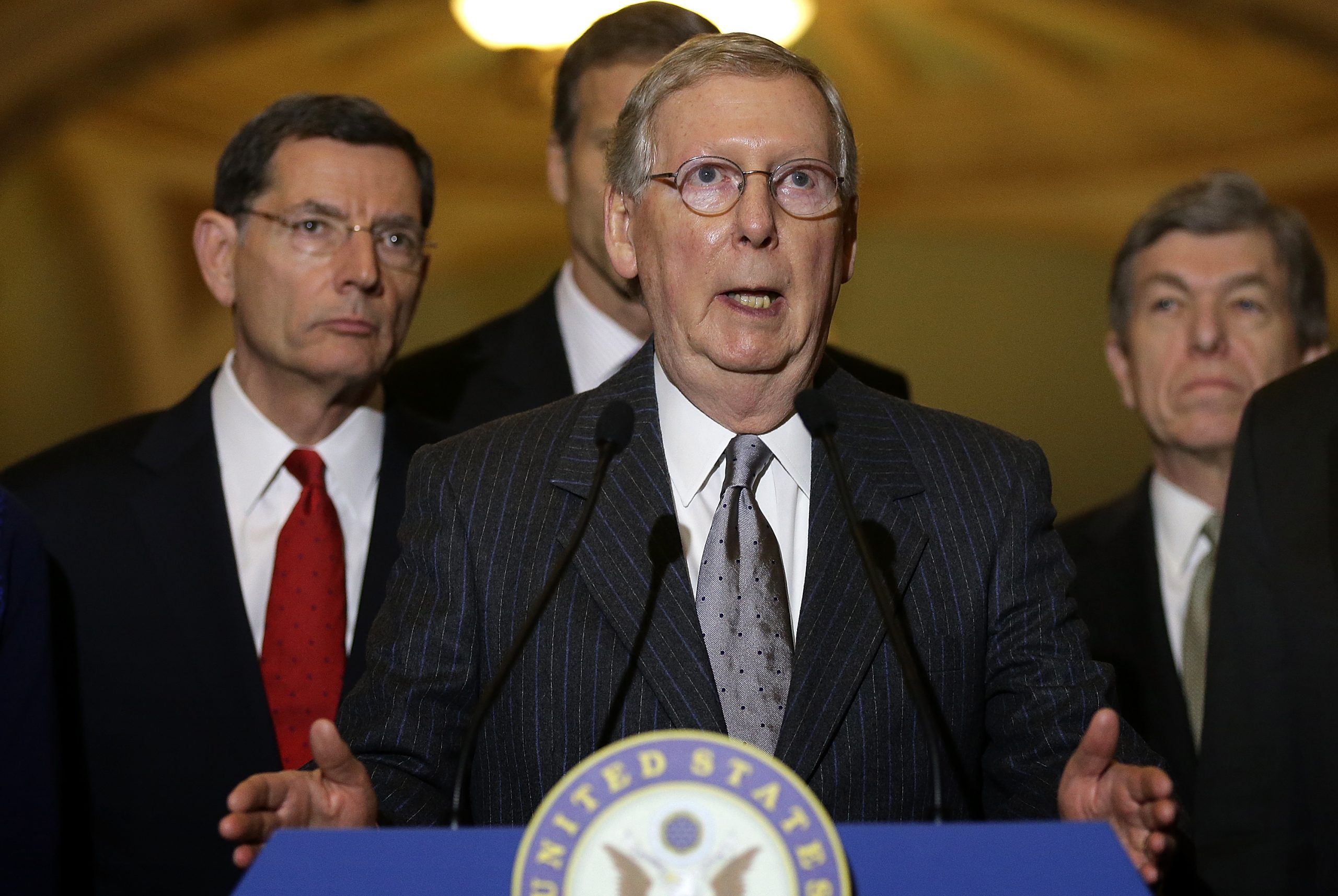
Senate Majority Leader Mitch McConnell is calling in the cavalry ahead of 2016, with his close confidant launching a super PAC to provide reinforcements for Republican incumbents who face incoming attacks from Democrats and GOP primary challengers.
Senate Leadership Fund opened this month under executive chairman Steven Law, a former aide to the Kentucky Republican who maintains his role as president and CEO of American Crossroads, considered the premier GOP-aligned super PAC. McConnell isn’t legally permitted to coordinate with SLF, but the new Senate majority leader can promote the organization to prospective donors and signal where — and how — he’d like the group to operate. Expect Law to pay attention.
Recommended Stories


In his first interview since rolling out SLF, Law detailed super PAC operations and strategy for advancing the first GOP majority in eight years. A key early decision involved using American Crossroads to provide infrastructure, such as office space it leases in downtown Washington, and letting that group’s personnel handle most day-to-day business management. SLF plans to contract with outside fundraising and political consultants, looking to strategists who did innovative work in 2014.
Law said SLF was created in part to focus the attention of major Republican donors on the Senate battleground in an election cycle when their natural inclination is to invest first and foremost in the presidential race. Having McConnell’s imprimatur provides the new group star attraction in this uniquely competitive environment. The first consultant to sign on with SLF was David Gershanik, a GOP fundraiser with McConnell ties.
“As we enter the kaleidoscope of a presidential cycle, there was a shared concern about whether donors would continue to be focused on the importance of protecting the majority,” Law said. “There is a huge amount of donor focus on the presidential; it’s just a natural magnet.”
Senate Republicans are going to need all the help they can get in 2016, and not just because they’re vying for resources with several in their party who are eying the White House and already raising money.
Democrats need to win only five seats to recapture the majority next year; and at least seven Senate races will be fought in blue states or swing territory. Combine that with the elevated voter turnout that usually accompanies presidential elections, and several Senate Republicans could be vulnerable. Of the 34 Senate seats on the ballot, a whopping 24 are Republican controlled.
During his last years as Senate majority leader, now Minority Leader Harry Reid, D-Nev., used a super PAC, Senate Majority PAC, to provide air cover to vulnerable Democrats and target Republicans. GOP political operatives say it’s long past time that Senate Republicans had a similar organization looking out for them.
“I think they have the potential to generate new money that has previously not been on the Senate battlefield,” said a Republican strategist who advised Senate candidates in 2014. “Not every donor has wanted to go through the groups that existed previously, so putting more choices on the cafeteria menu will attract a bigger crowd.”
With SLF, McConnell now has an outside group that he can depend on to bring resources to bear to underwrite his political strategy for holding the majority. In the age of conservative insurgents who have their own outside groups, that means supporting incumbents against primary challengers and intervening in open seat primaries to, as McConnell has described it, boost the most conservative Republicans who are also electable.
SLF means McConnell no longer has to depend on the generosity of the U.S. Chamber of Commerce or even American Crossroads, with it’s many interests, including the presidential races, to accomplish this — which he did in 2014, although those and other groups were helpful in the midterms. Nor do Senate Republicans have to put all their eggs in the NRSC basket. The party’s Senate campaign committee can only raise money in limited amounts; SLF can accept as a big a check as a donor is willing to write.
Law said a projected budget for SLF was still in development and is using as a benchmark the races that could be in play and what it takes to have an impact in those states. He declined to speculate on what the organization might raise or what size war chest it needs at this early stage. Ultimately, much of this will be governed at least partly by what the super PAC can raise.
Law envisions SLF being politically active in a variety of ways, not limiting itself simply to cutting television ads and carpet-bombing Democrats or GOP challengers who take on try to oust incumbents in primaries. That includes investing in opposition research and data, where it makes sense for SLF to spend its own money rather than leaning on American Crossroads.
SLF’s participation in Senate races is to be determined by conditions on the ground. Law described his approach as “extremely custom-crafted to each race, so when we get involved and how we get involved would have a lot to do with the unique political dynamic in any individual race.”
