

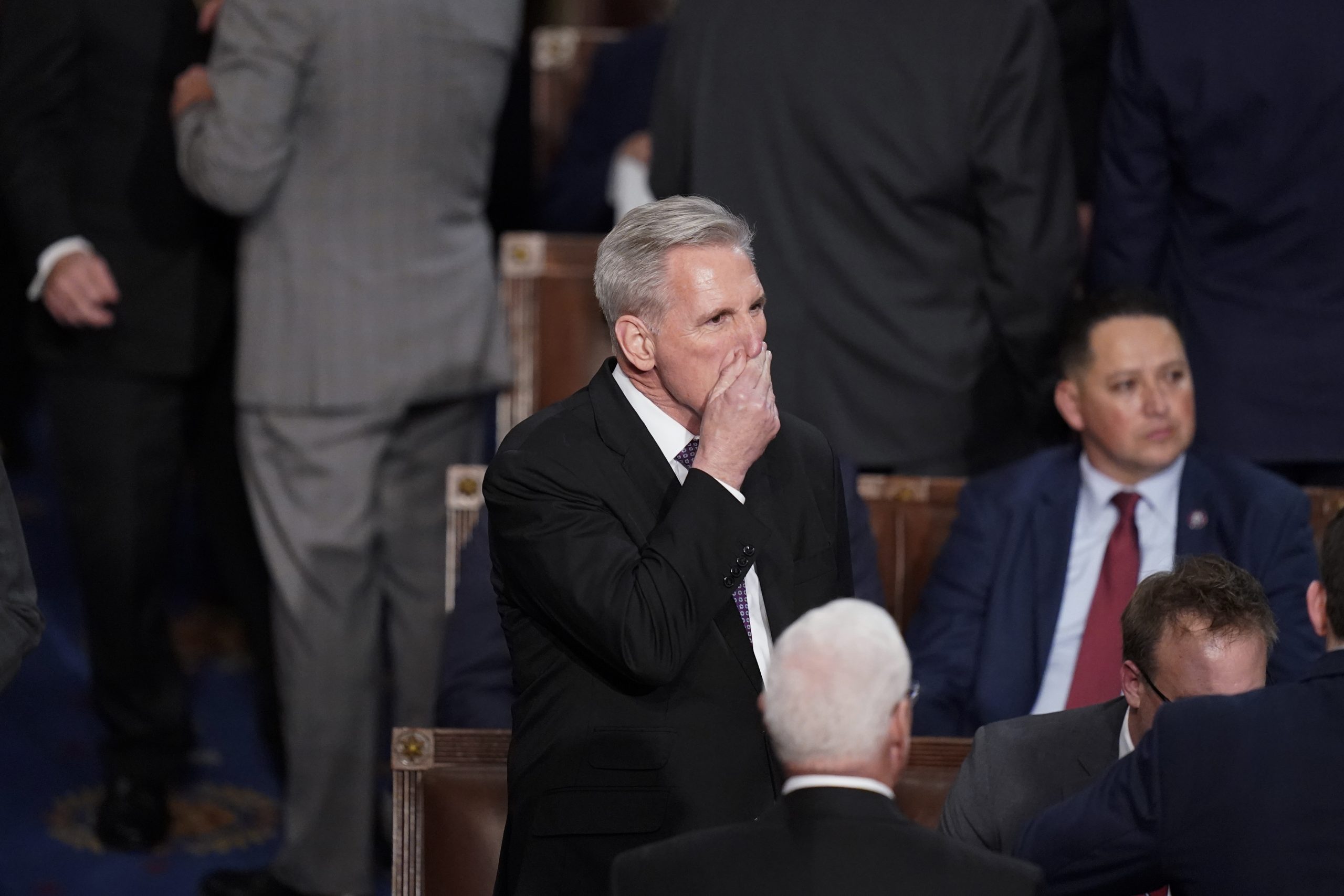
The majority of the Republicans opposing Rep. Kevin McCarthy’s (R-CA) bid for House speaker received a total of $120,000 in campaign funds from the party leader’s political action committee during the midterm cycle, according to finance filings.
At least 20 Republicans have voted against McCarthy’s nomination to become the next speaker, pitting the former minority leader against several members of his party. Of the 20 Republicans, 14 of them received a total of $120,000 from the Majority Committee alone, according to the Federal Election Committee. When taking into account all political groups affiliated with McCarthy, the group received a total of more than $1 million to boost campaigns.
FOUR KEY THINGS TO WATCH ON THIRD DAY OF CHAOTIC SPEAKER VOTE
Those who have blocked McCarthy’s speakership despite receiving support from his Majority Committee PAC include Reps. Dan Bishop (NC), Michael Cloud (TX), Andrew Clyde (GA), Byron Donalds (FL), Bob Good (VA), Andy Harris (MD), Ralph Norman (SC), Scott Perry (PA), and Matt Rosendale (MT), as well as Reps.-elect Anna Paulina Luna (FL), Josh Brecheen (OK), Andy Ogles (TN), Eli Crane (AZ), and Keith Self (TX).
Most candidates received the maximum donation amount of $10,000 split evenly between the primary election and general election, according to campaign filings. Others only received a $5,000 donation for the general election.
Some of the defectors also received huge sums from the McCarthy-aligned Congressional Leadership Fund, which poured millions of dollars into advertising in key battleground states.
The campaign filings show that despite monetary support from the powerful party leader, McCarthy has still failed to convince key members of his party to support him as he vies to become speaker. Only six of McCarthy’s opponents did not receive any campaign funding from McCarthy in the most recent midterm cycle, including Reps. Andy Biggs (AZ), Lauren Boebert (CO), Matt Gaetz (FL), Paul Gosar (AZ), Mary Miller (IL), and Chip Roy (TX).
CLICK HERE TO READ MORE FROM THE WASHINGTON EXAMINER
The House reconvened at noon on Thursday to continue its leadership elections as no nominee has garnered the majority vote needed to secure the speakership.
In order to win the speakership, a nominee must garner a majority of present House members — in this case, 218 lawmakers if every member casts a vote. Republicans hold the House majority with 222 seats, meaning a GOP nominee such as McCarthy can’t afford to lose more than five members.
