

Top employees at Anthropic, a major federal contractor, are reportedly involved in discussions to establish a dark money network that could be used to skirt campaign finance laws prohibiting the company from making political donations.
In July, the Defense Department awarded a contract worth up to $200 million to the artificial intelligence firm Anthropic. As a government contractor, Anthropic is legally barred from contributing to “any political party, committee, or candidate for Federal office,” according to U.S. law. On Nov. 25, the New York Times reported that senior employees at Anthropic were discussing ways the company could spend money to influence politics and that its executives would likely donate to a new political network helmed by former Democratic Oklahoma Rep. Brad Carson.
Carson’s network will be composed of two super PACs, one for Republican candidates and the other for Democrats, with the whole thing being funded through an affiliated 501(c)(4) nonprofit organization called Public First.
The New York Times, however, did not point out that transparency advocates have argued that 501(c)(4) organizations can be used by federal contractors to evade bans on political donations.
Unlike super PACs, which are required to list the names of all their donors within regularly filed disclosures, the individuals and organizations funding 501(c)(4) groups are totally anonymous, as those organizations are not legally required to publish their donors. Federal campaign finance laws allow 501(c)(4)s to donate to super PACs, and, when super PACs report their donors, they record the name of the 501(c)(4) that donated to them rather than the original source of the funds.
In practice, Anthropic could directly and anonymously donate to Public First, which could then funnel those funds to one of the super PACs. The super PACs could then proceed to cut checks in support of political candidates through independent expenditures. This would enable Anthropic to effectively circumvent the prohibition on its money influencing politics — a prohibition that exists to combat impropriety in the federal contracting process or any appearance thereof.
“If they were to actually earmark the funds from the 501(c)(4) for the super PAC, that would still be enforceable as a violation of the law,” Craig Holman, a lobbyist who works on campaign finance matters for Public Citizen, told the Washington Examiner. “Unfortunately, when it comes to enforcing campaign finance law with the Federal Election Commission, they look the other way when it comes to doing this sort of indirect, under-the-table violation.”
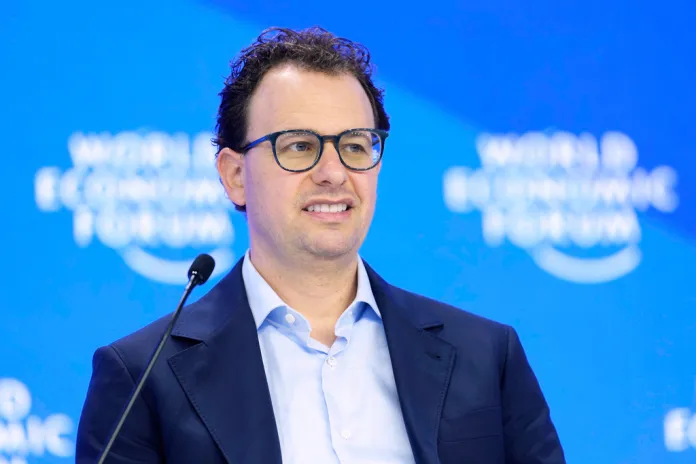
In a statement shared with the Washington Examiner, Carson said, “We’ve had discussions with donors on both sides of the aisle, both in-and-out of industry, about the need to check the unmatched election spending of those opposed to AI safeguards. In launching this project, [former Utah] Rep. [Chris] Stewart and I have put forward a pro-safeguards agenda, and it’s attracted the attention of a diverse coalition. The failed attempts at preempting state laws this year have mobilized people and groups across the country, helping make this a big-tent effort.”
However, neither Carson nor a spokesperson for Public First would commit to refusing funding from Anthropic when asked by the Washington Examiner. Anthropic did not respond when asked if it would donate to Public First.
“Just as ‘sunlight is said to be the best of disinfectants,’ as Louis Brandeis famously noted in 1913, it might also be said that darkness attracts those with ill-intent,” Taylor Lincoln, research director for Public Citizen’s congressional oversight program, wrote in 2022. “Those seeking to influence elections sometimes make concerted efforts to keep their fingerprints off their handiwork.”
Lincoln pointed to Koch Industries’s involvement in the 2012 election cycle as one example where a government contractor actually used 501(c)(4) dark money groups to flout campaign finance regulations.
Between 2011 and 2012, Koch Industries’s subsidiary, Georgia Pacific, received over $50 million in federal contracts to provide toilet paper to the DOD. During the 2012 election cycle, Koch Industries funnelled $274 million through dark money groups to influence federal elections. Two of the Koch groups were ultimately fined $190,000 for failing to properly report their electioneering operations, though, as Lincoln noted, this represented only a small fraction of their overall spending.
Lincoln pointed out that instances where federal contractors use dark money groups to illegally influence politics are inherently difficult to catch, given that donors to 501(c)(4) nonprofit organizations, corporate or otherwise, are largely unknown to the public.
If Anthropic were to route funds through Public First to fund super PACs, it is unlikely that it would face punishment from campaign finance authorities. Even corporations that flagrantly flout the law by donating to political committees directly while serving as federal contractors aren’t always penalized, and, when they are, the consequences are comparatively light. The FEC, for instance, fined the Hamilton Company just $56,000 in connection with its $300,000 donation to a super PAC during the 2020 election cycle.
Holman told the Washington Examiner that he has filed many complaints with the FEC alleging that federal contractors indirectly and illegally injected cash into the political process, but that none have led to enforcement actions. Even in cases where violations have been clear and direct, Holman said enforcement is “rare.”
TECH DONORS FUND MEDIA FELLOWSHIP SHAPING COVERAGE OF THEIR PET ISSUE
Transparency watchdogs have historically complained about the FEC largely failing to enforce the ban on government contractors making political contributions, with many contractors being exposed by the press and watchdogs but not being sanctioned by the agency.
While employees of federal contractors are free to make political contributions as they see fit, the firms themselves are prohibited from making such donations. Caron’s network is seeking to raise $50 million for its efforts, a sum that could prove challenging if it relies solely on individual donors.
