

A federal appeals court ruled Monday that Alina Habba unlawfully served as New Jersey’s top federal prosecutor, adding fresh legal turmoil to President Donald Trump’s efforts to keep loyalists installed in U.S. attorney positions after two high-profile cases fell apart last week over similar appointment problems.
A three-judge panel on the U.S. Court of Appeals for the Third Circuit upheld a lower court’s finding that Habba, a Trump ally and former personal attorney to the president, was never validly in office. The ruling comes days after a judge dismissed the criminal cases in Virginia against former FBI Director James Comey and New York Attorney General Letitia James, citing defects in the appointment of Lindsey Halligan, Trump’s temporary U.S. attorney in the Eastern District of Virginia.
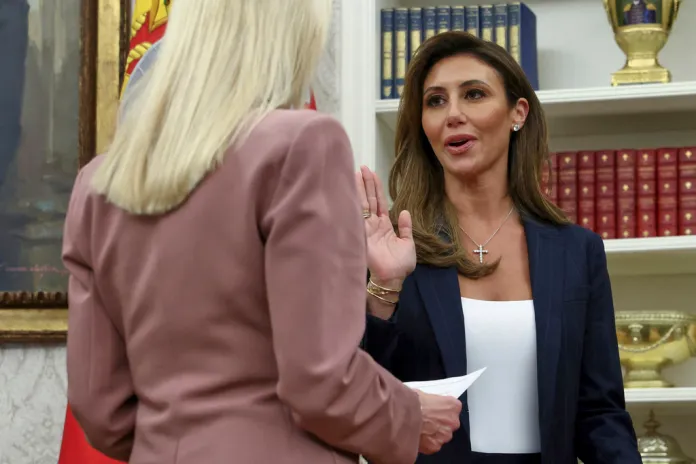
The new setback in New Jersey underscores how Trump’s broader strategy to bypass Senate confirmation in blue states is starting to buckle under judicial scrutiny.
The panel opened its opinion by warning that “the citizens of New Jersey and the loyal employees in the U.S. Attorney’s Office deserve some clarity and stability,” adding that the administration’s repeated attempts to install Habba reflected “frustration” with the legal limits Congress imposed. The administration can now seek review from the full Third Circuit or elevate the case directly to the Supreme Court.
Argument concerning Habba’s appointment were heard by the panel in October, where judges questioned the legality of the steps Trump and Attorney General Pam Bondi took to reinstall her after her initial 120-day tenure expired. The panel, composed of two George W. Bush appointees and one Obama appointee, appeared skeptical of Justice Department lawyer Henry Whitaker’s claim that Bondi had authority to fill the vacancy after Trump fired the court-appointed successor.
Whitaker insisted the administration was relying on “overlapping mechanisms” provided by Congress and that the DOJ had been “scrupulously careful” to follow them. A U.S. District Court judge rejected that narrative, saying the sequence of events that led to Habba’s appointment looked like “a complete circumvention” of the Constitution’s appointments clause.
After more than a month of toiling over the DOJ’s argument, the appeals court ultimately agreed with the district court, holding that “only the first assistant in place at the time the vacancy arises automatically assumes acting status,” meaning Habba was ineligible from the start. The panel further wrote that because Trump had already nominated her for the job, “the nomination bar prevented Habba from serving as Acting U.S. Attorney.”
Washington lawyer Abbe Lowell, who also defended James in her criminal case, represented the two sets of routine defendants who challenged Habba’s authority, arguing she could not prosecute them because she was never lawfully in office.
Lowell released a joint statement alongside attorneys Norm Eisen and Gerry Krovatin, two others who had challenged Habba’s appointment, saying the decision marked “the first time an appeals court has ruled that President Trump cannot usurp long standing statutory and constitutional processes to insert whomever he wants in these positions.”
Habba’s challenge to the district court finding her to be unlawfully serving had been the most far-advanced test of Trump’s approach to U.S. attorney appointments, but similar challenges are now overtaking other key prosecutions. In addition to Halligan’s collapse in Virginia, Trump-installed U.S. attorney Bill Essayli in California faces his own litigation over the validity of his appointment.
The panel also rejected the DOJ’s claim that Bondi could somehow circumvent the Federal Vacancies Reform Act through a sweeping delegation order that gave Habba authority to run the office. The judges said Bondi had attempted “to delegate to Habba the full panoply of powers of a U.S. Attorney,” a move the court warned would “permit anyone to fill the U.S. Attorney role indefinitely” and “bypass the constitutional … process entirely.”
Habba had no path to Senate confirmation, as New Jersey’s Democratic senators, Cory Booker and Andy Kim, refused to return blue slips.
HABBA’S US ATTORNEY APPOINTMENT FACES UPHILL BATTLE
The blue slip custom, reaffirmed by Senate Judiciary Committee Chairman Chuck Grassley (R-IA) earlier this year, effectively gives home-state senators veto power over U.S. attorney nominations. Trump has intensified his criticism of the practice, recently firing former U.S. Attorney Erik Siebert after Siebert received Democratic support and amid reporting that he was unwilling to bring criminal cases against Comey and James.
The Washington Examiner reached out to the DOJ for comment.
